Upper Trigram
艮 Gèn
Mountain — Stillness
Lower Trigram
巽 Xùn
Wind — Gentle
Classical Texts
The Goal
Gu is not mere decay — it is the deliberate confrontation with inherited corruption. The character 蠱 originally depicted insects breeding in a vessel left sealed too long: stagnation that has produced its own toxic life. The hexagram places Mountain (Gen) above Wind (Xun): stillness pressing down on gentle penetration, creating an airless space where problems fester unseen. What was once nourishing has turned poisonous through neglect. The judgment's 先甲三日,後甲三日 — "three days before 甲, three days after" — is the hexagram's most distinctive instruction, and the most commonly trivialized into generic advice about planning. Wang Bi reads it as procedure: 甲者,創制之令也。創制不可責之以舊,故先之三日,後之三日,使令治而後乃誅也 — 甲 is the decree that founds a new order, and people cannot be held to a new decree by the old standard, so it is published three days before and three days after, and only once the order has taken hold does punishment follow. Reforming inherited corruption means changing the rule, and changing the rule obliges you to give notice before you enforce it. The same doctrine returns at hexagram 57 as 先庚三日,後庚三日. It is not the tradition's only reading: Kong Yingda records that 鄭玄 and others took 甲 as the day the decree is issued, counting back to 辛 for self-renewal and forward to 丁 for repeated admonition, and he argues against them in Wang Bi's favour. Either way the three days are a procedure, not a mood. The opening 元亨 — "supreme success" — together with 利涉大川, "favorable to cross the great water," signals that this difficult work, properly understood, leads to fundamental renewal. The common mistake is treating Gu as a hexagram about cleaning up messes. Its actual goal is cultural and structural renovation — the conscious repair of systems that previous generations allowed to degrade. The father-and-mother references in the line texts (幹父之蠱, 幹母之蠱) make this explicit: you are working on what your predecessors left unfinished or broke. This is not blame — it is inheritance. Every generation receives a vessel with something breeding inside it. Gu's purpose is to open that vessel with full awareness and restore what can be restored.
The Judgment
Supreme fulfillment. Crossing the great river is supported. Three days before the new start, three days after. Decay. And the judgment is supreme fulfillment — because fixing what's rotten is one of the most supported things you can do. The river crossing is available. But the text adds: three days before the turning point, three days after. Deliberate on both sides. The repair works. The rush job doesn't.
The Image
Wind beneath the mountain: decay. The realized person accordingly stirs the people and nourishes character. Wind at the base of the mountain — things rotting from below. You can't see it from the top. The realized person's response isn't inspection. It's stimulation. Stir the people, feed the character. Because decay at the root doesn't respond to surface repair. It responds to life.
The Lines
Line 1
Correcting the father's decay. If there is a son to examine it, no fault falls. Strained, but in the end resolves well. The father's mess. And a child is fixing it. The text says: no fault on the father — because someone showed up to do the work. Strained, yes. But it resolves well. The person who inherits a problem and actually repairs it retroactively pardons the one who created it. That's structural absolution.
Line 2
Correcting the mother's decay. Sustained pressure is not supported. The mother's decay. And: don't push too hard. Same work, different parent, completely different approach. The father's decay you can attack directly. The mother's requires gentleness. Sustained pressure here is specifically not supported. The text is telling you that the same repair done with the same force in a different relationship breaks instead of fixes.
Line 3
Correcting the father's decay. Small deviation detected. No great fault. Fixing the father's mess again, and this time there's a small deviation. Not perfect. Not a disaster either. No great fault. The hinge line, and the verdict is: you're going to make minor errors in the repair. That's acceptable. The person waiting for the perfect fix never starts the work.
Line 4
Tolerating the father's decay. Continuing forward: friction. You're watching the rot and letting it be. Continuing: friction. Not adverse — just friction. The wheels slow down, the options narrow. Because tolerating decay is its own kind of decay. The line doesn't call you to action. It just describes what happens to the person who sees the problem and stays seated.
Line 5
Correcting the father's decay. Meeting with praise. The repair earns recognition. Fifth line, full visibility, and the work on the decay is honored. This is what it looks like when the correction is public and the public approves. The people who did nothing in line four watch the person in line five receive praise. Same mess. Different response. Different review.
Line 6
Not serving kings and lords. Honoring one's own work as lofty. Doesn't serve the sovereign. Sets a higher standard for their own work. The top of the decay hexagram and someone opts out entirely — not to fix the mess, not to tolerate it, but to stand apart and do their own thing at a higher altitude. No verdict. Just the observation that sometimes the right response to decay is to build something clean somewhere else.
Yilin: Forest of Changes
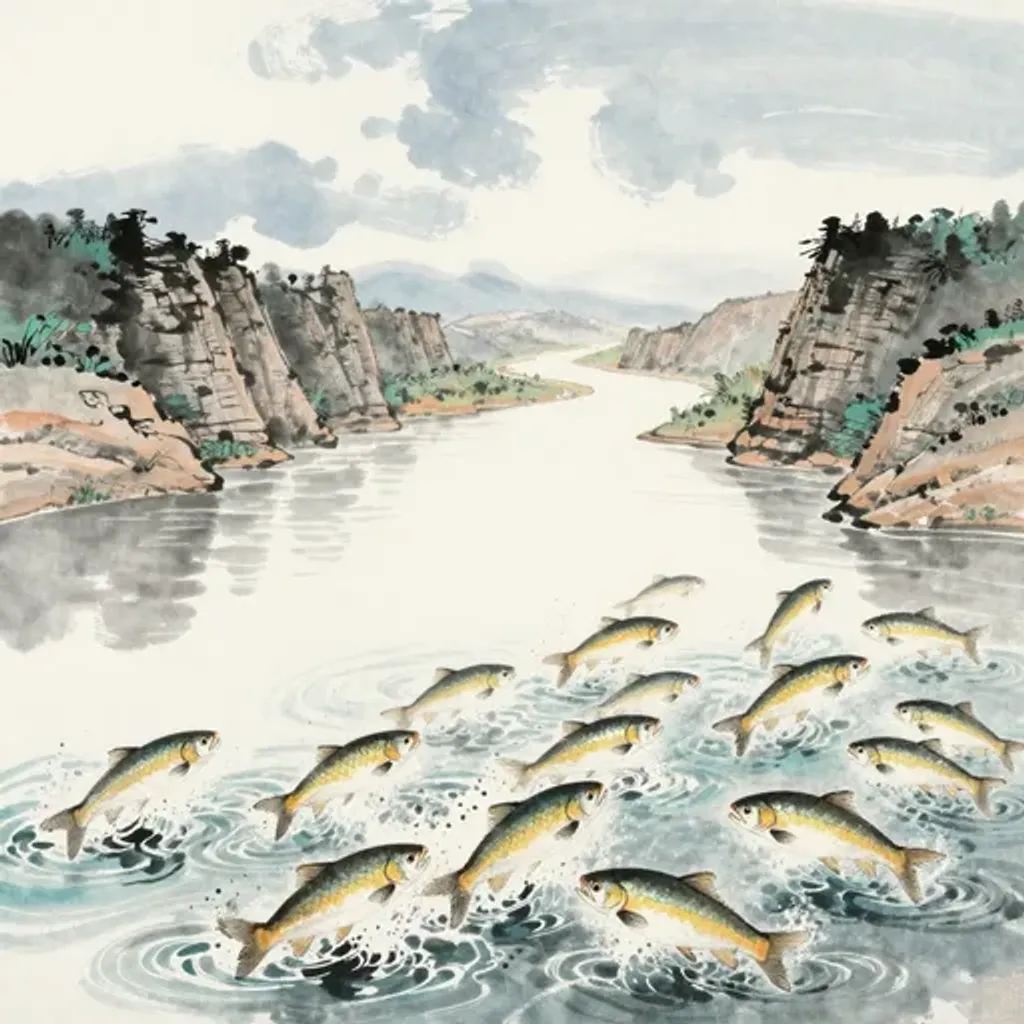
From Jiao Yanshou's Forest of Changes (焦氏易林) — the verse for Hexagram 18 in its unchanging form. A Han dynasty collection of four-character verses interpreting every hexagram transformation.
紡生江淮一轉為百周流四浸無有難惡
The bream is born in rivers and streams; one fish multiplies to a hundred. Circling throughout the realm, encountering no hardship or evil.
Read full commentary ↓
Wind beneath the mountain turns upon itself — decay facing its own reflection. The bream is born in rivers and marshes; one turns into a hundred. Circulating freely through all under heaven, encountering nothing difficult or harmful. The fish multiplying effortlessly in its native waters evokes natural abundance without external intervention. When the source hexagram meets itself as target, the question becomes: can decay renew decay? The answer here is yes — through natural fertility and free circulation. From Work on the Decayed to itself, the insight is that corruption contains its own remedy when life-force flows unobstructed. The mountain's wind, rather than stagnating, circulates and regenerates.
中文註釋
山下有風,蠱遇自身。魴生江淮——魴魚生於江淮之間;一轉為百——一化為百,繁殖自然。周流天下——游遍天下;無有難惡——不遇困難與惡事。魚在本水中自然繁衍,不假外力而豐饒。蠱之蠱,敗壞遇見自身之倒影:腐敗能否自我更新?此詩給出肯定之答:生命力若能自由流通,朽壞自有其再生之機。山下之風不再鬱滯,而是循環往復、生生不息。
This commentary was written against an earlier reading of the verse. Where the reading has since changed, the interpretation itself may no longer apply.
Jiao Shi Yi Lin 《焦氏易林》, manuscript from the Wenyuan Pavilion Siku Quanshu, Qianlong period, Qing dynasty.
National Palace Museum, accession nos. 故庫017987–017990
Fascicle 1, page 184
Read from the manuscript leaf
Shown unpunctuated, as in the manuscript.
About this reading
Read from the scanned leaf.
Related Hexagrams
Same upper trigram: Mountain (艮)
Same lower trigram: Wind (巽)