Upper Trigram
兌 Duì
Lake — Joyous
Lower Trigram
震 Zhèn
Thunder — Arousing
Classical Texts
The Goal
Sui is not compliance. It is the art of adaptive alignment — the capacity to respond to changing conditions without surrendering judgment. The hexagram places Lake (Dui) above Thunder (Zhen): joy above movement. The Tuan explains 剛來而下柔,動而說,隨 — "the firm comes and places itself below the yielding; movement joined with joy: this is Following." Active strength willingly takes the lower position and adjusts its movement so that relationship becomes possible. This is not weakness accommodating strength. It is strength choosing responsiveness over imposition. The judgment reads 元亨利貞,无咎 — "great success; favorable to remain correct; no blame." This is not an unconditional endorsement of following. The absence of blame depends upon 貞: alignment must remain correct. The later lines warn against attaching oneself to what is lesser and abandoning what is greater, and against following merely in order to obtain something. Sui therefore describes neither coerced obedience nor change for its own sake. It is the disciplined capacity to follow what the time genuinely requires. The first line says 官有渝,貞吉;出門交有功 — "what governs has changed; remaining correct brings good fortune. Going out through the gate and forming connections brings achievement." Following begins when one's governing position is capable of change, but the change must answer to what is right rather than to pressure, appetite, or private attachment. One changes because the situation has changed and because a wider field of relationship has become visible — not simply because one has been overpowered. The Image provides the hexagram's deepest rhythm: 澤中有雷,隨;君子以嚮晦入宴息 — "within the lake is thunder: Following. As evening approaches, the superior person enters and rests." Thunder does not act without interruption. Its force withdraws when the time for movement has passed. To follow is therefore also to respect alternation: movement and rest, initiative and receptivity, leading and yielding. Sui is not merely advice for those who occupy subordinate positions. It applies equally to anyone accustomed to initiating action. True leadership includes the capacity to recognize when one's season has changed, to relinquish the lead without resentment, and to align with what is genuinely emerging rather than force the continuation of an exhausted plan. The goal is not surrender of agency, but agency made responsive to time.
The Judgment
Supreme fulfillment. Sustained orientation is supported. No fault. Following. Not leading — following. And the judgment is: supreme fulfillment, full support, no fault. Three verdicts, all favorable. You know how many hexagrams get all three? Not many. The one about following gets the judgment that most leading hexagrams would kill for. There's a lesson in that.
The Image
Thunder within the lake: following. The realized person accordingly, at nightfall, goes indoors for rest. Thunder inside the lake — energy resting in stillness. At nightfall, go inside. That's the image for following: knowing when the day is done. The realized person doesn't push past dark. Following the natural rhythm isn't laziness. It's the thing that makes tomorrow's energy possible.
The Lines
Line 1
The standards are changing. Sustained orientation resolves well. Going out to interact has merit. The rules are shifting. And the instruction is: hold your course anyway, but go outside. Engage. The standards changing isn't a crisis — it's the first line, the beginning of following. When the ground moves, the person who both holds their center and walks out the door is the one the configuration favors.
Line 2
Attached to the small child. Losing the mature one. You grabbed the kid and lost the adult. No verdict — just the trade. In following, you always lose something. The question is what you chose to follow. This line doesn't say the choice was wrong. It just makes you look at what you're holding and what you let go.
Line 3
Attached to the mature one. Losing the small child. Following, one finds what one seeks. Abiding in sustained orientation is supported. Opposite of line two: you kept the adult, lost the kid. And now following gives you what you're looking for. The text rewards this trade — not because children don't matter, but because the configuration at this position requires choosing substance over potential. What you seek, you find. But only after you chose.
Line 4
Following gains a catch. Sustained orientation: adverse. Walking sincerely on the path with clarity — what fault is there? Following pays off. And then: sustained commitment here is adverse. Wait — what? You just succeeded. The catch is that success in following can become a trap. The remedy is sincerity and clarity on the path. Two verdicts in one line: the gain is real and the attachment to it is dangerous. Both true. Independently assessed.
Line 5
Sincerity in excellence. Resolves well. Trusting in what's genuinely good. That's it. Resolves well. The fifth line, maximum influence, and the instruction is the simplest in the hexagram. No tricks, no trade-offs — just: follow the excellent thing. When your allegiance is actually aligned with quality, the verdict is four characters of clean favorable.
Line 6
Seized and bound, then truly held fast. The sovereign makes offerings at the Western Mountain. First captured, then committed. Then sacred. The deepest following requires being caught first — held by something bigger than your choosing. The sovereign offering at the mountain isn't voluntarily showing up. It's acknowledging the thing that held him. At the top of following, the bond becomes a shrine.
Yilin: Forest of Changes
From Jiao Yanshou's Forest of Changes (焦氏易林) — the verse for Hexagram 17 in its unchanging form. A Han dynasty collection of four-character verses interpreting every hexagram transformation.
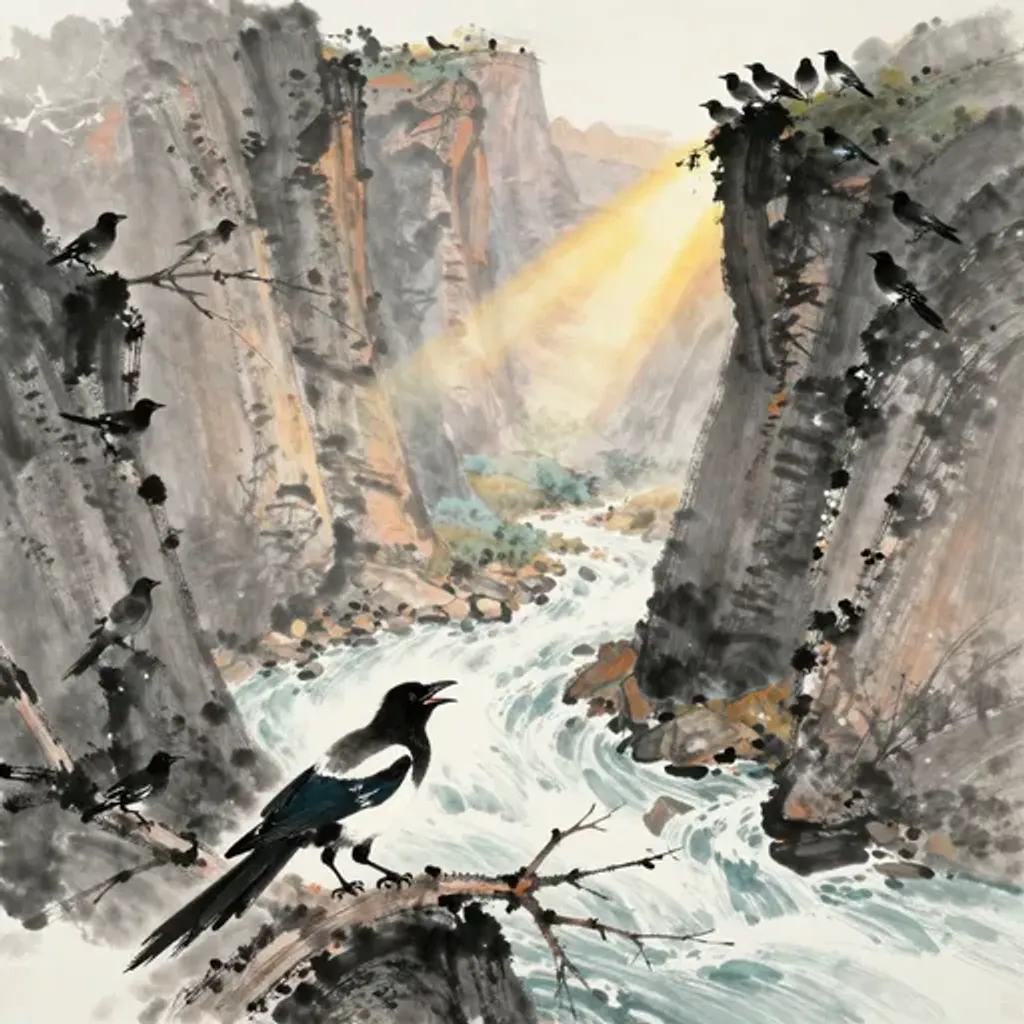
鳥鳴東西迎其羣侶似有所屬不得自專空返獨還
Birds call east and west, welcoming their flock; unable to act on their own, they return alone and empty.
Read full commentary ↓
Thunder rests within the lake, and a bird calls east and west, seeking its flock. Yet it cannot take the lead on its own terms and returns alone, empty-handed. This is Following turning upon itself — the hexagram doubled, Sui meeting Sui. The bird embodies the follower who longs for community but lacks the initiative to form it: calling in all directions, it waits for others to gather rather than establishing a rallying point. From Following to Following, the lesson is recursive: pure adaptiveness without anchor becomes aimless. One who only follows can never convene; the flock the bird seeks will never assemble around a voice that offers no direction.
中文註釋
澤中有雷,鳥鳴東西,四處呼喚同伴。然不得自專,無法主導聚合,空返獨還——獨自歸來,一無所獲。此為隨遇隨——本卦重疊。鳥即純粹追隨者之化身:渴望群體卻無自立之能,四方呼喚而不設集結之點。從隨至隨,教訓自反:純粹之順從若無錨定之處,便成漫無目的之漂泊。唯隨不立者永不能召集同行;鳥所尋之群伴,絕不會聚攏於一個無所指引的聲音周圍。
Jiao Shi Yi Lin 《焦氏易林》, manuscript from the Wenyuan Pavilion Siku Quanshu, Qianlong period, Qing dynasty.
National Palace Museum, accession nos. 故庫017987–017990
Fascicle 1, page 175
Read from the manuscript leaf
Shown unpunctuated, as in the manuscript.
About this reading
Read from the scanned leaf.
Related Hexagrams
Same upper trigram: Lake (兌)
Same lower trigram: Thunder (震)