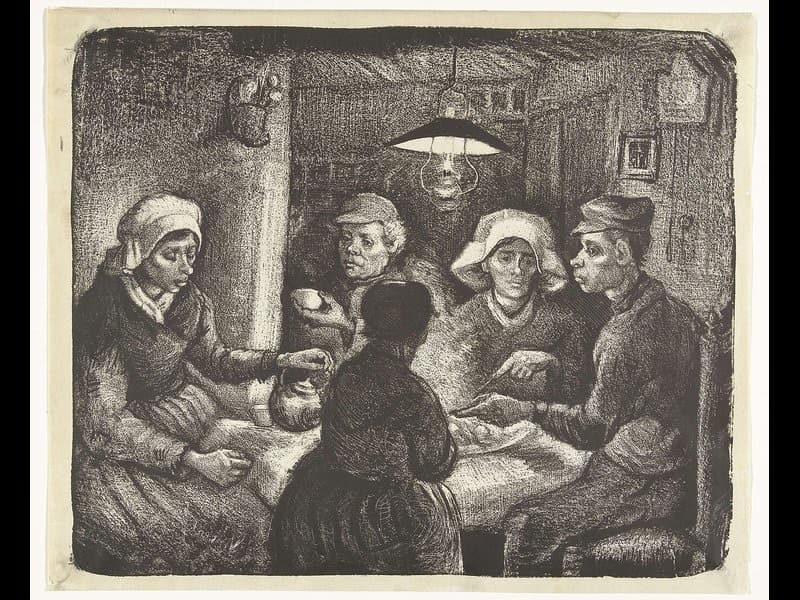
Upper Trigram
艮 Gèn
Mountain — Stillness
Lower Trigram
震 Zhèn
Thunder — Arousing
Classical Texts
The Goal
Yi 頤 (Nourishment) is not about food. It is about what you take in and what you put out — the total economy of nourishment, physical and spiritual, that sustains or degrades a person. The hexagram's shape is itself a mouth: a yang line at the top, a yang line at the bottom, four yin lines between them — open jaws with empty space inside. Mountain (Gen) above Thunder (Zhen): stillness over movement, the upper jaw fixed while the lower jaw moves. Everything depends on what passes between them. The judgment opens 貞吉 and then gives the instruction: 觀頤,自求口實 — "contemplate nourishment; seek for yourself what fills the mouth." This is simultaneously literal and diagnostic. Observe what a person takes in and what they offer others, and their priorities, dependencies and integrity are legible. The word 觀 is the character that names Hexagram 20, which raises this act of watching to the level of contemplation. You are not merely watching someone eat. The Image divides the mouth's two functions and puts a discipline on each: 山下有雷,頤;君子以慎言語,節飲食 — "below the mountain is thunder: Nourishment. The superior person is careful in speech and moderate in eating and drinking." Speech is what leaves the mouth, food is what enters it, and the hexagram asks for restraint at both openings. This is why Yi's scope is not dietary. What ideas you absorb and what words you produce run through the same aperture. 顛頤 appears twice and the two instances go opposite ways. Wang Bi defines the term at 六二: 養下曰顛 — nourishing those below is what 顛 means. The direction is downward, not upward. On Wang Bi's reading 六二 is 凶 because it is itself in a low position and 居下不奉上而反養下, failing to serve those above while feeding those below, and 六四 is 吉 because it is above and 以上養下,得頤之義, feeding downward from a position that has something to give. The same act inverts on where you stand. 六四's 虎視眈眈,其欲逐逐 — "the tiger's gaze fixed, the desire relentless" — is appetite, and its line Image (小象) says why it is nonetheless 无咎: 上施光也, what is above dispenses light. Hunger of that intensity would be alarming if it fed only itself; this one feeds downward, and the direction is what redeems it. Wang Bi takes the same words as bearing rather than hunger — 下交不可以瀆,故虎視耽耽。威而不猛,不惡而嚴: dealings with those below must not become familiar, so the gaze is steady, dignified without ferocity, severe without hostility — and glosses 其欲逐逐 as 尚敦實, solidity pursued relentlessly rather than food. His reading takes the appetite out of the line; ours leaves it in and lets the 小象's 上施光也 do the work. Yi's goal is the alignment of consumption with purpose: taking in only what genuinely sustains, producing only what genuinely nourishes, and recognizing that the quality of what enters the mouth determines the quality of what emerges from it.
The Judgment
Sustained orientation resolves well. Observe the jaws. From what one seeks to fill the mouth. Watch what people eat. Watch what they say. Same organ, two directions. The text says you can read someone's entire character from their mouth — what goes in and what comes out. Sustained focus on this resolves well. Which means most people don't focus on it at all. They just open and close.
The Image
Thunder beneath the mountain: nourishment. The realized person accordingly is careful with speech and moderate in eating and drinking. Thunder trapped under a mountain — all that energy, and the instruction is: watch your mouth. Careful with words, moderate with food. Two disciplines that sound easy and ruin almost everyone. The person who masters their input and output has solved a problem that looks trivial and isn't.
The Lines
Line 1
Setting aside your spirit tortoise, watching me with hanging jaws. Adverse. You have a magic tortoise — a thing that feeds itself on nothing, that needs no external source. And you set it down to stare at someone else's dinner with your mouth hanging open. Adverse. You had self-sufficiency and you traded it for envy. That's not a bad deal. That's not even a deal. That's just loss.
Line 2
Overturned nourishment. Departing from the usual toward the hilltops. Seeking nourishment by advancing: adverse. Feeding upside down — looking up instead of down for what sustains you. Heading for the hilltops, away from the norms. And pushing forward with this hunger: adverse. The person who can't feed themselves and goes looking for someone else to do it has a dependency problem dressed up as ambition.
Line 3
Turning away from nourishment. Sustained orientation: adverse. For ten years do not act. No direction is supported. Rejecting real nourishment. Adverse. And then the harshest time penalty in the book: ten years out of service. No direction works. You know what earns a decade of nothing? Not starvation — rejection. The person who had access to what they needed and turned it down. The text has a very long memory for that.
Line 4
Overturned nourishment. Resolves well. Tiger gazing intently, its desire pursuing and pursuing. No fault. Same upside-down feeding as line two — but this time it resolves well. Why? The tiger stare. Intense, focused, absolutely locked on. The desire runs and runs and there's no fault because the hunger serves something larger than the hungry person. Same behavior, different motive, opposite verdict. The I-Ching notices.
Line 5
Departing from the usual. Dwelling in sustained orientation resolves well. One cannot cross the great river. Breaking from the norm — but staying put. Resolves well, but don't attempt the big crossing. The fifth line has enough self-awareness to know its limits. You can deviate from convention. You cannot deviate from convention and take on the biggest challenge at the same time. Pick one.
Line 6
The source of nourishment. Strained but resolves well. Crossing the great river is supported. You are the source. Everyone eats from you. Strained — because being the origin of nourishment for others is exactly as exhausting as it sounds. But it resolves well, and the great crossing is supported. The person at the top of the nourishment hexagram who can still feed others after being depleted? That's who the river parts for.
Yilin: Forest of Changes
From Jiao Yanshou's Forest of Changes (焦氏易林) — the verse for Hexagram 27 in its unchanging form. A Han dynasty collection of four-character verses interpreting every hexagram transformation.
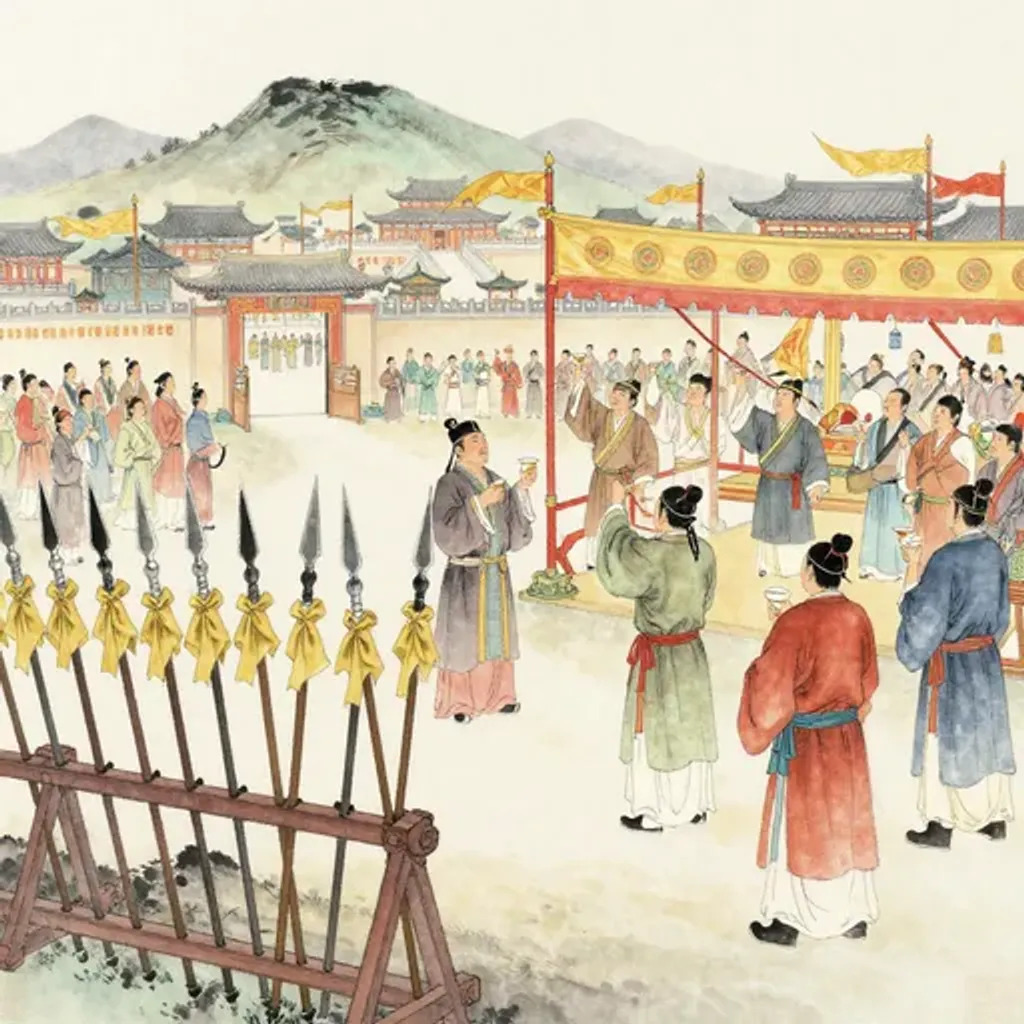
家給人足頌聲並作四夷賓服干戈卷閣
Every household provided, every person content; songs of praise arise in chorus. The four frontiers submit as guests; weapons of war are rolled up and shelved.
Read full commentary ↓
Mountain over thunder remains mountain over thunder — Nourishment unchanged, its essence distilled. Every household is well provisioned and every person satisfied; hymns of praise arise in chorus. The four barbarian peoples submit as guests, and weapons of war are rolled up and stored in the pavilion. This is the golden age vision of nourishment perfected: when the mouth is governed wisely, material abundance cascades into cultural harmony and diplomatic peace. Spears sheathed and songs composed — the realm needs no army because it is properly fed. Nourishment turning upon itself amplifies its own virtue, proving that careful governance of what enters and exits the mouth underlies all civilization.
中文註釋
山下有雷不變,頤之本質自我澄明。家給人足,頌聲並作——家家富足,人人飽暖,讚歌四起。四夷賓服,干戈卷閣——蠻夷歸順,兵器收藏。此為養之至善之象:口之所養得宜,物質之豐化為文教之盛、邦交之和。不須甲兵而天下歸心,蓋因養之正也。頤之自化自證:「慎言語、節飲食」之修為,推而廣之即為太平之基。一口之養繫天下之治。
Jiao Shi Yi Lin 《焦氏易林》, manuscript from the Wenyuan Pavilion Siku Quanshu, Qianlong period, Qing dynasty.
National Palace Museum, accession nos. 故庫017987–017990
Fascicle 2, page 78
Read from the manuscript leaf
Shown unpunctuated, as in the manuscript.
About this reading
Read from the scanned leaf.
Related Hexagrams
Same upper trigram: Mountain (艮)
Same lower trigram: Thunder (震)