Upper Trigram
震 Zhèn
Thunder — Arousing
Lower Trigram
震 Zhèn
Thunder — Arousing
Classical Texts
The Goal
Zhen is not catastrophe. It is the shock that recalibrates — the thunderclap that jolts awareness back to what matters before complacency sets in. Thunder doubled on itself gives not one jolt but repeated ones, each testing whether composure was actually achieved or only performed. The hexagram's concern is never the shock; it is the quality of response the shock exposes. The judgment carries its own dramatic structure: 震來虩虩,笑言啞啞 — "the shock comes, and there is fright; then laughing words, ha ha." Terror followed by relief is not weakness but the sign of fear that is proportionate and does not outstay the danger. Then the image that anchors everything: 震驚百里,不喪匕鬯 — the thunder terrifies for a hundred miles, and the officiant does not drop the ladle and the sacrificial wine. Not numbness. Composure rooted deep enough that the shock does not reach the hands doing the work. 初九 repeats the judgment's arc and calls it 吉. The Image says what the shock is for: 洊雷,震;君子以恐懼修省 — "thunder upon thunder: Shock. The superior person, in fear and trembling, sets himself in order and examines himself." Shock is the instrument, not the enemy. The lines refuse to make this uniform, and that refusal is the honest part. 六二 loses everything and is told not to chase it: 億喪貝,躋于九陵,勿逐,七日得 — "great loss of treasure; climb the nine hills; do not pursue, in seven days you will get it back." That is the same count as 復's 七日來復. 九四 gets no encouragement at all: 震遂泥, the shock ends in the mud. And 上六 explicitly forbids action — 征凶 — while noting 震不于其躬,于其鄰,无咎, the shock reaches the neighbour rather than oneself, and there is no blame; the right response there is to take warning from what struck someone else. So the teaching is not one posture repeated six times. It is that shock arrives in different conditions and each demands its own reading — recover, wait, endure, hold still. The goal of Zhen is the inner steadiness that lets a person be shaken without being shattered, and part of that steadiness is knowing which of those the moment is asking for.
The Judgment
Fulfillment. Shock arrives — terror, terror! Laughing words — ha, ha! Shock startles for a hundred miles. One does not drop the sacrificial spoon and wine. Thunder hits and you scream. Then you laugh. Terror followed by laughter — that's the sequence, not a choice between them. The shock reaches a hundred miles and you don't drop the sacred wine. Not because you're brave. Because your hands know something your mind forgot. The person whose grip holds through the scream has trained for this without knowing it.
The Image
Repeated thunder: the arousing. The realized person accordingly uses fear and trembling to set their life in order and examine themselves. Thunder after thunder — the shock that comes twice. And the instruction is: use the fear. Not survive it, not endure it — use it. To set your life in order. To examine yourself. The fear is the teacher. The person who wastes a good shock has wasted the most efficient tool for self-improvement the universe offers.
The Lines
Line 1
Shock arrives — terror, terror! Afterward, laughing words — ha, ha! Resolves well. Screaming, then laughing. Same event, two responses, one after the other. Resolves well. The first line of shock, and the complete arc is here: the terror is real, the laughter is real, and the laughter comes second. The person who screams at the thunder and then laughs about it has processed the entire hexagram in one line. That's what 'resolves well' looks like.
Line 2
Shock arrives with danger. A hundred thousand times losing valuables. Climbing to the ninth hill. Do not pursue. In seven days, recovered. Everything lost. Climb to the high ground. Don't chase what fell. In seven days, it comes back. The second line of shock is the hardest instruction for the person who just watched their valuables scatter: don't go after them. Climb. Wait. Seven days. The things you lost in the shock return on their own schedule, not yours. Pursuing them extends the loss.
Line 3
Shock stirs and awakens. If shock moves you to action, no mishap. The shock wakes you up. And if that awakening becomes action — real action, not panic — no mishap. The third line is the pivot: shock as alarm clock, not as disaster. The person who hears the thunder and moves with it instead of against it has found the only relationship with shock that produces no damage. Be stirred. Then act.
Line 4
Shock sinks into mud. The thunder hits the mud and... nothing. It sinks. No echo, no movement, no response. The fourth line is what happens when shock meets inertia. The person who absorbs the shock without being moved by it hasn't survived it. They've wasted it. The mud doesn't get a verdict because the mud doesn't do anything. It just sits there, absorbing.
Line 5
Shock going and coming — danger. The intention is to lose nothing while there are things to do. Shock from every direction — coming and going, no pause. Danger. But the intention holds: lose nothing, keep working. The fifth line of shock, and the person in the center of repeated lightning maintains purpose. Not calm — you can't be calm here. But purposeful. The distinction between panic and intensity is whether you're still pointed at something.
Line 6
Shock — trembling and trembling. Eyes darting in alarm. Advancing: adverse. The shock is not upon one's own body but upon the neighbor. No fault. Even marriage partners have things to say. Shaking. Wild-eyed. Can't move. Adverse to advance. But — the shock hasn't actually hit you yet. It hit your neighbor. No fault. The top of the shock hexagram, and the final image is: the person so terrified by what happened nearby that they're paralyzed. The shock was real but it wasn't yours. The gossip will flow. Let it. The fault would be in moving from this position, not in staying.
Yilin: Forest of Changes
From Jiao Yanshou's Forest of Changes (焦氏易林) — the verse for Hexagram 51 in its unchanging form. A Han dynasty collection of four-character verses interpreting every hexagram transformation.
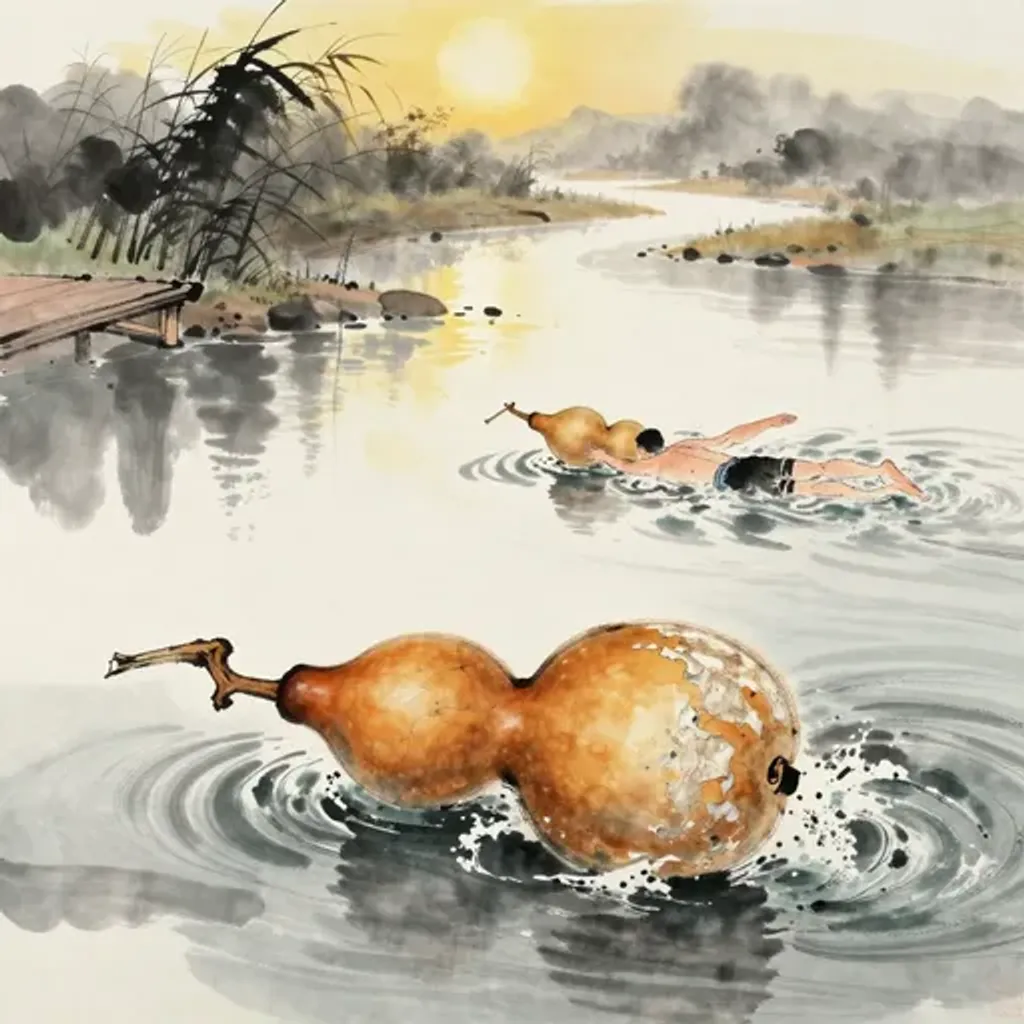
枯瓠不朽利以濟舟渡踰江海無有溺憂
The dried gourd does not decay; it serves to ferry the boat. Crossing over rivers and seas; there is no worry of drowning.
Read full commentary ↓
Thunder meets itself: pure shock reflected and redoubled. A dried gourd that does not rot — useful for crossing by boat. It ferries one across rivers and seas without fear of drowning. The gourd (瓠), hollow and light, floats naturally. Zhuangzi famously argued that even a useless thing, if understood correctly, becomes a vessel: the massive gourd that cannot be used as a ladle becomes a boat. The verse applies this insight to the self-referential hexagram: Thunder to Thunder, the shock that returns to itself discovers its own buoyancy. What seems empty and dried out proves to be the very quality that saves. From The Arousing to itself, the lesson is that thunder's nature, accepted without resistance, carries one safely through the deepest waters.
中文註釋
洊雷震動,復歸震動——純粹之震,自我映照。枯瓠不朽——乾瓠不腐。利以濟舟——可為渡舟之用。渡踰河海,無有溺憂——漂越河海而無溺水之虞。瓠者,中空而輕,天然浮於水。莊子曾論:無用之大瓠,不可為瓢,卻可為舟。此詩用於自歸之卦:震復歸震,衝擊回歸自身,方發現本有之浮力。看似枯空無用之質,恰是救渡之關鍵。從震至震——接受本性而不抗拒,方能安然渡過至深之水。恐懼修省,即是自渡之道。
This commentary was written against an earlier reading of the verse. Where the reading has since changed, the interpretation itself may no longer apply.
Jiao Shi Yi Lin 《焦氏易林》, manuscript from the Wenyuan Pavilion Siku Quanshu, Qianlong period, Qing dynasty.
National Palace Museum, accession nos. 故庫017987–017990
Fascicle 4, page 68
Read from the manuscript leaf
Shown unpunctuated, as in the manuscript.
About this reading
Read from the scanned leaf.
Related Hexagrams
Same upper trigram: Thunder (震)
Same lower trigram: Thunder (震)