Upper Trigram
震 Zhèn
Thunder — Arousing
Lower Trigram
乾 Qián
Heaven — Creative
Classical Texts
The Goal
Da Zhuang is not a license to act. It is the hexagram that teaches power its own discipline. Thunder (Zhen) above Heaven (Qian) — arousing force driven by pure creative energy — represents strength at its peak, and the judgment answers with two characters: 利貞, "constancy furthers." No praise, no elaboration, no conditions for success. Just: stay correct. The brevity is itself the teaching. When power is greatest the instruction must be simplest, because the temptation to find sophisticated justifications for using strength is precisely what this hexagram warns against. The Image makes the principle explicit: 雷在天上,大壯;君子以非禮弗履 — "thunder above heaven: Great Power. The superior person does not tread what is not in accord with propriety." The constraint is placed on the feet, not on the strength — nothing is asked of the power itself except where it is permitted to walk. The ram shows what happens when that counsel is ignored. 九三 divides the two responses — 小人用壯,君子用罔 — "the small person uses force, the superior person uses 罔." 罔 carries two live readings and the line works under both: as 無, he uses none; as 羅, a net, which is Wang Bi's — 小人用之以為壯,君子用之以為羅己者也, the superior person treats strength as the snare it would become for him. Either way what separates the two is that one of them declines to reach for it — and then gives the consequence: 羝羊觸藩,羸其角, "the ram butts the hedge and entangles its horns." 上六 repeats the image with the entanglement complete: 不能退,不能遂 — it can neither back out nor push through. But the line does not end there. 艱則吉 — "in hardship, good fortune." Even the ram that has trapped itself has a way out, and it runs through difficulty rather than around it: the strength that created the tangle cannot undo it, and only the patience of working through can. The goal of Da Zhuang is to hold maximum force in alignment with maximum correctness. The hexagram follows Dun in the sequence — after strategic withdrawal has rebuilt strength, power returns at full magnitude. The question it poses is not whether you have power but whether you can refrain from displaying it. 九四 gives the answer: 藩決不羸,壯于大輿之輹 — "the hedge opens, no entanglement; power in the axle-block of a great cart." Real strength operates invisibly, moving heavy loads without spectacle. The axle, not the ram's horns, is the image of power properly employed.
The Judgment
Sustained orientation is supported. Great power. And the only instruction is: stay oriented. Not 'use it wisely,' not 'be careful' — just: sustained orientation. Because the problem with great power isn't that people misuse it. It's that they stop checking whether they're still pointed in the right direction. The power feels so good they forget the compass.
The Image
Thunder above heaven: great power. The realized person accordingly does not tread where it does not accord with propriety. Thunder above heaven — maximum force in the highest position. And the instruction is about where not to walk. Not about what to do with all that power. Where not to go. The realized person with great power uses it primarily to avoid wrong paths. That's the most sophisticated use of force in the book: restraint that looks like nothing.
The Lines
Line 1
Power in the toes. Advancing: adverse. There is sincerity. All that power and it's in the toes. The lowest part, ready to kick forward. Advancing: adverse. But there is sincerity — the desire to move is real. The text doesn't question your motive. It questions your position. You're sincere and you're wrong. Those things can absolutely coexist.
Line 2
Sustained orientation resolves well. Two words. Resolves well. The second line of great power and the entire instruction fits in a breath. Stay oriented. Done. The text knows that at this point the power is balanced and the only thing that can ruin it is overthinking. So it doesn't give you anything to overthink.
Line 3
The petty person uses power. The realized person uses restraint. Sustained orientation: strained. The ram butts the hedge and entangles its horns. The ram charges the fence and gets stuck. Horns tangled in the hedge. And the text splits it clean: the small person uses force, the realized person uses nets — subtlety, indirection. The ram has more power than the hedge. It doesn't matter. The hedge wins through structure. Every direct assault on an indirect problem ends the same way: stuck.
Line 4
Sustained orientation resolves well. Deviation detected dissolves. The hedge breaks open without entanglement. Power in the great cart's axle mounts. The hedge opens. No entanglement. The power moved into the axle of the cart — invisible, structural, carrying real weight. This is what happens when power stops showing off and starts working. The ram from line three is still stuck in the fence. This line put the same energy into the infrastructure. The fence didn't stand a chance.
Line 5
Loses the ram with ease. No deviation detected. The ram is gone. Lost easily, no regret. The stubborn, battering-ram approach just... disappeared. And there's no deviation to detect because it wasn't a loss. It was an upgrade. The person who releases their need to fight is not weaker. They just stopped confusing aggression with power. Turns out those were different things.
Line 6
The ram butts the hedge. Cannot retreat. Cannot advance. No direction is supported. Difficulty, then resolves well. Stuck again. Same ram, same hedge, same horns. Can't go forward, can't go back. Nothing works. But — difficulty, then resolves well. The last two words change everything. The deadlock breaks, but only after you stop trying to break it. The ram that finally stands still in the hedge discovers the hedge was never the problem. The charging was the problem.
Yilin: Forest of Changes
From Jiao Yanshou's Forest of Changes (焦氏易林) — the verse for Hexagram 34 in its unchanging form. A Han dynasty collection of four-character verses interpreting every hexagram transformation.
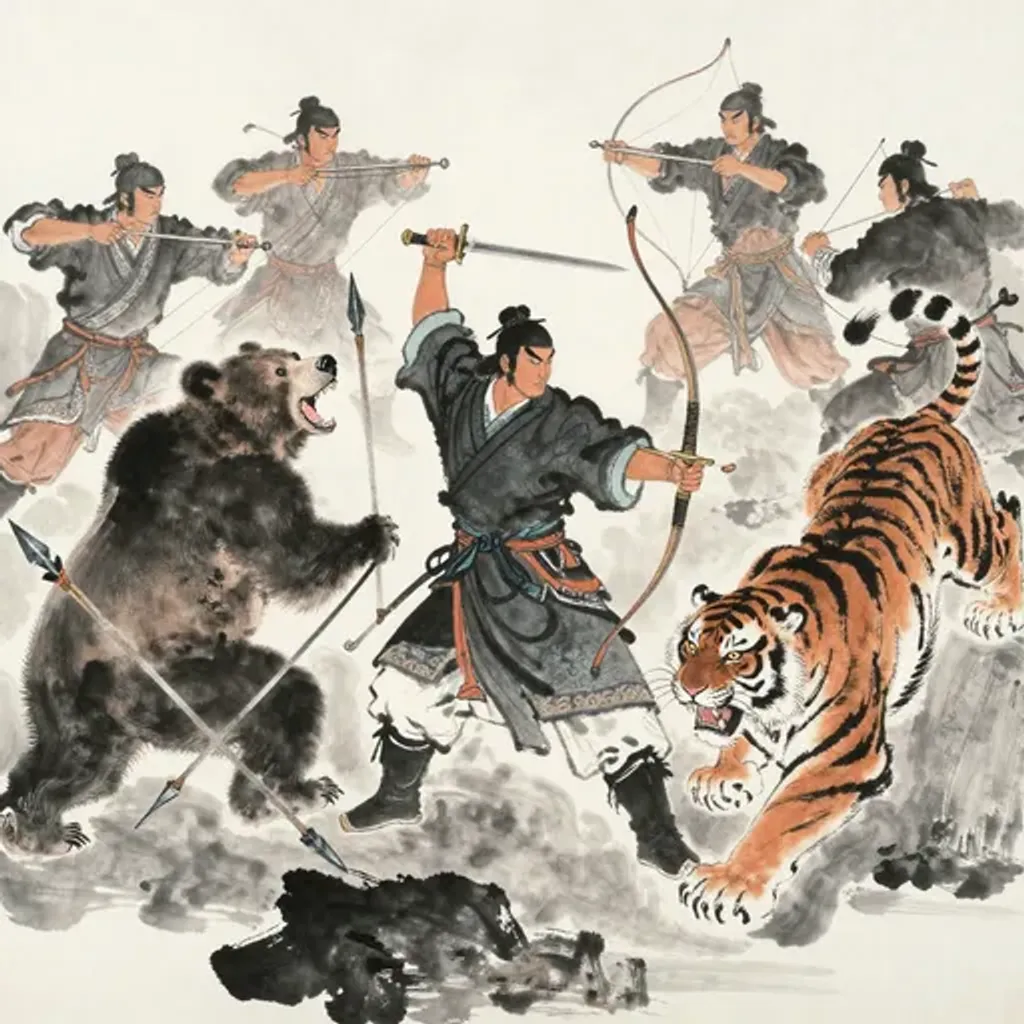
左有噬熊右有嚙虎前觸銕牙後躓強弩無可抵者
On the left, a biting bear; on the right, a gnawing tiger. Ahead, the iron spear's point; behind, the strong crossbow's string. None can withstand it.
Read full commentary ↓
Thunder doubles upon thunder above heaven — Great Power remains Great Power, the hexagram transforming into itself. The verse paints a warrior surrounded on all sides: a biting bear to the left, a gnawing tiger to the right, iron spears ahead, strong crossbows behind. There is no safe direction, no angle of escape, no one who can resist such concentrated force. This is power at its absolute zenith, hemmed in by its own magnitude. From Dazhuang to Dazhuang, the image mirrors itself: when power faces equally matched power from every quarter, even the mightiest stands paralyzed. The verse reads not as triumph but as warning — total strength without maneuver room becomes total entrapment.
中文註釋
雷在天上,大壯不變——卦自變為己。左有噬熊,右有囓虎,前觸銕矛,後躓強弩,無可抵者。四面受敵,無處可退,壯力之極致反成極致之困。大壯之大壯,鏡像自映:當同等之力從四方壓來,最強者亦動彈不得。此詩非頌強盛,乃警壯極。力大無當,威猛無方,全力反成全困——壯之極即壯之窮。
This commentary was written against an earlier reading of the verse. Where the reading has since changed, the interpretation itself may no longer apply.
Jiao Shi Yi Lin 《焦氏易林》, manuscript from the Wenyuan Pavilion Siku Quanshu, Qianlong period, Qing dynasty.
National Palace Museum, accession nos. 故庫017987–017990
Fascicle 3, page 36
Read from the manuscript leaf
Shown unpunctuated, as in the manuscript.
About this reading
Read from the scanned leaf.
Related Hexagrams
Same upper trigram: Thunder (震)
Same lower trigram: Heaven (乾)