Upper Trigram
兌 Duì
Lake — Joyous
Lower Trigram
乾 Qián
Heaven — Creative
Classical Texts
The Goal
Guai is not aggression. It is the moment when accumulated righteous force must confront the last residue of what is corrupt — and the hexagram's primary concern is that the confrontation not corrupt the one confronting. Lake (Dui) above Heaven (Qian) shows five yang lines pressing upward against a single yin line at the top: overwhelming strength facing a small but entrenched opposition. The judgment lays out a protocol: 揚于王庭 — "make it known at the king's court"; 孚號有厲 — "a sincere outcry, and there is danger"; 告自邑,不利即戎 — "announce it from one's own city; it does not further to resort to arms." Public declaration, acknowledged risk, examination beginning at home, and an explicit prohibition on force. The Tuan names the temper the whole sequence requires: 健而說,決而和 — firm yet pleased, decisive yet harmonious. The Image gives the deeper logic: 澤上於天,夬;君子以施祿及下,居德則忌. Water gathered above heaven must overflow; that part is inevitable. What the hexagram governs is what happens at the moment of overflow — and the second clause is where the readings part. Taken in the ordinary sense of 忌, what is to be shunned, the line runs "the superior person distributes emolument to those below, and shrinks from resting on his virtue": whoever hoards the advantage the breakthrough produced, or settles into the merit of having made it, has replaced one corruption with another. Wang Bi glosses 忌 as 禁 and gets a different sentence — 法明斷嚴,不可以慢,故居德以明禁也。施而能嚴,嚴而能施 — dwelling in virtue means making the prohibitions plain, so that giving and severity issue from the same hand. Both readings keep the overflow from becoming spoil. Ours guards against self-satisfaction; his guards against slackness, and makes breakthrough a matter of law rather than of force. 九三 states the dilemma exactly: 壯于頄,有凶;君子夬夬,獨行遇雨,若濡有慍,无咎 — "strength in the cheekbones brings misfortune; the superior person is resolute upon resolute; walking alone he meets rain, and though drenched and resented, there is no blame." Whoever keeps a working relationship with the corrupt element while inwardly resolved against it will look compromised and will be criticized for it. The line grants no vindication, only 无咎 — the discomfort is the price, not a misunderstanding to be cleared up. 上六 shows the other failure: 无號,終有凶 — "no outcry; in the end, misfortune." The last trace, left alone because the situation looks resolved, regenerates. The goal of Guai is to apply overwhelming force so that it removes what is corrupt without becoming so — which means finishing the work, and refusing to enjoy it.
The Judgment
Proclaimed in the king's court. A sincere appeal — there is danger. Notify your own city. Resorting to arms is not supported. Going forward is supported. Announce it publicly. Make the appeal with sincerity. But — danger. And tell your own people first, not the enemy. And don't use force. The breakthrough hexagram lays out the most precise rules in the book for confronting what's wrong: speak openly, expect resistance, warn your community, and put down the weapon. The person who fights the darkness with a sword becomes part of it.
The Image
The lake rises above heaven: breakthrough. The realized person accordingly distributes rewards downward, and resting in character avoids accumulation. The lake above heaven — water higher than the sky, which means it's about to break. And the instruction is: give downward. Distribute before the break. Because the person who accumulates at the moment of overflow gets the flood. The realized person who gives everything away before the breakthrough has nothing left to lose. That's the safest position in the hexagram.
The Lines
Line 1
Powerful in the advancing toes. Going forward and not prevailing constitutes fault. All the power is in the toes — ready to charge. And the text says: if you go and fail, that's on you. Not 'adverse.' Fault. Because the first line of breakthrough requires honest assessment: can you actually do this? The person who charges into a confrontation they can't win didn't commit an act of courage. They committed an error of math.
Line 2
An anxious cry. There are arms in the evening and night. Do not worry. Alarm in the dark. Weapons at night. And: don't worry. The second line of breakthrough is the person who stays vigilant when everyone else is asleep. The cry is the early warning. The weapons are the readiness. And the 'don't worry' is for the person who did the preparation — because readiness is the antidote to anxiety. You armed yourself before nightfall. That's why you can sleep.
Line 3
Powerful in the cheekbones. There is misfortune. The realized person, resolved in their resolution, walks alone and encounters rain. As if soaked, there is displeasure. No fault. It shows in your face — the determination is visible, and that brings misfortune. But the realized person walks alone through the rain anyway. Gets soaked. Gets criticized. No fault. The third line of breakthrough: you're going to look bad. You're going to be alone. You're going to be wet and uncomfortable. And you're going to be right. Those things are not mutually exclusive.
Line 4
No skin on the buttocks. Walking halts and stumbles. Led like a sheep, deviation detected dissolves. Hearing words but not believing. Raw and stumbling. Led like a sheep and the regret would dissolve — if you'd let it. But you hear the words and don't believe them. The fourth line of breakthrough: the good advice is available, the solution is simple, and you can't accept it because your stubbornness has become structural. The sheep that's being led to safety keeps pulling back toward the cliff.
Line 5
Wild plants on the height, resolved in resolution. Walking the middle: no fault. Weeds on the ridge — they keep coming back. And the instruction is: keep resolving. Stay in the middle. No fault. Because the inferior thing in a high position doesn't die from one confrontation. It grows back. The person who resolves once and declares victory hasn't met a real weed. Real weeds need sustained, centered, unglamorous removal. Every time.
Line 6
No cry. In the end, there is misfortune. Silence. No warning, no alarm, no call. And: misfortune in the end. The last line of the breakthrough hexagram, and the failure is not action — it's silence. The person who saw the last remnant of the problem and said nothing. Who assumed the breakthrough was complete. The seed you don't name is the one that grows back. Always call it out. Always.
Yilin: Forest of Changes
From Jiao Yanshou's Forest of Changes (焦氏易林) — the verse for Hexagram 43 in its unchanging form. A Han dynasty collection of four-character verses interpreting every hexagram transformation.
戴堯扶禹松喬彭祖西遇王母道路夷易無敢難者
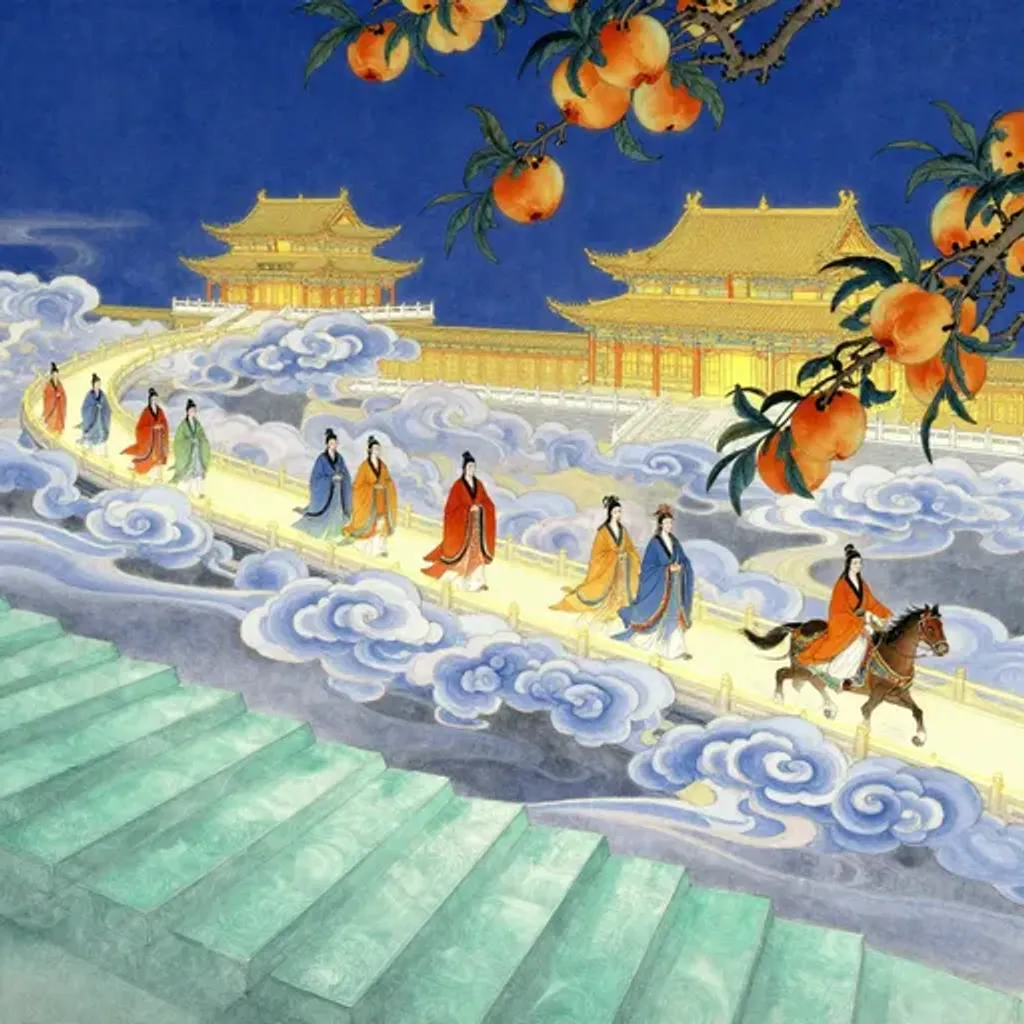
Upholding Yao, supporting Yu; with Song Qiao and Peng Zu. Journeying west past the Queen Mother; the road is smooth and easy. None dares pose a challenge.
Read full commentary ↓
Lake upon heaven meets itself — Breakthrough returning to Breakthrough. The verse invokes the supreme figures of Chinese mythology: supporting Emperor Yao, assisting Yu the Great, accompanied by the immortals Chisongzi and Wang Qiao, journeying westward past the Queen Mother of the West. The road is smooth and easy; no one dares obstruct the way. This is the ultimate pilgrimage — sage-kings and immortals traveling together across the cosmos with effortless authority. From Breakthrough to itself, the pattern is pure decisiveness, undiluted and self-reinforcing. When the decisive principle encounters no contrary force, it becomes a triumphant procession through all of heaven and earth. The one who carries both royal legitimacy and celestial friendship passes unchallenged.
中文註釋
澤上於天,夬遇自身。戴堯扶禹——擁戴堯帝,輔佐大禹。松喬彭祖——赤松子、王子喬、彭祖等仙人相伴。西過王母——西行拜訪西王母。道里夷易,無敢難者——道路平坦,無人敢阻。此乃至高之巡遊——聖王與仙人同行宇宙,從容自若而權威無上。從夬至夬,決斷遇決斷,純粹而自我強化。當果決之力不遇任何相反之力,便化為暢行天地之凱旋。兼具王者正統與天仙之誼者,所向無礙。
This commentary was written against an earlier reading of the verse. Where the reading has since changed, the interpretation itself may no longer apply.
Jiao Shi Yi Lin 《焦氏易林》, manuscript from the Wenyuan Pavilion Siku Quanshu, Qianlong period, Qing dynasty.
National Palace Museum, accession nos. 故庫017987–017990
Fascicle 3, page 126
Read from the manuscript leaf
Shown unpunctuated, as in the manuscript.
About this reading
Read from the scanned leaf.
Related Hexagrams
Same upper trigram: Lake (兌)
Same lower trigram: Heaven (乾)