Upper Trigram
巽 Xùn
Wind — Gentle
Lower Trigram
乾 Qián
Heaven — Creative
Classical Texts
The Goal
Xiao Chu is not weakness. It is the accumulation of small restraining forces that hold back something far more powerful — gentle persistence reshaping what direct confrontation cannot move. The hexagram shows Wind (Xun) above Heaven (Qian): the softest trigram sitting atop the strongest, like persuasion applied to raw creative force, like the advisor who cannot command the ruler but can influence the direction of policy through patient, repeated suggestion. The single yin line in the fourth position restrains five yang lines — an apparent structural imbalance that nonetheless holds, because restraint here operates through a different kind of power than what it restrains. The imbalance is apparent rather than real: the fourth position is itself a yin place, correctly occupied, and the line stands in defined relation to those around it. The judgment captures this tension in a single image: 密雲不雨,自我西郊 — "dense clouds but no rain, from our western outskirts." The moisture has gathered, the conditions for release exist, yet the rain does not fall. Accumulation continues without discharge. This is the hexagram of the almost — of preparation that has not yet reached its tipping point, of influence that shapes without yet transforming. The third line dramatizes what happens when force tries to break through prematurely: 輿說輻,夫妻反目 — "the spokes burst from the wagon wheels; husband and wife glare at each other." Premature assertion against even gentle restraint produces humiliation rather than progress. The Image — 風行天上,小畜;君子以懿文德 — directs attention inward during the interval of restraint: "wind moves across heaven; the superior person refines the form through which virtue is expressed" — 文德 covering cultivated form, conduct, expression, and civil virtue together. When you cannot act decisively in the world, refine your capacity. Polish what you will eventually deploy. Xiao Chu's goal is not permanent restraint but the recognition that some periods require accumulation rather than release, and that the small forces of cultivation, refinement, and patient influence can hold creative power in check until the moment when the clouds finally break and the rain falls of its own accord.
The Judgment
Fulfillment. Dense clouds but no rain. From our western frontier. The clouds are thick. Everything says rain. It doesn't rain. You're fulfilled but the big release hasn't happened yet. From the frontier — not the center, the edge. Sometimes every condition is present and the thing still doesn't come. The fulfillment is real. The rain isn't. Both true.
The Image
Wind moves across heaven: small taming. The realized person accordingly refines and cultivates character. Wind above heaven — movement everywhere, nothing accumulated. Can't grab wind. So the instruction is: work on yourself. When the external situation won't hold still, the internal one is the only project available. Not a consolation prize. The actual move.
The Lines
Line 1
Returning to one's own path. How could that be wrong? Resolves well. You went off course and came back. The text is practically incredulous: how could that be a problem? It resolves well. Returning to your own path is one of the very few moves that comes with its own rhetorical question. The book almost never asks questions. When it does, the answer is always obvious.
Line 2
Drawn back to return. Resolves well. Pulled back. Not by choice — drawn. And it resolves well. Sometimes the best thing that happens to you is the thing that stops you. The person who gets pulled back to center by something they didn't choose is having a better day than the person who kept going.
Line 3
The cart throws off its wheel spokes. Husband and wife glare at each other. The wheels come off. Literally — spokes fly out of the cart. And then: a married couple glaring at each other. The text puts those two images side by side and lets you connect them. Something structural broke and now two people who are supposed to be on the same team are staring daggers. No verdict needed. The image is the verdict.
Line 4
Sincerity present. The bleeding stops, the anxiety departs. No fault. The bleeding stops. The worry leaves. Just like that — because sincerity showed up. No fault. What becomes visible at this position is that the crisis was never about the wound. It was about the doubt. Once the doubt goes, the bleeding stops on its own. Turns out trust is a hemostatic.
Line 5
Sincerity that binds together. Enriched along with one's neighbors. Sincerity so real it's contagious. Your neighbors get richer because you're trustworthy. Not because you helped them — because trust spreads. Maximum influence, and the mechanism isn't strategy or generosity. It's the fact that when one person is genuinely reliable, the people nearby benefit without anyone arranging it.
Line 6
The rain has come, rest has arrived. Character is honored and carried. The wife's sustained orientation: strained. The moon nearly full. The noble one advancing: adverse. The rain finally came. Remember — the whole hexagram was clouds without rain. Now it arrives, and the instruction is: stop. The small force that held everything together is at its limit. The moon is almost full, which means it's about to wane. Advancing now is adverse. You know what's harder than waiting for the rain? Knowing that once it arrives, the season changes and what worked before doesn't anymore.
Yilin: Forest of Changes
From Jiao Yanshou's Forest of Changes (焦氏易林) — the verse for Hexagram 9 in its unchanging form. A Han dynasty collection of four-character verses interpreting every hexagram transformation.
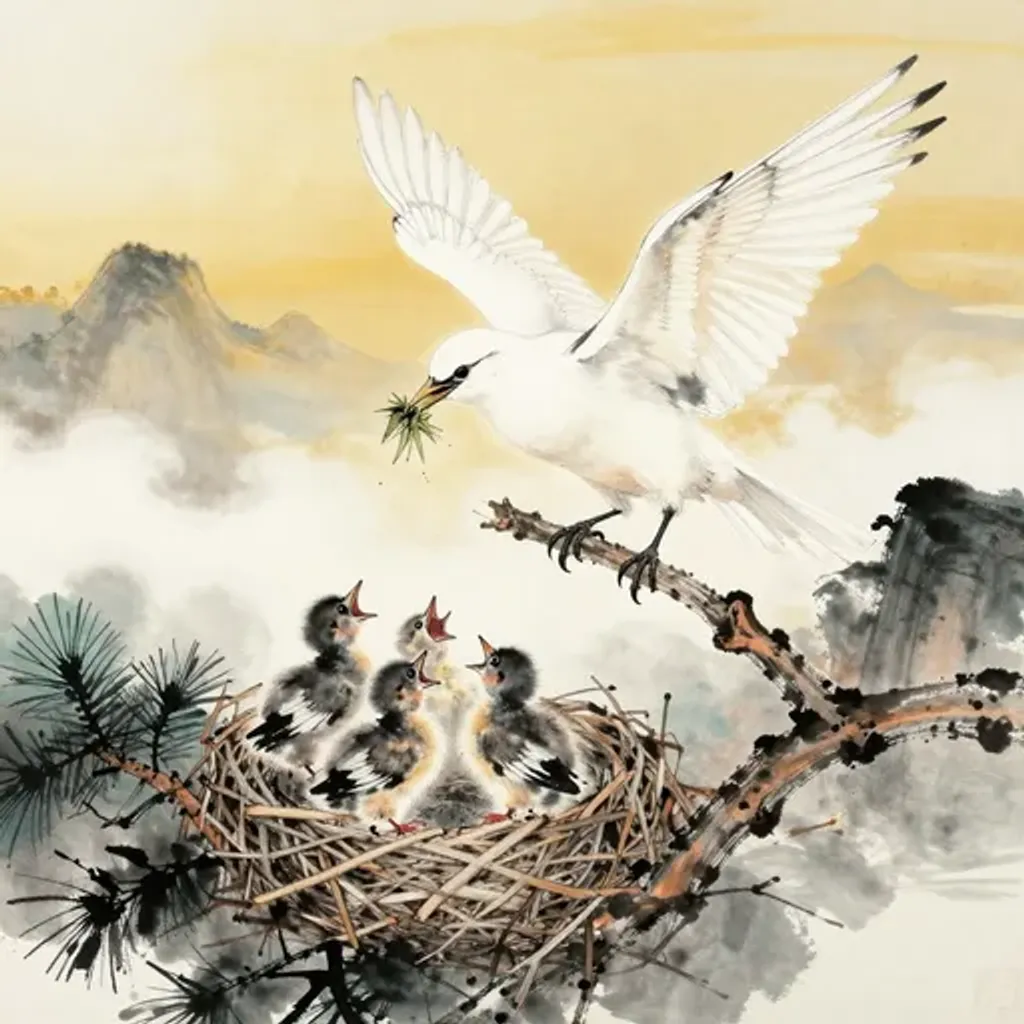
白鳥銜餌鳴呼其子旋枝張翅來從其母伯仲季叔元賀舉手
The white bird holds bait in its beak, calling out to its young. Bending the branch, spreading its wings, the chicks come to their mother. Elder and younger brothers all raise their hands in celebration.
Read full commentary ↓
Wind above heaven returns to itself — Small Taming meeting its own image. A white bird carries food in its beak, calling to its young. It spreads its wings upon the branch, and the chicks come flocking to their mother. Brothers eldest to youngest — Bai, Zhong, Shu, Ji — raise their hands in celebration. The verse is a portrait of familial wholeness: the mother nourishes, the children gather, the household rejoices. When Small Taming meets itself, gentle accumulation needs no transformation. The wind that refines heaven's force simply sustains what it has always cultivated: warmth, bonds, and the quiet sufficiency of a family fed and together.
中文註釋
風行天上,小畜重逢自身——同卦相遇,本質不變。白鳥銜餌呼喚幼雛,展翅枝頭迎候;雛鳥來從其母,依偎其下。伯仲叔季——兄弟四人齊全——尢賀舉手,共慶團圓。此為家庭圓滿之圖景:母哺子聚,闔家歡欣。小畜遇小畜,柔風之蓄養無需變化轉化,只需持守既有之溫暖。風行天上而不改其質,所畜者即此:親情之紐帶、日常之知足、一家飽暖相聚之寧靜喜悅,平凡而珍貴。
The commentary reflects an earlier reading and may refer to wording the manuscript does not carry.
Jiao Shi Yi Lin 《焦氏易林》, manuscript from the Wenyuan Pavilion Siku Quanshu, Qianlong period, Qing dynasty.
National Palace Museum, accession nos. 故庫017987–017990
Fascicle 1, page 95
Read from the manuscript leaf
Shown unpunctuated, as in the manuscript.
About this reading
Read from the scanned leaf.
Related Hexagrams
Same upper trigram: Wind (巽)
Same lower trigram: Heaven (乾)