Upper Trigram
巽 Xùn
Wind — Gentle
Lower Trigram
坎 Kǎn
Water — Abysmal
Classical Texts
The Goal
Huan is not dissolution into chaos. It is the deliberate dispersal of rigidity — breaking up hardened formations so that what has frozen can move again. Wind (Xun) above Water (Kan) gives wind driving across water, scattering the surface into waves and spray. What looks like the destruction of unity is the restoration of movement to what had stagnated. The judgment names the instrument: 亨。王假有廟。利涉大川。利貞 — "success; the king approaches the ancestral temple; it furthers to cross the great water; constancy furthers." This is not casual dissolution but sacred reconvening. When a people has hardened into factions, the remedy is a shared centre of meaning strong enough to draw them back. And 利涉大川 belongs to the same logic: one cannot cross the river while still holding the bank. 六四 states the paradox that the rest of the hexagram turns on: 渙其羣元吉,渙有丘,匪夷所思 — "he disperses his group; supreme good fortune. Dispersion has its mound. This is not what ordinary thinking arrives at." The faction is scattered, and out of the scattering something accumulates — a hill where there had been a clique. The line's last clause is the hexagram admitting that this looks wrong: dispersal producing gathering is not what anyone expects, which is why 匪夷所思 is attached to the one line marked 元吉. 九五 shows the same motion from above: 渙汗其大號 — "he disperses his great proclamations like sweat." Once issued, the word cannot be recalled and reaches everywhere, the way perspiration leaves the body. Dispersal here is how the centre reaches the parts. The goal of Huan is to dissolve what prevents integration — the hardened self-interest and factional rigidity that accumulate in any system. The Image preserves the ancient method: 風行水上,渙;先王以享於帝,立廟 — "the ancient kings made offerings to the supreme deity and set up temples." Dispersal is not achieved by criticism but by building a centre powerful enough to draw scattered things back into relation. The wind does not merely break the water's surface; it aerates and circulates it.
The Judgment
Fulfillment. The king approaches the ancestral temple. Crossing the great river is supported. Sustained orientation is supported. The king goes to the temple. Everything dissolves — barriers, rigidity, the ice between people. And the way it dissolves is through the sacred. Not through argument, not through persuasion. Through the temple. The dispersion hexagram says that the only force strong enough to scatter what's frozen is the force that reminds people they share an origin.
The Image
Wind moves over water: dispersion. The ancient kings accordingly made offerings to heaven and established temples. Wind over water — the surface scatters into a thousand directions. And the ancient kings' response: build temples. Make offerings. Because when things fly apart, the center must be re-established through the sacred, not through force. The person who tries to hold scattered people together with authority gets exhaustion. The person who gives them a shared temple gets cohesion.
The Lines
Line 1
Using a strong rescue horse: resolves well. A strong horse. Fast, powerful, effective. Resolves well. The first line of dispersion and the instruction is: act immediately with maximum force. Not after the ice has formed — before. The person who brings a rescue horse at the first sign of dissolution prevents the dispersion from becoming structural. Speed here isn't panic. It's precision.
Line 2
In the dispersion, rushing to one's support. Deviation detected dissolves. Everything's scattering and you run — not away, but toward your foundation. The thing that holds you up. Deviation dissolves. The second line: when dissolution begins internally, the move is toward what supports you, not toward what's dissolving. The person who finds their foundation during the dispersion has turned a crisis into a correction.
Line 3
Dispersing the self. No deviation detected. Dissolving yourself. No regret. The third line of dispersion, and the subject isn't external dissolution — it's voluntary self-dissolution. The ego, the agenda, the private interest. Gone. No regret. Because the person who can dissolve their own boundaries during a time of dispersion has removed the one barrier that was actually causing the problem.
Line 4
Dispersing one's group. Supremely resolves well. Dispersion creates accumulation — not what ordinary thinking would expect. Dissolving your own faction. Your group, your allies, your faction — dissolved. And: supremely resolves well. The most counterintuitive line in the hexagram. Because the person who breaks up their own party during a time of dispersion is thinking on a level nobody else has reached. Beyond faction, there's the whole. The accumulation that follows this dissolution is larger than what any faction could hold.
Line 5
Dispersion like sweat — the great cry. Dispersion. The king's residence: no fault. The great cry that breaks like sweat — the fever breaking, the crisis passing through the body and out. The king stays put. No fault. The fifth line: dispersion at its peak, the healing crisis. The cry is the announcement that reaches everyone. The sweat is the body's way of releasing what was killing it. The king doesn't move because the king IS the center. Moving would undo the dissolution.
Line 6
Dispersing one's blood. Departing, keeping distant, going out. No fault. Dispersing the blood — the hot-blooded impulse, the anger, the urgency that leads to violence. Get away from it. Put distance between you and it. No fault. The top of the dispersion hexagram: the last thing to dissolve is the desire for conflict itself. The person who can dissolve their own blood-heat and walk away has completed the work of the hexagram.
Yilin: Forest of Changes
From Jiao Yanshou's Forest of Changes (焦氏易林) — the verse for Hexagram 59 in its unchanging form. A Han dynasty collection of four-character verses interpreting every hexagram transformation.
望幸不到文章未就羊子逐兎犬踦不得
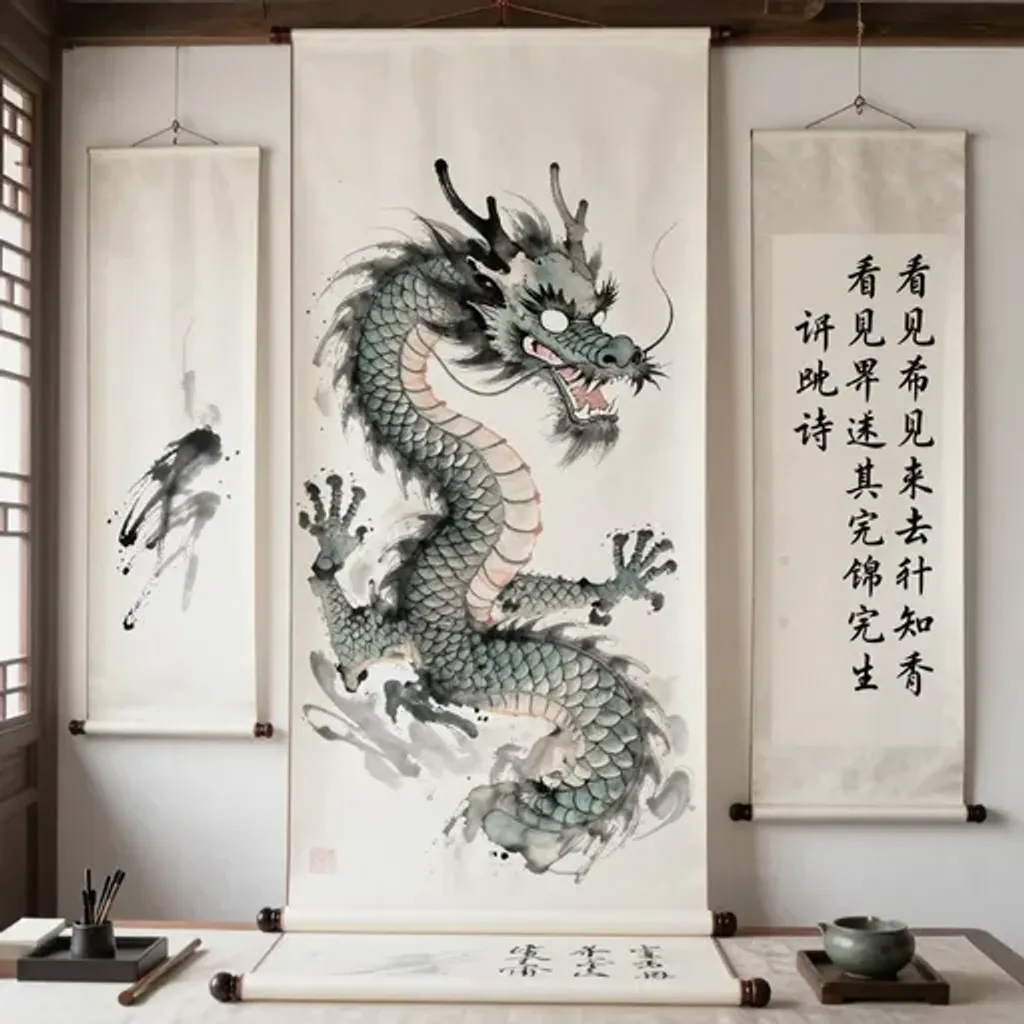
畫龍未點睛,詩成缺末句。風吹墨跡散,紙上空留痕。
The dragon is painted but the eye is not dotted; the poem is complete but missing its final line. Wind scatters the wet ink — only smudges remain on the paper.
Read full commentary ↓
Wind over water, returning to itself — Dispersion into Dispersion. The original verse captures incompletion at every level: the hoped-for audience never arrives, the literary work remains unfinished. A prince chases a rabbit, but his dog stumbles and the prey escapes. Each image is of effort that falls just short, the final stroke never delivered. Wind over water, dispersing what was already dispersed — the condition is recursive, an endless loop of dissolution. From Dispersion to Dispersion, there is no transformation, no resolution: the dragon painted without its pupils, the poem missing its last line, the ink blown across the page by the very wind that should have dried it. This is the hexagram contemplating its own nature: the permanent condition of things never quite coming together.
中文註釋
風行水上,渙歸渙。此詩有改寫,當據原文:「望幸不到,文章未就。王子逐兔,犬踦不得。」所望之人不至,文章未成——事事差一步。王子追兔,獵犬跛足,獵物逃逸。每一意象皆為功虧一簣:最後一筆永遠落不下。渙之渙,散者再散,遞歸無盡。從渙至渙,無轉化、無解答:龍未點睛,詩缺末句,墨跡被風吹散——而那風正是應該使其乾透的風。此為卦觀照自身:永遠差一步聚攏的常態。
This commentary was written against an earlier reading of the verse. Where the reading has since changed, the interpretation itself may no longer apply.
Jiao Shi Yi Lin 《焦氏易林》, manuscript from the Wenyuan Pavilion Siku Quanshu, Qianlong period, Qing dynasty.
National Palace Museum, accession nos. 故庫017987–017990
Fascicle 4, page 153
Read from the manuscript leaf
Shown unpunctuated, as in the manuscript.
About this reading
Read from the scanned leaf.
Related Hexagrams
Same upper trigram: Wind (巽)
Same lower trigram: Water (坎)