Upper Trigram
兌 Duì
Lake — Joyous
Lower Trigram
兌 Duì
Lake — Joyous
Classical Texts
The Goal
Dui is not pleasure. It is the joy that arises from genuine exchange between equals — the mutual enrichment when inner substance meets its complement and both are enlarged. The Image gives the picture: 麗澤,兌 — joined lakes, two bodies of water connected so that each replenishes the other. A single lake stagnates or evaporates; connected lakes hold. The judgment is spare: 亨,利貞 — "success; constancy furthers." Joy without constancy becomes indulgence; constancy without joy becomes grim endurance. The lines sort authentic joy from its counterfeits by a single test — which direction it moves. 初九 gives 和兌,吉 — harmonious joy, arising from inner alignment rather than external stimulus. 九二 gives 孚兌,吉,悔亡 — sincere joy, rooted in truthfulness, and remorse vanishes because nothing has been falsified. 六三 gives 來兌,凶 — joy that *comes* — sought, imported, fetched from outside — and it is the only line in the hexagram marked 凶. 九五 warns about the company joy keeps: 孚于剝,有厲, "sincerity toward what strips away; there is danger" — trusting what erodes, 剝 being hexagram 23's dissolution. 九四 is the one that does the work: 商兌未寧,介疾有喜 — "weighing joy, not yet at rest; separating from the affliction, there is gladness." Joy that has to be deliberated is not yet joy, and the resolution comes not from choosing better pleasures but from cutting away the thing that made deliberation necessary. 上六 ends without a verdict: 引兌 — "drawn-out joy," and nothing else. No 吉, no 凶, no 无咎. The hexagram that most concerns itself with judging joy declines to judge the last one, and the silence reads as its own comment on pleasure extended past its moment. The goal of Dui is communion — exchange that strengthens everyone in it without depleting anyone. The Image names the method: 君子以朋友講習 — "the superior person joins with friends in discussion and practice." Connected lakes are the image; mutual study is the mechanism. Two people explaining what they know to each other end with more than either brought. Joy here is not a reward for achievement but the ordinary condition of truthful exchange between people with something to exchange.
The Judgment
Fulfillment. Sustained orientation is supported. Joy. Fulfillment. Sustained orientation supported. The judgment is simple because genuine joy is simple. Not complicated, not conditional, not dependent on circumstances. The joyous hexagram doesn't explain happiness. It just says: this is what it looks like when the configuration supports it. Sustained orientation — because joy without depth is just mood.
The Image
Joined lakes: the joyous. The realized person accordingly joins with friends for discussion and practice. Two lakes connected — each replenishing the other. And the instruction is: join with friends. Discuss. Practice. Because joy that isn't shared evaporates like a single lake. Joy that's connected — lake to lake, person to person — sustains itself. The realized person doesn't practice joy alone. That's not joy. That's an exercise.
The Lines
Line 1
Harmonious joy. Resolves well. Harmony. Joy. Resolves well. The simplest line in the joyous hexagram — joy that needs nothing, demands nothing, depends on nothing external. The first line: the joy that arises from inner harmony is the only kind that comes with a clean verdict. No conditions, no warnings. Just: this. This is the real thing.
Line 2
Sincere joy. Resolves well. Deviation detected dissolves. Joy rooted in sincerity. Resolves well. Whatever was off-course disappears. The second line: when joy comes from what's true rather than what's pleasant, it has the side effect of correcting everything around it. The deviation dissolves not because you addressed it directly. Because genuine joy is incompatible with falseness. They can't coexist.
Line 3
Approaching joy. Adverse. Joy coming from outside. Adverse. Two characters that diagnose an entire way of living: the person who waits for joy to arrive has confused happiness with delivery. The third line: joy that approaches you — that you don't generate internally — is the kind that takes more than it gives. The emptiness that attracted it is the emptiness it fills temporarily and deepens permanently.
Line 4
Deliberated joy is not yet at peace. Setting aside the urgency brings happiness. Weighing the options. Not at peace yet. But setting aside the anxious calculation: happiness. The fourth line describes the person who's deciding between pleasures and can't enjoy any of them. The fix isn't choosing better. It's stopping the deliberation. The person who sets down the comparison and just allows the joy to land has discovered that analysis and happiness operate on different circuits.
Line 5
Trusting in what disintegrates. There is danger. Placing your trust in the thing that's falling apart. Danger. The fifth line of the joyous hexagram, and the warning is specific: the source of your joy is decaying. You can see it. And you're trusting it anyway. Because the pleasure is still present even as the foundation is leaving. The person who clings to a disintegrating joy isn't optimistic. They're in danger.
Line 6
Led into joy. Led. Not leading, not choosing — led. Into joy. No verdict. The top of the joyous hexagram and the final image is someone who has given up direction entirely. The joy isn't chosen. It isn't resisted. It isn't evaluated. It's just... followed. The text leaves the verdict blank because at this point, what happens depends entirely on what's doing the leading. And the text can't tell you that.
Yilin: Forest of Changes
From Jiao Yanshou's Forest of Changes (焦氏易林) — the verse for Hexagram 58 in its unchanging form. A Han dynasty collection of four-character verses interpreting every hexagram transformation.
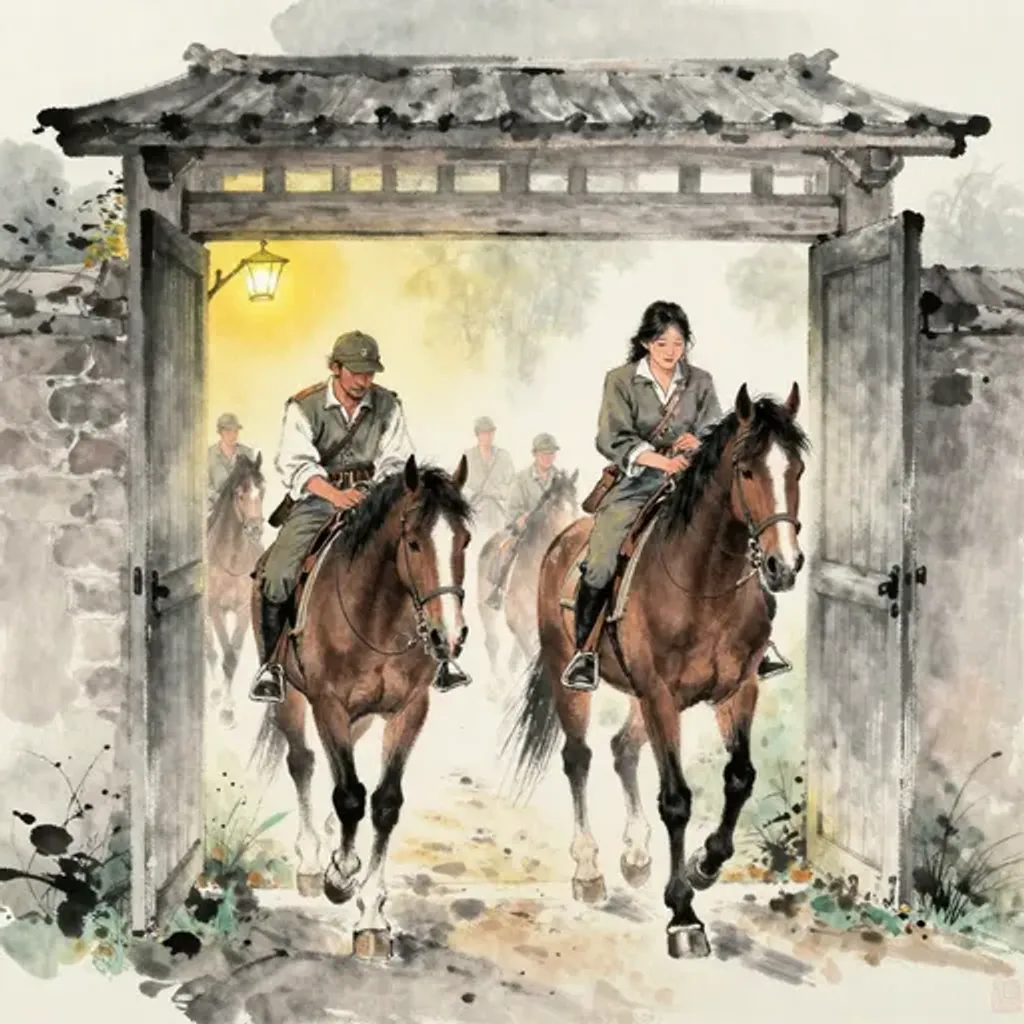
班馬還師以息勞疲役夫嘉言入戶見妻
The dappled horses return with the army, resting from their weary toil. The husband who lagged behind rejoices, entering the door to see his wife.
Read full commentary ↓
Paired lakes mirror each other in perfect symmetry — The Joyous reflecting itself. The army's spotted horses return from campaign to rest their weary bones. Afterward, a husband comes home with joy, entering the door to see his wife. The phrase 'ban ma' (spotted horses) echoes the Shijing where returning warhorses signify the end of a campaign. From The Joyous to The Joyous, the transformation is identity: joy deepened by recognition. Friends lecture and practice together — the hexagram image made flesh. The soldier returns to domestic happiness; the doubled lake produces not excess but resonance. This is joy's purest form: reunion after absence, the familiar face at the threshold.
中文註釋
麗澤兌,朋友講習之象。班馬還師,以息勞疲。後夫嘉喜,入戶見妻。班馬即歸師之戰馬。征人歸來,先息軍旅之勞,後入家門得見妻子,歡喜之至。從兌至兌,喜悅映照喜悅。麗澤之象——兩澤相連,互相滋潤。此為歡悅之純粹形態:離別後之重逢,門前見到熟悉之面容。兌之自返不是重複而是共鳴——如兩湖相映,喜悅加倍。
This commentary was written against an earlier reading of the verse. Where the reading has since changed, the interpretation itself may no longer apply.
Jiao Shi Yi Lin 《焦氏易林》, manuscript from the Wenyuan Pavilion Siku Quanshu, Qianlong period, Qing dynasty.
National Palace Museum, accession nos. 故庫017987–017990
Fascicle 4, page 142
Read from the manuscript leaf
Shown unpunctuated, as in the manuscript.
About this reading
Read from the scanned leaf.
Related Hexagrams
Same upper trigram: Lake (兌)
Same lower trigram: Lake (兌)