Upper Trigram
坤 Kūn
Earth — Receptive
Lower Trigram
兌 Duì
Lake — Joyous
Classical Texts
The Goal
Lin is not simply drawing near — it is the specific dynamic of authority approaching what it will govern. The hexagram places Earth (Kun) above Lake (Dui): vast receptive capacity over joy and openness. The two yang lines at the bottom are advancing upward into a field of yin, and the image is one of growing influence — a rising tide, a ruler entering the territory of the people. This is power in its phase of expansion, still welcome, not yet oppressive. The judgment carries the four characters 元亨利貞, which the Tuan reads as 大亨以正 — great success through correctness, not regardless of it. It then attaches a warning: 至于八月有凶 — "when the eighth month comes, there is misfortune." The Tuan explains it in three words, 消不久也: the waning is not far off. This is the hexagram's structural key. Approach is a phase, and its reversal is already scheduled. Power that treats its present expansion as permanent will be undone by the same rhythm that raised it. The Image gives the work that fits the phase: 澤上有地,臨;君子以教思無窮,容保民無疆 — "above the lake is the earth: Approach. The superior person teaches without limit, and protects and sustains the people without bound." 無窮 and 無疆 mark the one thing here that is not finite. The season of influence closes on schedule; the teaching and the care put into it do not. The goal of Lin is therefore not to maximize the approach but to spend it well. The two yang lines are growing, but four yin lines still dominate the structure. Authority that rushes to fill every space, mistaking early momentum for a permanent mandate, violates the hexagram's teaching. Approach with joy and generosity, remain aware that the season has a natural limit, and use it to establish what will outlast the retreat.
The Judgment
Supreme fulfillment. Sustained orientation is supported. Arriving at the eighth month: adverse. Approach. Everything opens up — supreme fulfillment, full support. And then: by the eighth month, adverse. The most important sentence in the judgment is the deadline. Spring approaches now, and the text is already telling you about autumn. Every expansion contains the date of its contraction. The configuration doesn't want you surprised when the turn comes.
The Image
The lake with earth above: approach. The realized person accordingly teaches with inexhaustible thought and protects the people without limit. Earth over the lake — reaching down to what's below. The realized person teaches without running out and protects without boundaries. Approach isn't a moment. It's an orientation that doesn't stop being generous. The limit on protection is: there is no limit.
The Lines
Line 1
Joint approach. Sustained orientation resolves well. Approaching together. Resolves well. The first line of the approach hexagram and the instruction is: don't do it alone. Joint. Shared. The commitment that resolves well at the beginning is the collective kind. Solo approach might work later. Right now the configuration wants company.
Line 2
Joint approach. Resolves well. Nothing that isn't supported. Same instruction as line one, stronger verdict. Resolves well, everything supported. When the joint approach reaches the second position, the support becomes unconditional. Nothing excluded. The text is practically shouting: together. Still together. This is working.
Line 3
Comfortable approach. No direction is supported. Once one worries about it: no fault. The easy approach. Nothing supported. The approach got comfortable and the configuration withdrew its support. But — once you worry about that? No fault. The worry is the correction. Comfort in approach is the disease; anxiety about comfort is the cure. The text hands you the diagnosis and the prescription in the same line.
Line 4
Complete approach. No fault. Fully committed approach. No fault. The fourth position, visible and consequential, and the instruction is total commitment. Not hedged, not cautious — complete. At this point in the approach, holding back is the error and going all in is blameless.
Line 5
Wise approach. Appropriate for a great leader. Resolves well. Approach with knowledge. This is how the great leader does it. Fifth line, maximum influence, and the quality that resolves well isn't power or generosity — it's knowing. The wise approach. The leader who understands what they're approaching is the one the configuration trusts.
Line 6
Authentic approach. Resolves well. No fault. Honest, genuine approach. The top of the hexagram and the last form of approach is the real one. Resolves well, no fault. After joint, comfortable, complete, and wise — the sequence ends at authentic. Every other kind of approach was preparation for this one. The genuine article, at the limit.
Yilin: Forest of Changes
From Jiao Yanshou's Forest of Changes (焦氏易林) — the verse for Hexagram 19 in its unchanging form. A Han dynasty collection of four-character verses interpreting every hexagram transformation.
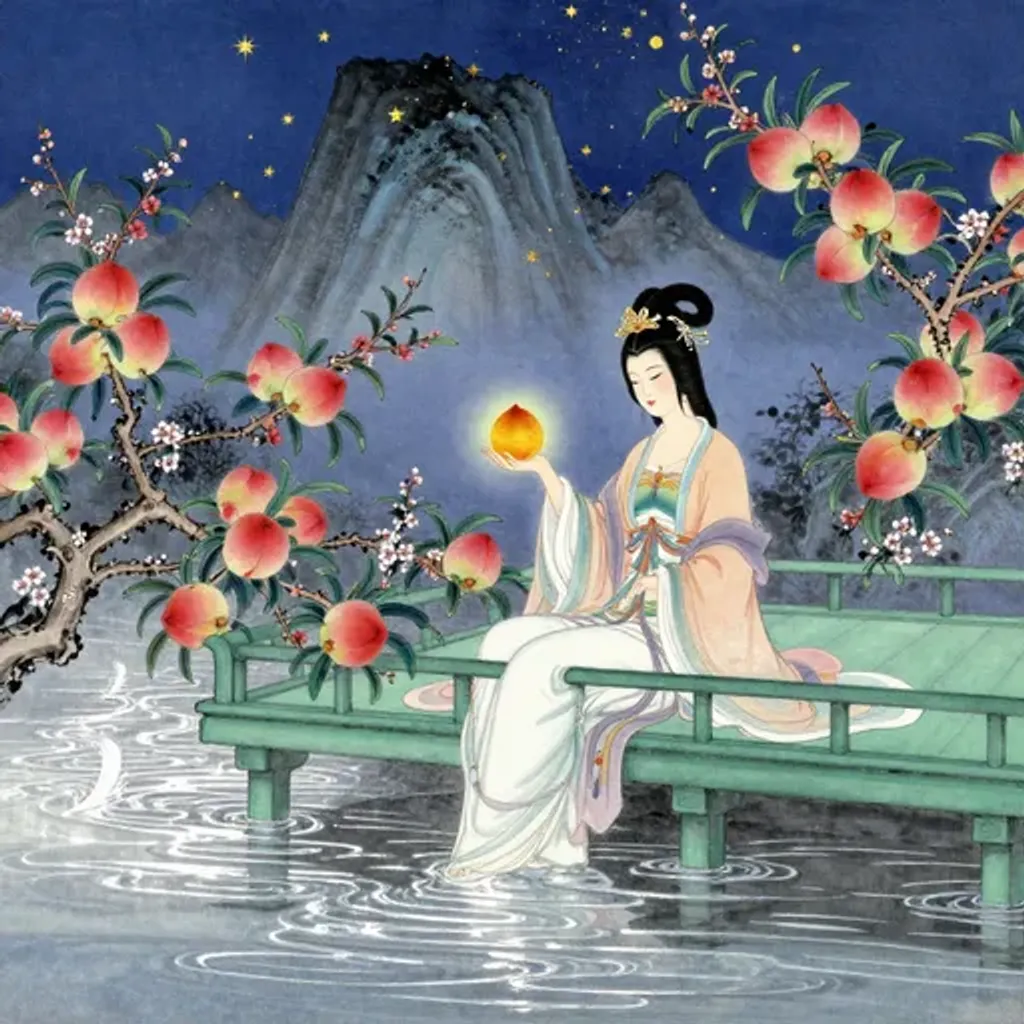
弱水之西有西王母生不知老與天相保行者危怠利居善喜
Above the Weak Water dwells the Queen Mother of the West; born without knowing old age, she endures alongside heaven. The traveler is weary and endangered -- better to stay and find contentment.
Read full commentary ↓
Earth above the lake doubled — Approach meeting itself. Above the Weak Water dwells the Queen Mother of the West, who knows neither aging nor death, preserved eternally alongside Heaven. Yet the verse pivots: travelers face danger and exhaustion, while those who remain in place find benefit and joy. With Approach redoubled, the oracle counsels that true sovereignty lies not in restless expansion but in cultivating what is already near. The Queen Mother's immortality at the world's edge teaches that the deepest power resides in stillness, not pursuit. The Weak Water cannot be crossed — not as obstacle but as wisdom of natural limits. Those who know when to stop find what endures.
中文註釋
澤上有地,臨卦重疊,臨之又臨。弱水之上,有西王母——居世界盡頭之弱水畔,西王母端坐其間。生不知老——不知衰老為何物;與天相保——與天同壽。行者危怠——行旅者疲危不安;利居善喜——安居者得利而歡喜。臨卦自變,示真正之臨在不在無休之遠征,而在深耕眼前。西王母居弱水之畔而得永生——弱水不可渡,非阻隔也,乃界限之智慧。知止者方得長久,知足者方有所獲。
Jiao Shi Yi Lin 《焦氏易林》, manuscript from the Wenyuan Pavilion Siku Quanshu, Qianlong period, Qing dynasty.
National Palace Museum, accession nos. 故庫017987–017990
Fascicle 1, page 194
Read from the manuscript leaf
Shown unpunctuated, as in the manuscript.
About this reading
Read from the scanned leaf.
Related Hexagrams
Same upper trigram: Earth (坤)
Same lower trigram: Lake (兌)