Upper Trigram
乾 Qián
Heaven — Creative
Lower Trigram
兌 Duì
Lake — Joyous
Classical Texts
The Goal
Lü 履 (Treading) is not about danger — it is about conduct in the presence of overwhelming power. The hexagram shows Heaven (Qian) above Lake (Dui): the strongest trigram above the most yielding, the joyous and open walking beneath the creative and forceful. The famous image — 履虎尾,不咥人 — "treading on the tiger's tail without being bitten" — is not a story about luck. It is about the specific behavior that allows the weak to move through the territory of the strong without triggering destruction. The tiger does not bite because the treading is done correctly, not because the tiger is tame. The Image text reveals the hexagram's structural purpose: 上天下澤,履;君子以辯上下,定民志 — "heaven above, lake below: treading. The superior person distinguishes high and low and thereby settles the will of the people." Lu is fundamentally about the recognition and proper navigation of hierarchy. The lake does not pretend to be heaven; heaven does not need to prove it is above the lake. When these distinctions are clear, movement becomes possible precisely because positions are understood. The third line shows what happens when this clarity is absent: 眇能視,跛能履,履虎尾,咥人凶 — "the one-eyed claims to see, the lame claims to walk; treading on the tiger's tail, it bites." Those who overestimate their position and approach power without adequate awareness are destroyed. Lu's goal is the calibration of conduct to circumstance — knowing exactly where you stand in relation to greater forces and behaving accordingly. This is not servility. The fourth line proves it: 履虎尾,愬愬終吉 — treading on the tiger's tail with caution ultimately leads to good fortune. You still walk in dangerous territory. You still step on the tiger's tail. But awareness of the risk, combined with appropriate conduct, transforms the encounter from fatal to fortunate. Lu regulates the relationship between the individual and the powers that exceed the individual, teaching that proper comportment is itself a form of strength.
The Judgment
Treading on the tiger's tail. It does not bite. Fulfillment. You're stepping on a tiger's tail. It doesn't bite. That's the whole judgment. Not 'be careful around the tiger' — you're already on the tail. Fulfillment. The configuration isn't about avoiding danger. It's about conducting yourself so well inside the danger that the danger doesn't activate.
The Image
Heaven above, the lake below: treading. The realized person accordingly distinguishes high and low, and steadies the people's resolve. Heaven above, lake below — each in its place. That's treading: knowing what goes where. The job is to make the distinctions clear so everyone knows where they stand. Not flatten the hierarchy. Clarify it. Because a tiger you can see is a tiger you can walk past.
The Lines
Line 1
Simple, plain treading forward. No fault. Just walk. Nothing fancy, nothing clever — plain steps forward. No fault. The first line of the tiger hexagram and the move that works is the most boring one imaginable. No special technique. No strategy for tigers. Just walk simply. The person with no pretense doesn't trigger the bite.
Line 2
Treading a level, smooth path. The solitary one's sustained orientation resolves well. Flat road, easy walking. And the person it favors is the hermit. Not the leader, not the warrior — the quiet solitary one who keeps their head down. In a hexagram about stepping on tigers, the safest position belongs to the person nobody notices.
Line 3
The one-eyed can still see. The lame can still walk. Treading on the tiger's tail — bitten. Adverse. The warrior acts for the great leader. You can barely see. You can barely walk. And you step on the tiger anyway. It bites. Of course it bites. The line is almost exasperated — one working eye, a limp, and you picked a fight with a tiger? The warrior doing this for the great leader isn't brave. He's the expendable one. Adverse is what happens when confidence exceeds capacity.
Line 4
Treading on the tiger's tail. Cautious, cautious — in the end, resolves well. Same tiger. Same tail. Completely different outcome. The word for caution appears twice — the text is stuttering with carefulness. And it works. Same danger as line three, but the person trembling with awareness walks through and the one who charged in got eaten. Fear, it turns out, is the correct equipment.
Line 5
Decisive treading. Sustained orientation: strained. Decisive steps. Sounds great, right? Strained. Maximum visibility, maximum influence, and decisiveness itself is under strain. In the tiger hexagram, the thing that looks like strength is actually the problem. The tiger doesn't bite the trembling person in line four. It notices the decisive one. Confidence here has a cost the book won't let you ignore.
Line 6
Looking back at one's steps, examining the signs. When they come full circle: supremely favorable. At the top, you stop and look back at every step you took. All of them. And if the pattern is complete — if it all comes full circle — supremely favorable. The last line of the tiger hexagram isn't about the tiger at all. It's about the review. The walk is over. Did the whole thing make sense? When it does: the best verdict the book can give.
Yilin: Forest of Changes
From Jiao Yanshou's Forest of Changes (焦氏易林) — the verse for Hexagram 10 in its unchanging form. A Han dynasty collection of four-character verses interpreting every hexagram transformation.
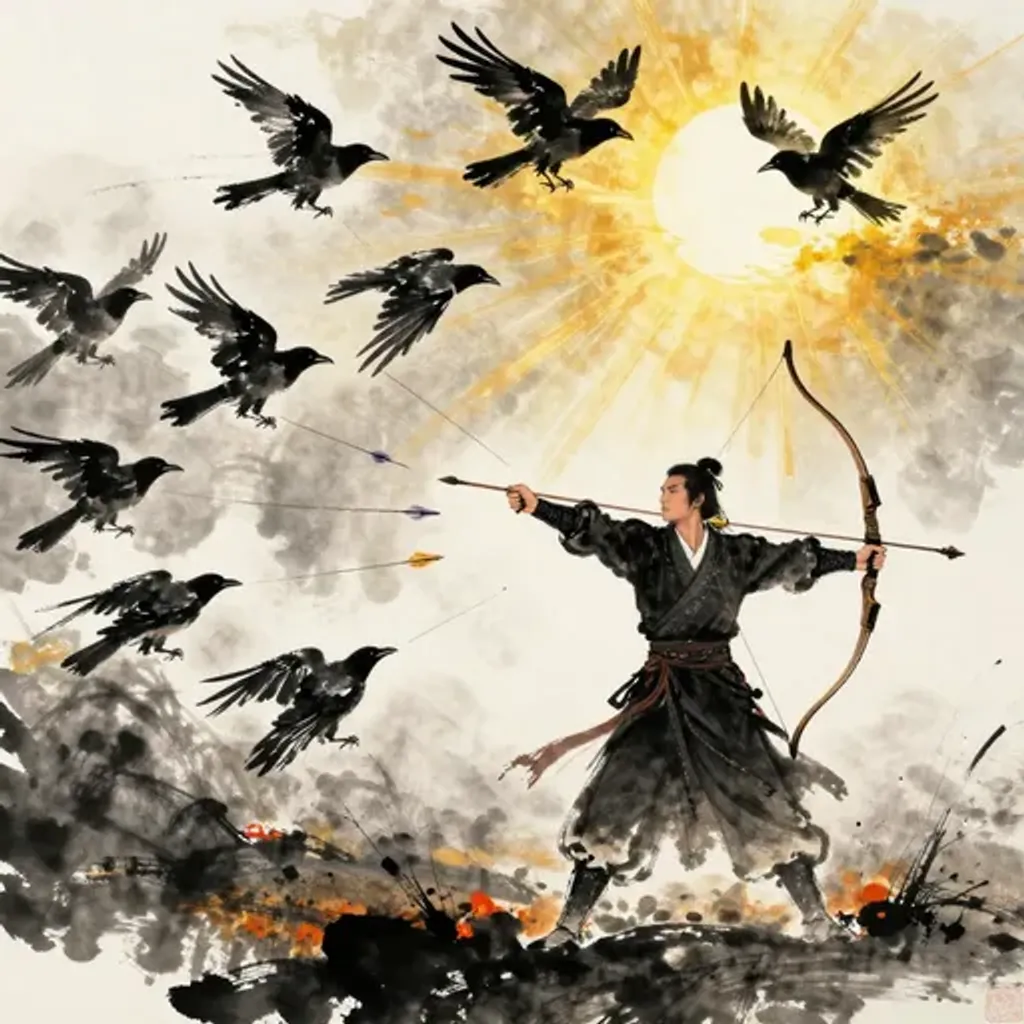
十鳥俱飛羿射九雌雄得獨全雖驚不危
Ten crows fly together; Yi shoots down nine hens. Though what is gained is kept whole; there is a fright, but no real danger.
Read full commentary ↓
Treading upon itself — the hexagram doubled. Ten sun-crows fly together, and Archer Yi brings down nine, but takes only the females. Though the world survives intact, the fright was real. This directly invokes the myth of Hou Yi shooting down the nine surplus suns that were scorching the earth, leaving one to light the world. Yet the detail of 'nine females' is curious — perhaps distinguishing the docile from the dangerous, or counting only what was safely captured. From Treading to Treading, the pattern is self-referential: peril managed through precise conduct, danger averted but not forgotten. The tiger's tail was touched; the tiger did not bite.
中文註釋
履之本卦,象重疊。十日並出,羿射得九,皆取其雌。雖得保全,驚而未危。此即后羿射日之神話:十烏(十日)同飛,灼燒天下,羿射落其九,留一以照世間。「九雌」之說或為區分柔順與兇猛,或僅記所獲之數。從履至履,自我映照之象:險境以精準之行止化解,危難已過然餘悸猶在。虎尾已踩,虎未噬人——此即履卦「履虎尾,不咥人」之本義。
Jiao Shi Yi Lin 《焦氏易林》, manuscript from the Wenyuan Pavilion Siku Quanshu, Qianlong period, Qing dynasty.
National Palace Museum, accession nos. 故庫017987–017990
Fascicle 1, page 106
Read from the manuscript leaf
Shown unpunctuated, as in the manuscript.
About this reading
Read from the scanned leaf.
Related Hexagrams
Same upper trigram: Heaven (乾)
Same lower trigram: Lake (兌)