
Upper Trigram
乾 Qián
Heaven — Creative
Lower Trigram
坎 Kǎn
Water — Abysmal
Classical Texts
The Goal
Song is not battle. It concerns the kind of conflict that arises when two forces move in contrary directions and cannot reach resolution by continuing along their existing paths. The hexagram shows Heaven above Water: heaven rises, water descends, and their movements diverge. This is not a clash of armies but a conflict of trajectories—the kind that emerges when each side trusts its own position, yet their directions remain fundamentally incompatible. The character 訟 carries the speech radical 言, pointing to litigation and argument rather than warfare: conflict conducted through claims and counterclaims, through competing appeals to what is right. The judgment delivers one of the most precisely calibrated warnings in the I-Ching: 有孚窒惕,中吉,終凶—"there is sincerity, but it is obstructed; remain cautious. Holding to the middle is auspicious; pursuing the matter to its end is disastrous." The text recognizes that the person entering the dispute may be sincere and may possess a legitimate claim. But sincerity does not guarantee complete understanding, and being justified does not make relentless pursuit wise. The crucial instruction is 中吉: remain within measure. Stop before the conflict reaches its final extreme. Accept an incomplete settlement rather than demand total vindication. The Image reinforces this by directing attention to origins: 君子以作事謀始—"the superior person, when undertaking affairs, plans at the beginning." Conflict is best prevented or contained at the point where an undertaking is first structured, before ambiguities harden into opposing positions. The upper line then reveals the instability of victory itself: even if one is awarded the ceremonial belt, it may be stripped away three times within a single morning. A triumph won through contention does not produce secure possession. Song's purpose is therefore not to eliminate all disagreement, but to recognize the limits of adversarial resolution. When heaven and water move in contrary directions, forcing one side to prevail may only deepen the division. 利見大人—"it is favorable to see the great person"—points toward an impartial and authoritative figure capable of judging what those inside the dispute cannot see clearly. 不利涉大川—"it is not favorable to cross the great water"—because dangerous undertakings require unified purpose, while internal contention fractures precisely the concentration on which survival depends.
The Judgment
Sincerity present, yet obstructed. Vigilance. In the middle: resolves well. At the end: adverse. The situation affords meeting the realized person. Crossing the great river is not supported. You're right, and it's going to cost you. The middle of this conflict resolves well — that's the part where you could still walk away. The end? Adverse. Two separate verdicts for two separate moments. The text is practically drawing you a map with an exit marked on it.
The Image
Heaven and water move in opposition: conflict. The realized person accordingly plans carefully at the start of any undertaking. Heaven goes one way, water goes the other. Both correct. Completely incompatible. The realized person's takeaway? Think harder at the beginning. Because once two legitimate forces are moving in opposite directions, there's no clever move in the middle that fixes it.
The Lines
Line 1
Do not prolong the affair. Some talk. In the end, resolves well. Drop it. Whatever this is, don't extend it. There will be talk — there's always talk — but the ending is favorable. You know what the hardest move in a conflict is? The one where you stop. Everything in you wants the last word. The last word is what turns 'resolves well' into something else.
Line 2
Cannot prevail in the conflict. Returns and retreats to one's village of three hundred households. No calamity. You lost. You went home. Three hundred households — not nobody, but not the capital either. Here's the thing: no calamity. The person who loses the fight and goes home to a small life is not described as unfortunate. They're described as undamaged. There's a version of losing that the configuration respects.
Line 3
Sustained by long-standing virtues. Sustained orientation. Strained, but in the end resolves well. Perhaps attending to the sovereign's affairs. No personal achievement. You're living off what you built before. Not building new — subsisting on old capital. It's strained. Resolves well anyway, but only because the foundation was already there. If the sovereign calls, you go. You won't get credit. You already knew that.
Line 4
Cannot prevail in the conflict. Returns to face a higher calling. Changes to settled orientation. Resolves well. You lost the fight. Again. But this time instead of going home, you found something better to do. The key word is 'changes' — not surrender, a pivot. The person who loses a conflict and discovers a calling has done something the winner hasn't.
Line 5
The conflict. Supremely favorable. Two words. The conflict itself, at this position, is supremely favorable. Not 'despite the conflict' — the conflict. Sometimes the dispute is the point. The fifth line is where things become visible, and sometimes what needs to be visible is the disagreement itself.
Line 6
Perhaps awarded the champion's belt. By morning's end, stripped of it three times. You won. They gave you the belt. By morning they'd taken it back three times. The top of the conflict hexagram and the final image is a trophy you can't keep. You know what's worse than losing? Winning something that won't stay won. At least the loser in line two got to keep his village.
Yilin: Forest of Changes
From Jiao Yanshou's Forest of Changes (焦氏易林) — the verse for Hexagram 6 in its unchanging form. A Han dynasty collection of four-character verses interpreting every hexagram transformation.
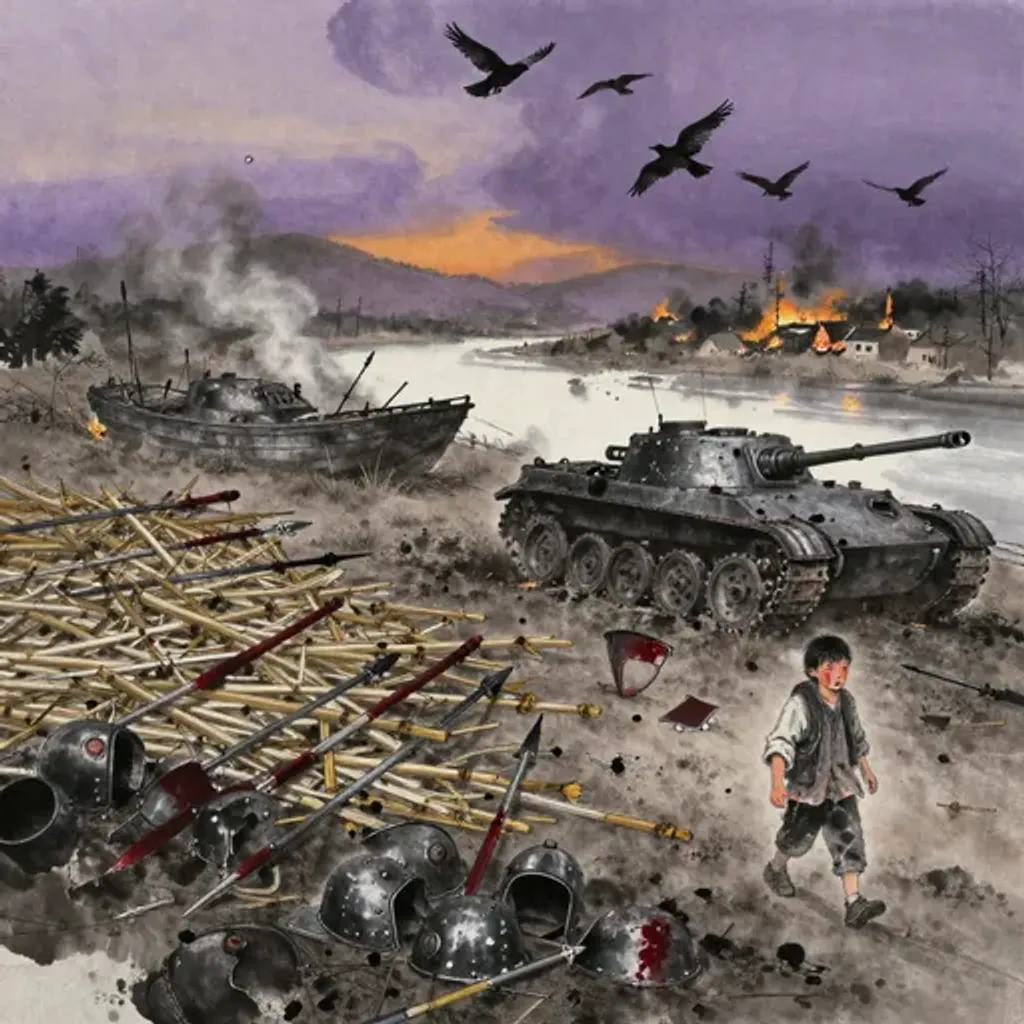
文巧俗弊將反大質僵死如麻流血漂杵皆知其母不識其父干戈乃止
Artifice corrupts customs, about to return to plain substance. The dead lie stiff like hemp; flowing blood soaks the oar-shields. All know their mothers, none know their fathers; only then do arms cease.
Read full commentary ↓
Conflict doubled upon itself: heaven and water oppose, and the opposition feeds on its own energy. Cunning artifice corrupts custom until society reverts to raw essence. Corpses lie stiff as hemp stalks; blood soaks the war-tower shields. The imagery echoes Jia Yi's 'On the Faults of Qin': people know their mothers but not their fathers — the ultimate breakdown of social bonds. Yet the verse ends abruptly: weapons and shields are laid down. From Conflict to Conflict, there is no transformation, no escape valve. The same pattern redoubles. The verse warns that when strife becomes self-perpetuating, it consumes everything until exhaustion forces a halt — not resolution, but collapse.
中文註釋
訟之重卦,天與水違行之勢自我強化,無可轉化,無可脫逃。文巧之術敗壞風俗,終將回歸大質。僵屍如麻,血流濡櫓——戰場之慘烈極矣。此景呼應賈誼《過秦論》所述社會崩壞——「皆知其母,不識其父」,人倫瓦解至極,父子不相識認。然詩末驟然收束:干戈乃止。從訟至訟,無所變化,無出路可尋。同一對立模式層層疊加。詩警示:紛爭若成自我循環,終將吞噬一切,直至力竭而止——非和解,乃崩潰。
Jiao Shi Yi Lin 《焦氏易林》, manuscript from the Wenyuan Pavilion Siku Quanshu, Qianlong period, Qing dynasty.
National Palace Museum, accession nos. 故庫017987–017990
Fascicle 1, page 64
Read from the manuscript leaf
Shown unpunctuated, as in the manuscript.
About this reading
Read from the scanned leaf.
Related Hexagrams
Same upper trigram: Heaven (乾)
Same lower trigram: Water (坎)