Upper Trigram
乾 Qián
Heaven — Creative
Lower Trigram
坤 Kūn
Earth — Receptive
Classical Texts
The Goal
Pi is not bad luck. It is the structural condition in which communication between upper and lower has ceased — the particular stagnation that occurs when heaven and earth move apart. The hexagram shows Heaven above Earth, an arrangement that appears correct but functions in precisely the wrong way: heaven rises, earth descends, and the distance between them increases. Their energies do not meet; nothing passes between them. This is the inverse of Tai. The I-Ching places the two together to show that communion and separation are alternating conditions within the same cycle, each requiring a different form of conscious response. The judgment — 否之匪人,不利君子貞,大往小來 — may be read: "in standstill, human order fails; the superior person's constancy finds no advantage; the great departs, the small approaches." The tide is the reverse of Tai: what is great, life-giving, and capable of connection withdraws, while what is narrow and diminishing advances. But 不利君子貞 does not command the superior person to abandon integrity. It means that integrity cannot be effectively advanced through the normal channels, because those channels no longer transmit it. One must preserve the right without insisting that a disordered structure recognize or reward it. The Image makes the appropriate response explicit: 天地不交,否;君子以儉德辟難,不可榮以祿 — "heaven and earth do not communicate: Standstill. The superior person restrains the display of virtue to avoid danger and does not seek honor through official reward." During standstill, one does not lend legitimacy to a deteriorating order by accepting the honors it offers. Withdrawal is not moral surrender. It is refusal to let one's integrity become an ornament of the system that has made integrity powerless. The fifth line shows the beginning of recovery: 休否,大人吉。其亡其亡,繫于苞桑 — "standstill is brought to rest; good fortune for the great person. 'It may perish, it may perish' — bound to a cluster of mulberry." The person capable of arresting decline must remain intensely aware that recovery can still be lost. The repeated warning prevents early success from becoming complacency; the mulberry supplies an image of fastening what has been regained to something firmly rooted. Pi's purpose is therefore the preservation of integrity during separation. It teaches how to live when institutions no longer connect high and low, principle and power, word and response. Retreat under such conditions is not necessarily defeat. It may be the strategic conservation of what must not be corrupted — the keeping of seeds through winter so that, when communication becomes possible again, something remains worth planting.
The Judgment
Of inferior people. Not supporting the noble one's sustained orientation. The great departs, the small arrives. Peace in reverse. The great is leaving, the small is arriving. The direction of traffic flipped. And the sustained commitment of the noble person? Not supported. The configuration doesn't just block you — it specifically blocks the people who care. The ones who don't care are doing fine.
The Image
Heaven and earth do not interact: standstill. The realized person accordingly conserves character to avoid difficulty, not accepting honors or payment. Heaven and earth have stopped talking to each other. That's stagnation — not destruction, just silence between the things that are supposed to be in contact. The realized person's move? Pull inward. Don't take the money. When the system is broken, the person who accepts its rewards has just endorsed the break.
The Lines
Line 1
Pulling up thatch grass, it comes with its kind by the roots. Sustained orientation resolves well. Fulfillment. Same grass image as the peace hexagram, completely different instruction. There you advanced. Here you retreat — and bring your people with you. The roots are still connected. In stagnation, the cluster that comes up together is the one heading for safety. Resolves well. The fulfillment is in the withdrawal.
Line 2
Embracing and serving. The lesser person: resolves well. The great person in standstill: fulfillment. Two different people, two different verdicts. The small person accepting servitude? Fine. The great person accepting stagnation? Also fine — but for completely different reasons. The small person adapts because they don't see the problem. The great person endures because they see it clearly. Both survive. Only one understands why.
Line 3
Embracing shame. Two characters. No verdict. Just: holding the disgrace. The shortest line in the hexagram and there's nothing to add. When the people who shouldn't be in charge are in charge, the people who should be are holding shame. The text doesn't explain this. It just names it.
Line 4
Having a higher calling. No fault. Those of like kind share in the blessing. A mandate arrives. No fault, and the people aligned with you share the benefit. This is the turn in the stagnation hexagram — the fourth line, where something shifts. Not the stagnation ending. A purpose appearing inside it. The calling doesn't fix the situation. It gives you something to do while it lasts.
Line 5
Standstill ceases. The great person: resolves well. 'What if it fails? What if it fails?' — secured to a cluster of mulberry shoots. The stagnation breaks. And the great person's response isn't confidence — it's 'what if it fails?' Twice. Tied to the mulberry shoots like they might blow away. This is what real leadership sounds like at the end of stagnation: not triumph, but the anxious awareness that what just opened can close again. The worry is the competence.
Line 6
Standstill overturned. First standstill, then joy. It's over. Standstill becomes its opposite. First the block, then the breakthrough. The top of the stagnation hexagram is pure reversal — the whole thing tips. No complicated instruction, no nuance. Just: what was frozen melts. The text has been building to this for six lines and when it arrives, it only needs six characters.
Yilin: Forest of Changes
From Jiao Yanshou's Forest of Changes (焦氏易林) — the verse for Hexagram 12 in its unchanging form. A Han dynasty collection of four-character verses interpreting every hexagram transformation.
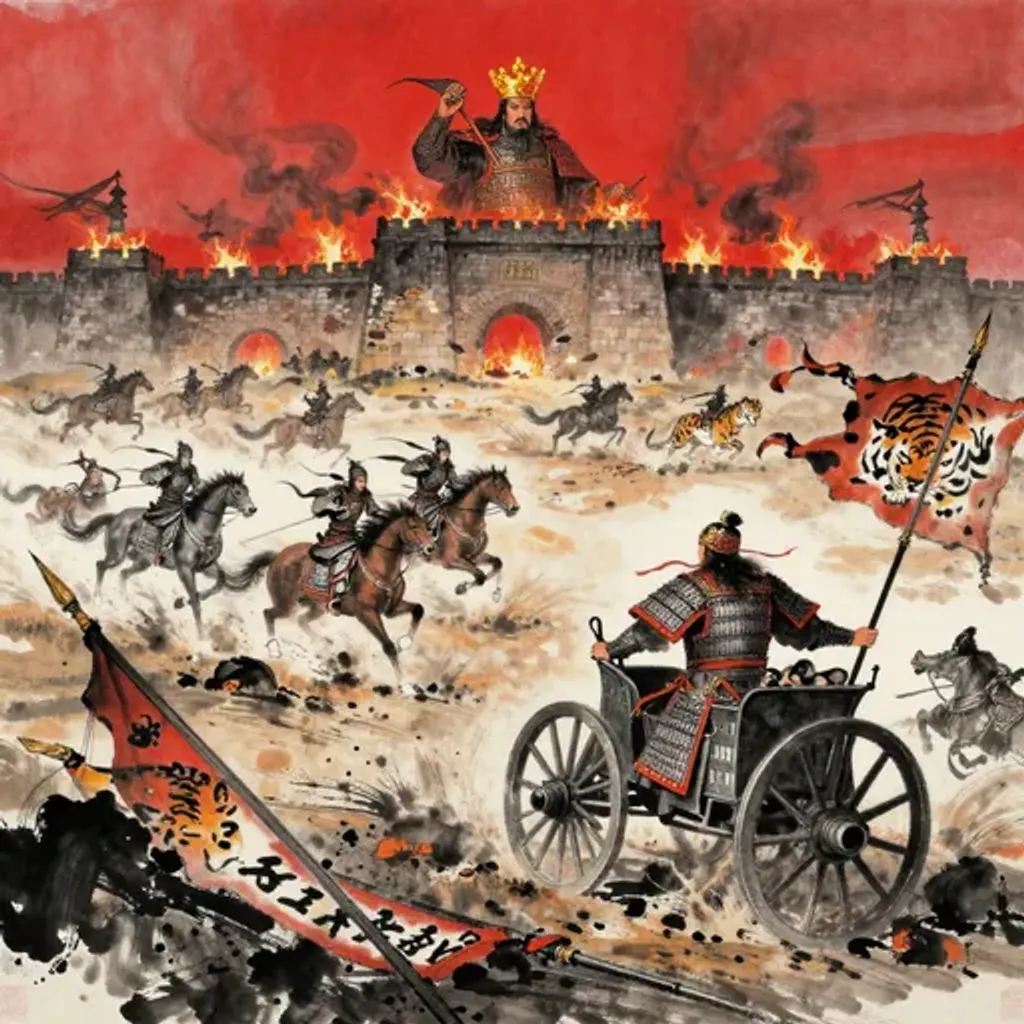
秦為狼虎與晉爭強并吞其國號曰始皇
Qin was as wolf and tiger, contending with Jin for supremacy. Swallowing and annexing its states, it proclaimed itself First Emperor.
Read full commentary ↓
Heaven and earth stand apart, and Standstill meets its own image — Pi doubled. Qin acts as tiger and wolf, contending with the six states for supremacy, swallowing them all and proclaiming its lord the First Emperor. When Standstill encounters itself, the blockage intensifies rather than resolves. Qin's unification was achieved through total non-communication — the destruction of rival voices, the burning of books, the silencing of dissent. The First Emperor's empire is Pi's ultimate expression: heaven and earth sealed so tightly that nothing circulates. The verse captures the terrifying efficiency of doubled stagnation: order imposed by extinguishing all exchange, a peace that is merely the silence of the conquered.
中文註釋
天地不交之否,否遇自身——閉塞加倍。秦為虎狼,與晉(六國)爭強,併吞其國,號曰始皇。否之重否,壅塞更甚。秦之統一以徹底的不溝通達成——滅異聲、焚詩書、禁議論。始皇之帝國乃否之極致:天地封閉至滴水不漏。雙重否塞之可怖效率在此:以消滅一切交流而得秩序,以噤聲被征服者而得太平。然否極必反——過秦之論已在弦外。虎狼之強終不敵否極之變。
This commentary was written against an earlier reading of the verse. Where the reading has since changed, the interpretation itself may no longer apply.
Jiao Shi Yi Lin 《焦氏易林》, manuscript from the Wenyuan Pavilion Siku Quanshu, Qianlong period, Qing dynasty.
National Palace Museum, accession nos. 故庫017987–017990
Fascicle 1, page 125
Read from the manuscript leaf
Shown unpunctuated, as in the manuscript.
About this reading
Read from the scanned leaf.
Related Hexagrams
Same upper trigram: Heaven (乾)
Same lower trigram: Earth (坤)