
Upper Trigram
坤 Kūn
Earth — Receptive
Lower Trigram
坤 Kūn
Earth — Receptive
Classical Texts
The Goal
Kun 坤 (The Receptive) is not passivity. It is the power to sustain, carry, and actualize potential without distortion. Hexagram 1 creates; Hexagram 2 realizes. Without Kun, nothing stabilizes, nothing grows, nothing takes form. Qian without Kun is pure unrealized potential — Kun turns potential into world. The mare metaphor is crucial: 利牝馬之貞 — "favorable is the perseverance of the mare." The mare follows terrain, endures distance, carries weight, navigates collectively. This is adaptive strength, not domination. Receptivity in classical Chinese thought is not emptiness — it is fertile capacity, adaptive intelligence, responsive containment. Earth receives seeds, water, seasons, sunlight and transforms them into life. Kun is transformational through accommodation. The top line warns what happens when this is forgotten: "Dragons fight in the wilderness; their blood black and yellow." When receptivity turns into competitive assertion, when Kun ceases being Kun and attempts to become Qian, balance collapses into catastrophe. The hexagram's goal is not submission — it is becoming a vessel capable of carrying and realizing the mandate of reality without distortion. Perfect alignment with the unfolding of things. Not passive surrender. Responsive completion.
The Judgment
Supreme fulfillment. Sustained orientation of the mare is supported. The noble one has somewhere to go. At first, disorientation; then, finding the way. Mastery is supported. In the southwest, companions found. In the northeast, companions lost. Settled orientation resolves well. The longest judgment in the book and it's for the one who follows. Not because following is easy — because it's so hard to describe well. The mare covers more ground than the stallion. She just doesn't pick where. You'll get lost first. That's not a bug. That's the calibration.
The Image
The earth's capacity: acceptance. The realized person accordingly sustains all things with generous character. Earth holds the cathedral and the strip mall with the same patience. Nobody asked its opinion about either one. That's not weakness. That's the only thing in the world with enough capacity to hold everything without collapsing.
The Lines
Line 1
Treading on frost. Solid ice is coming. Frost. Not ice — frost. And the whole line is just: ice is next. You know what most people do with this information? Nothing. They felt the frost. They know what frost means. They keep walking. The line isn't telling you something you don't know. It's asking if you're going to do anything about it.
Line 2
Straightforward, methodical, expansive. Without rehearsal, nothing that isn't supported. No practice needed. Which sounds like the easiest line in the book until you realize what it's actually saying: if you have to rehearse being direct, you're not being direct. These aren't skills. They're orientations. You either hold them or you fake them, and faking is the one thing the configuration won't carry.
Line 3
Containing one's brilliance allows sustained orientation. Perhaps attending to the sovereign's affairs. No personal achievement, but completion. Here's the deal: you're brilliant and nobody's going to know. The work gets finished. Somebody else gets the credit. And the line says that's not just okay — that's the configuration that holds. You want to know what's harder than being talented? Being talented in a room where the talented person isn't supposed to be the headline.
Line 4
The bag tied shut. No fault, no praise. The sack is closed. Nothing in, nothing out. You had something to say and you didn't say it. You know what the verdict is? Nothing. No fault, no praise. The most aggressively neutral assessment in the entire book. Somewhere in that silence is the sound of a very good decision.
Line 5
A golden-yellow lower garment. Supremely favorable. The highest praise in the entire hexagram goes to an undergarment. Not the crown. Not the sword. The skirt. Supremely favorable — and it's for the thing nobody sees. The people who need to know what you're wearing know. Everyone else can keep guessing.
Line 6
Dragons battle in the wilderness. Their blood runs dark and golden. This is what happens when the receptive forgets it's the receptive and picks a fight with heaven. Both sides bleed. Dark blood, golden blood — both wounded, boundary destroyed. The role was to hold, not to contest. Once that line is crossed there's no version of this that doesn't end with blood on the ground.
Yilin: Forest of Changes
From Jiao Yanshou's Forest of Changes (焦氏易林) — the verse for Hexagram 2 in its unchanging form. A Han dynasty collection of four-character verses interpreting every hexagram transformation.
不風不雨白日皎皎宜出驅馳通利大道
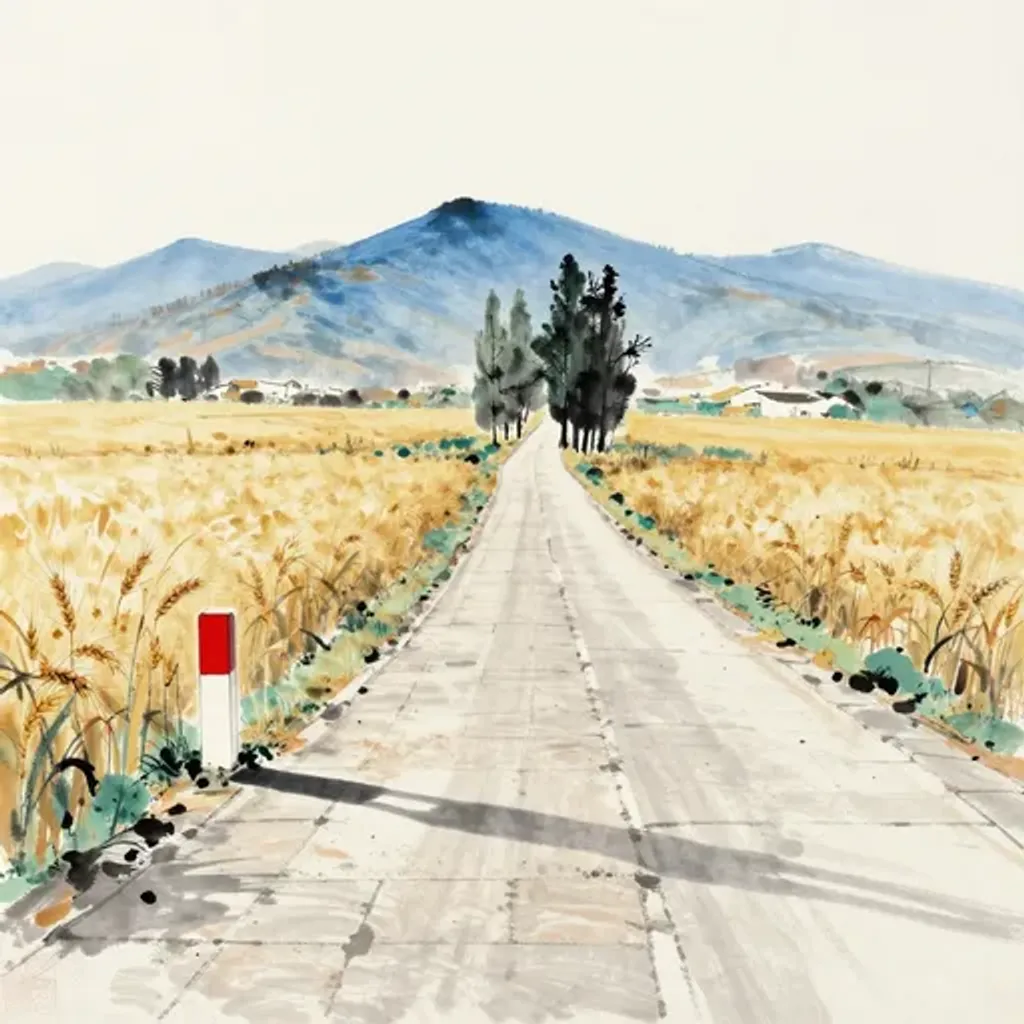
No wind, no rain; the white sun shines bright. Fit to ride forth and gallop; the great road runs clear.
Read full commentary ↓
Earth doubled upon itself: the Receptive remains the Receptive. No wind, no rain — a white sun shining bright. One should venture forth, driving freely along the broad road. When Kun transforms into Kun, no change occurs; the earth's nature simply deepens. The verse paints a day of perfect clarity: the sky withholds both storm and gust, offering unobstructed passage. This is the Receptive at its most generous — the open field, the level plain, the road that runs straight without hindrance. The absence of drama is itself the gift. From Kun to Kun, the message is one of quiet confidence: when the ground beneath is steady, move forward without hesitation. The earth does not need to become anything else to serve the traveler well.
中文註釋
坤之又坤,地勢重疊,純陰不變。不風不雨,白日皎皎——天朗氣清,無風無雨,陽光明亮。宜出驅馳,通利大道——適宜出行,大道暢通。坤至坤,無所變化,唯大地之本性更加深厚。此詩寫安穩順遂之日常:天不作風雨之擾,路不設崎嶇之阻,行者但行便是。坤德在於順承,不事張揚而自然利物。非激昂之辭,而是從容行路之樂。坤不必化為他卦方能成就,厚德本身即是最大之利。
Jiao Shi Yi Lin 《焦氏易林》, manuscript from the Wenyuan Pavilion Siku Quanshu, Qianlong period, Qing dynasty.
National Palace Museum, accession nos. 故庫017987–017990
Fascicle 1, page 25
Read from the manuscript leaf
Shown unpunctuated, as in the manuscript.
About this reading
Read from the scanned leaf.
Related Hexagrams
Same upper trigram: Earth (坤)
Same lower trigram: Earth (坤)