Upper Trigram
離 Lí
Fire — Clinging
Lower Trigram
兌 Duì
Lake — Joyous
Classical Texts
The Goal
Kui is not conflict. It is the structural condition of divergence — things that see differently, move differently, and cannot be forced into agreement. Fire (Li) above Lake (Dui) shows two elements that inherently separate: flames rise, water descends. They share a boundary but do not merge. The judgment says only 小事吉 — "in small matters, good fortune." No 亨, no 利貞. What is available under divergence is small, careful acts of connection; what is not available is a merger. The Tuan refuses to leave it there, and this is the hexagram's real claim: 天地睽而其事同也 — heaven and earth diverge, and their work is the same — closing with 睽之時用大矣哉, the use of the time of divergence is great indeed. So the limitation in 小事吉 is a limitation on the scale of action, not on the significance of the condition. Difference is not a failure of unity. It is how a system does work that uniformity could not do. The Image gives the practice: 上火下澤,睽;君子以同而異 — "fire above, lake below: Divergence. The superior person is together-yet-different." 同而異 is the philosophical centre, and Wang Bi divides it precisely: 同於通理,異於職事 — the same in the principle that runs through everything, different in the work each has to do. Community that does not require sameness. This is not compromise. It is the recognition that opposition is itself a relationship rather than the absence of one. The top line dramatizes what divergence does to perception when it hardens into isolation: 睽孤,見豕負塗,載鬼一車,先張之弧,後說之弧,匪寇婚媾,往遇雨則吉 — "isolated in divergence, one sees a pig covered in mud and a cart full of ghosts; first one draws the bow, then sets it down; not robbers but suitors; going on and meeting rain brings good fortune." The apparitions are produced by the isolation, not by the other party — the line Image (小象) says 群疑亡也, the swarm of doubts disappears. Nothing about the other person changed; the seeing did. The goal of Kui is to hold irreducible difference without either forcing unity or abandoning connection. 初九 gives the method: 喪馬勿逐自復,見惡人无咎 — "the lost horse returns of itself, do not chase it; meeting a repellent person, no blame." Do not pursue what diverges, do not shun what appears hostile. Resolution comes as rain does — the meeting of heaven and earth, tension released without anyone having forced it.
The Judgment
Small matters resolve well. Opposition. And the only things that resolve well are small. Not the reconciliation, not the grand resolution — the small matter. The text knows that when people are estranged, the bridge back is built from tiny things. The person who tries to fix the whole relationship in one conversation hasn't understood this hexagram.
The Image
Fire above, lake below: opposition. The realized person accordingly finds commonality while preserving difference. Fire rises, water sinks — they'll never meet. And the instruction isn't to force them together. It's to find what they share while letting them stay different. Same and different at the same time. The realized person doesn't resolve opposition by eliminating it. They hold both sides without pretending they're the same.
The Lines
Line 1
Deviation detected dissolves. The lost horse — do not chase it; it returns on its own. Seeing difficult people: no fault. The horse ran away. Don't chase it. It comes back. And while you're waiting: see the difficult people. No fault. The first line of the opposition hexagram and the instruction is maximum patience with minimum effort. The things you lost return without pursuit. The people you avoid need to be met. Both are counterintuitive. Both are right.
Line 2
Meeting the master in a narrow lane. No fault. An alley encounter. Not the formal meeting, not the scheduled appointment — the narrow lane. No fault. In times of opposition, the direct approach is blocked. So the connection happens sideways, accidentally, in a space that barely fits two people. The important meeting almost never happens where you planned it.
Line 3
Seeing the wagon dragged back. Its ox restrained. Its driver branded and nose-cut. No beginning, but there is an end. Everything going wrong at once. The wagon dragged backward, the ox held back, the driver mutilated. Every possible humiliation. And the verdict: no beginning, but there is an end. Which means: yes, it looks catastrophic. Yes, every sign says failure. But the end exists. The person who can survive the middle of this line gets to the end of it.
Line 4
Isolated through opposition. Meeting a great person. Exchanging trust. Strained but no fault. Alone. Completely isolated. And then: you meet someone real. One person, in the middle of the estrangement, who you can actually trust. Strained — because trust in isolation feels dangerous. But no fault. The text knows that one genuine connection in a field of opposition changes everything. You don't need everyone. You need one.
Line 5
Deviation detected dissolves. The kinsman bites through the wrapping. Going forward — how could there be fault? Someone bites through the layers to reach you. Your own person, chewing through the barriers. And the text asks: going forward — how could there be fault? It's almost laughing. The separation was real but the connection was realer. The wrapping comes off. Go.
Line 6
Isolated through opposition. Seeing a pig covered in mud. A cart loaded with ghosts. First drawing the bow, then setting it down. Not an assailant — a suitor. Going forward, meeting rain: resolves well. You see a mud-covered pig, a cart full of ghosts, and you reach for your bow. Then you put it down. Because it's not an attack — it's a proposal. The most elaborate misperception in the entire book. Everything looked like a threat. Everything was actually an approach. Going forward, rain comes, and it resolves well. The rain is the tension breaking. The rain is the relief.
Yilin: Forest of Changes
From Jiao Yanshou's Forest of Changes (焦氏易林) — the verse for Hexagram 38 in its unchanging form. A Han dynasty collection of four-character verses interpreting every hexagram transformation.
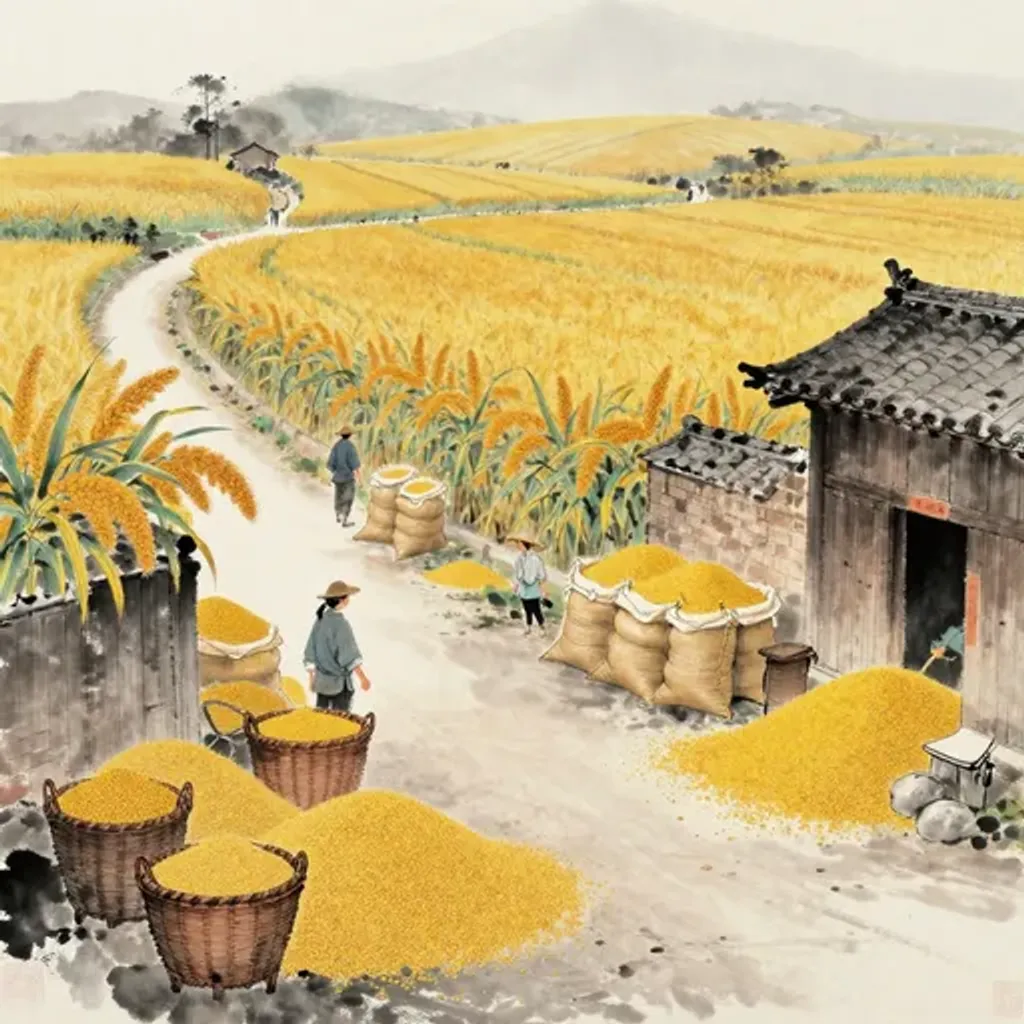
倉盈庾億宜稼黍稷年豐歲熟民得安息
Granaries brimming, stores in the billions; fit for planting millet and grain. The year yields its increase.
Read full commentary ↓
Fire above the lake returning to itself — Opposition contemplating its own reflection. Yet the verse describes not discord but abundance: granaries overflow with billions of measures, the land is perfectly suited for millet and grain, and the harvest yields surplus year upon year. When Opposition meets itself, the doubled estrangement paradoxically cancels out: two mirrors facing each other reveal not infinite regression but clarity. The fire-lake tension, confronting its own nature, resolves into the recognition that opposing forces held in stable equilibrium are the very mechanism of agricultural prosperity — sun above, water below, each feeding the other. The same hexagram sustained becomes its own remedy through self-aware balance.
中文註釋
上火下澤,睽之自照。睽變睽,對立回歸自身——然詩中非寫乖離,乃寫豐盈。倉盈庾億,糧倉滿溢以億計;宜稼黍稷,土地宜於種植五穀;年歲有息,歲歲豐收而有餘。雙重之睽反而相消:兩面鏡子相對,非無盡後退,乃澄澈自照。火澤之張力面對自身時,領悟到對立之力若保持穩定之均衡,恰為農耕豐收之機制——上有日照、下有水澤,彼此滋養。同卦相疊,以自覺之平衡化解自身之矛盾。
This commentary was written against an earlier reading of the verse. Where the reading has since changed, the interpretation itself may no longer apply.
Jiao Shi Yi Lin 《焦氏易林》, manuscript from the Wenyuan Pavilion Siku Quanshu, Qianlong period, Qing dynasty.
National Palace Museum, accession nos. 故庫017987–017990
Fascicle 3, page 76
Read from the manuscript leaf
Shown unpunctuated, as in the manuscript.
About this reading
Read from the scanned leaf.
Related Hexagrams
Same upper trigram: Fire (離)
Same lower trigram: Lake (兌)