Upper Trigram
坎 Kǎn
Water — Abysmal
Lower Trigram
艮 Gèn
Mountain — Stillness
Classical Texts
The Goal
Jian 蹇 (Obstruction) is not merely difficulty — it is the specific condition of facing an obstacle that cannot be overcome by direct advance. Water (Kan) above Mountain (Gen) shows danger piled on stillness: the abyss ahead, immobility beneath. The judgment maps the terrain by direction: 利西南,不利東北 — "the southwest furthers; the northeast does not." Southwest is level ground, the yielding approach, the place where allies gather; northeast is the mountain, the obstacle met head-on. What the hexagram forbids is the heroic line of attack, and what it prescribes is harder: turning back when every instinct says press on. The six lines make that structure explicit, and it is the clearest pattern in the hexagram. Every one of them opposes 往 to 來 — 往蹇來譽, 往蹇來反, 往蹇來連, 往蹇來碩 — going forward meets obstruction; coming back brings praise, return, alliance, substance. This is not a hexagram in which nothing can be done. It is one in which everything available lies in the other direction. The Image redirects the blocked energy: 山上有水,蹇;君子以反身修德 — "water upon the mountain: Obstruction. The superior person turns back upon himself and cultivates virtue." 反身 is the same 反 as the lines' 來: the movement is inward because inward is where the road still runs. This is not consolation. It is the recognition that the energy which cannot be spent advancing has somewhere else to go. 六二 marks the one case where advance into obstruction is still right: 王臣蹇蹇,匪躬之故 — "the king's servant meets obstruction upon obstruction; it is not on his own account." The line offers no good fortune, and its line Image (小象) says only 終无尤也, in the end no fault. Obstruction borne for oneself is folly; obstruction borne in service is blameless, and the text is careful not to promise more than that. The goal of Jian is to convert the energy of blocked advance into developed character. The judgment closes 利見大人,貞吉 — obstruction is also the time to seek counsel, to admit the obstacle exceeds one's own capacity. 九五 confirms it: 大蹇朋來, "in great obstruction, friends come." The most severe blockage draws the help that eventually clears it, to whoever has used the waiting to become worth helping.
The Judgment
The southwest is supported. The northeast is not supported. Seeing the great person is supported. Sustained orientation resolves well. Two directions, two verdicts. Southwest works, northeast doesn't. And the solution isn't to push harder — it's to find the great person. The text is describing a situation where individual effort fails and collective wisdom succeeds. The obstruction isn't testing your strength. It's testing whether you'll ask for help.
The Image
Water upon the mountain: obstruction. The realized person accordingly turns inward to cultivate character. Water on top of a mountain — it can't flow, it just sits there. And the instruction is to turn inward. Not to find a way around the obstacle. To use the obstacle. The realized person who hits a wall and immediately improves themselves has understood something the rest of us take decades to learn: the wall is the curriculum.
The Lines
Line 1
Going forward: obstruction. Coming back: praise. Go forward, hit a wall. Come back, receive praise. The math is that simple. The person who recognizes an impassable obstacle and returns gets more credit than the person who keeps walking into it. Coming back isn't failure — it's the first intelligent move available.
Line 2
The sovereign's minister, obstruction upon obstruction. It is not a personal matter. Obstruction piled on obstruction, and it's not about you. The minister serves the ruler and walks into difficulty after difficulty — not from personal choice but from duty. The text makes the distinction explicit: this isn't your mess. But it is your job. The person who serves a cause larger than themselves doesn't get to choose which obstacles belong to them.
Line 3
Going forward: obstruction. Coming back: return. Forward is blocked. Come home. The people who depend on you are waiting. The hero's impulse is to keep pushing into the obstacle. The text says: turn around. Your people need you more than your ambition does. Coming back is the harder direction because it feels like giving up. It isn't.
Line 4
Going forward: obstruction. Coming back: connection. Forward is blocked again. But coming back this time brings allies. Connection. The obstruction hasn't changed but your approach has — instead of soloing it, you're gathering people. The text walked you through three lines of 'come back' and each one gave a different reward: praise, return, connection. The pattern is the teaching.
Line 5
Great obstruction. Companions come. The biggest obstacle yet. And companions arrive. Not because you called them — because the greatness of the obstruction called them. Some problems are so large they create their own gravity, pulling in the people who are needed. The fifth line of the obstruction hexagram and help shows up uninvited. That's how you know the problem is real.
Line 6
Going forward: obstruction. Coming back: ripeness. Resolves well. Seeing the great person is supported. One more time: forward is blocked. And this time, coming back brings ripeness. Not just survival, not just connection — maturity. Resolves well. The top of the obstruction hexagram, and the person who has been turned back six times arrives at the last line having gained everything the obstacles were designed to teach. The great person is supported because you've become one.
Yilin: Forest of Changes
From Jiao Yanshou's Forest of Changes (焦氏易林) — the verse for Hexagram 39 in its unchanging form. A Han dynasty collection of four-character verses interpreting every hexagram transformation.
同濟共輿中道別去喪我元夫獨與孤苦
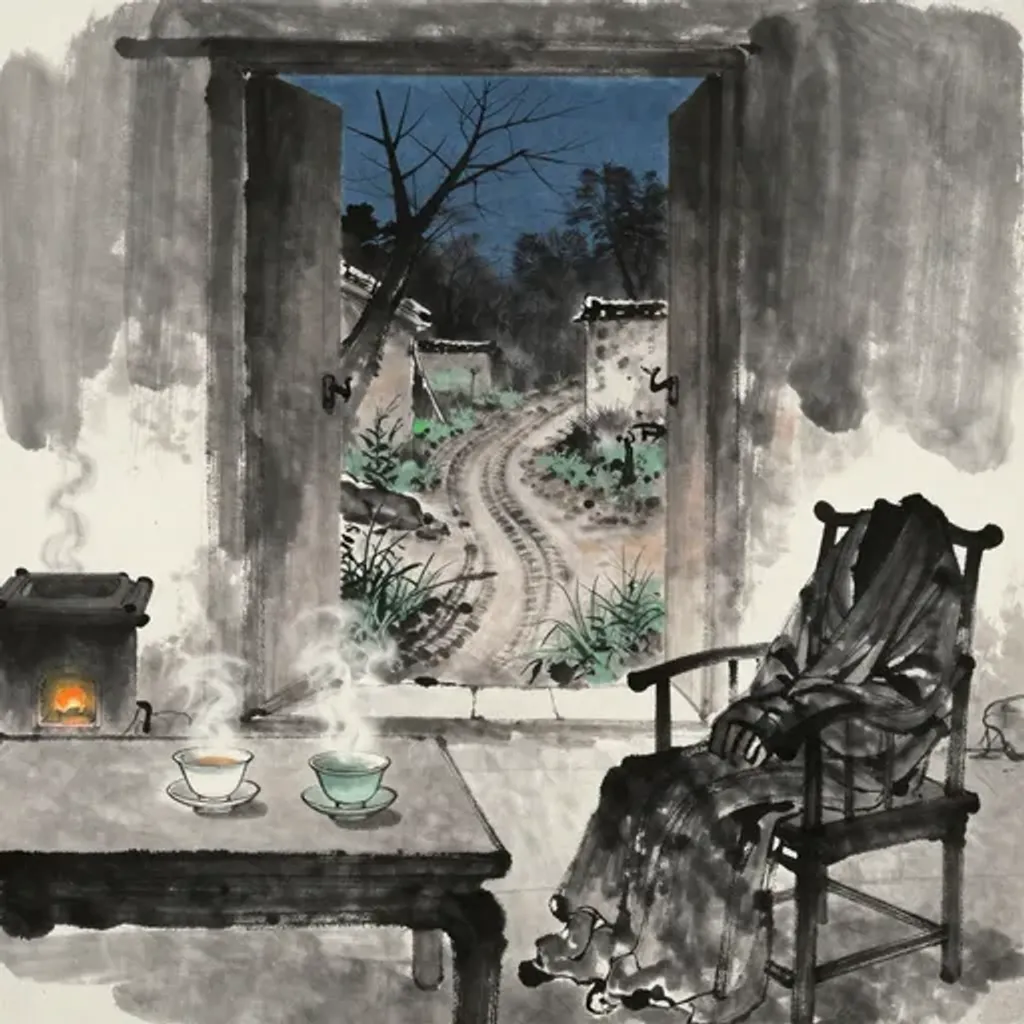
兩杯茶一冷一溫,椅上衣衫尚餘痕。門外車轍已長草,夜夜聽風不等人。
Two cups of tea — one cold, one still warm. On the chair, clothes still hold a trace of warmth. Outside the gate, the carriage ruts are overgrown with grass — night after night, listening to the wind, waiting for no one.
Read full commentary ↓
Water on the mountain returns to water on the mountain — Obstruction unchanged. This verse (a rewrite) must be read through the original: 'Sharing one carriage, we traveled together, but midway you departed. I have lost my husband, and dwell alone in solitude.' The original captures the most intimate form of abandonment: two who rode the same carriage, bound by marriage and shared direction, until one simply left. The survivor remains, companionless, in an empty house. From Obstruction to Obstruction, the pattern holds: the mountain does not move, the water does not flow. When the same hexagram meets itself, there is no transformation — only the pure, unrelieved experience of the condition. The empty chair and the cold tea are obstruction without exit, grief without the consolation of change.
中文註釋
山上有水,蹇之蹇——阻之自身。此為改寫詩,須據原詩:「同載共輿,中道別去;喪我元夫,獨與孤居。」同車而行,中途離散。夫已亡故,獨守空屋。最親密之棄離:同乘一輿之人,中途竟別。從蹇至蹇,山不動、水不流。同卦相遇無變化,唯有純粹的、不可緩解的蹇之體驗。空椅、冷茶——阻滯無出口,哀慟無轉圜之慰藉。
This commentary was written against an earlier reading of the verse. Where the reading has since changed, the interpretation itself may no longer apply.
Jiao Shi Yi Lin 《焦氏易林》, manuscript from the Wenyuan Pavilion Siku Quanshu, Qianlong period, Qing dynasty.
National Palace Museum, accession nos. 故庫017987–017990
Fascicle 3, page 87
Read from the manuscript leaf
Shown unpunctuated, as in the manuscript.
About this reading
Read from the scanned leaf.
Related Hexagrams
Same upper trigram: Water (坎)
Same lower trigram: Mountain (艮)