
Upper Trigram
艮 Gèn
Mountain — Stillness
Lower Trigram
艮 Gèn
Mountain — Stillness
Classical Texts
The Goal
Gen is not inaction. It is the precise application of stillness to the place where stillness is needed, and only there. Mountain doubled on itself gives absolute stability, and the judgment immediately specifies where it operates: 艮其背,不獲其身 — "keeping the back still, he does not get hold of his body." Wang Bi puts it plainly: 背者,无見之物也。无見則自然靜止 — the back is the thing that is not seen, and what is not seen is naturally still. Stillness applied there, Wang Bi adds, 不隔物欲,得其所止 — does not wall off desire, and finds the place where stopping belongs. This is targeted cessation, not paralysis: halting the motor of compulsive action so that perception can clear. The line texts map stillness ascending through the body: 趾 the toes (初六), 腓 the calves (六二), 限 the waist (九三), 身 the trunk (六四), 輔 the jaw (六五), and finally 敦艮 at the top, stillness made solid. Stillness is cultivated from the ground up, never imposed from above — and two lines show what happens when it is imposed. 六二 stills the calf and 不拯其隨,其心不快: the part it should have supported is not rescued, and the heart is not glad. 九三 stills at the waist and 列其夤,厲熏心 — "the spinal flesh is torn; the danger smothers the heart." Wang Bi states the principle behind both: 施止不於无見,令物自然而止,而強止之,則姦邪並興 — apply stillness anywhere but the unseen, forcing what should have stopped of itself, and corruption rises with it. Rigidity produces exactly the agitation it claims to cure. 六五 shows the same discipline succeeding: 艮其輔,言有序,悔亡 — "stillness in the jaw; speech has order; remorse vanishes." The result of stilling the mouth is not silence but sequence. What was going to come out unarranged now comes out arranged. The judgment's second clause completes the teaching: 行其庭,不見其人 — "he walks through his courtyard and does not see his people." Not blindness or indifference, but perception operating without the distortion of what one wants from the person seen. The Image adds 兼山,艮;君子以思不出其位 — "the superior person does not let his thoughts go beyond his position." The goal of Gen is not withdrawal from the world but a mind that stays where it actually is. In the sequence it follows Zhen: after repeated shocks, the rest that lets what the shock revealed settle into place.
The Judgment
Stilling the back. Not grasping the body. Walking through the courtyard, not seeing the people. No fault. Still the back — not the front. The back. The part you can't see. And then: you walk through the courtyard and don't see anyone. No fault. The stillness hexagram isn't about freezing in place. It's about becoming so still internally that the external world passes through you without registering. You're there. You're walking. You just stopped grasping.
The Image
Connected mountains: keeping still. The realized person accordingly thinks of nothing beyond their present situation. Mountain beside mountain — stillness doubled. And the instruction is: don't think beyond where you are. Not 'don't think.' Don't think beyond. The realized person who contains their attention within the present situation has solved the problem that meditation is trying to solve. Not by emptying the mind. By giving it a boundary.
The Lines
Line 1
Stilling the toes. No fault. Enduring sustained orientation is supported. Still the toes. Before they step. Before the movement even begins, stop it at the lowest level. No fault. The first line of stillness and the earliest possible intervention. The person who can catch the impulse in the toes — before it reaches the calves, the thighs, the heart — has found the only place where stopping is effortless.
Line 2
Stilling the calves. Unable to rescue what follows. The heart is not at ease. The calves are still but the body keeps moving. You can't save what's above you. The heart isn't happy. The second line: stillness in the wrong place at the wrong time. The legs stopped but the torso didn't, and the result is frustration, not peace. Because stillness that's out of sync with the whole system isn't stillness. It's a stumble in slow motion.
Line 3
Stilling at the waist. Separating the lower back. Danger. The heart smothers. Stillness at the hips — the body split in two. Upper and lower disconnected. The heart suffocates. Dangerous. The third line: forced stillness. The kind where you're rigid at the division point and everything above it is choking. This is meditation by violence — the person who tries to make their mind shut up by clenching. The smoke has nowhere to go.
Line 4
Stilling the body. No fault. Stilling the whole trunk. No fault. Four characters, clean verdict. The fourth line arrives at the stillness that line three couldn't force. Not the hips, not the waist, not one section — the body. The whole thing, at rest. No fault because there's nothing partial about it. The body stills when you stop trying to still it piece by piece.
Line 5
Stilling the jaws. Words have order. Deviation detected dissolves. Still the jaw. When you do, the words that come out have order. And whatever deviation existed just dissolves. The fifth line: controlled speech as the product of stillness. Not silence — ordered words. The person who stills the jaw doesn't stop talking. They start making sense. The deviation disappears because the noise disappears.
Line 6
Genuine stillness. Resolves well. Authentic stillness. The real thing. Resolves well. Two characters for the description, two for the verdict. The top of the keeping-still hexagram, and after six lines of partial stillnesses — toes, calves, waist, body, jaw — the final line is the whole person, genuinely at rest. Not performing stillness. Being it. That's the only version that resolves well.
Yilin: Forest of Changes
From Jiao Yanshou's Forest of Changes (焦氏易林) — the verse for Hexagram 52 in its unchanging form. A Han dynasty collection of four-character verses interpreting every hexagram transformation.
君孤獨處單弱無輔名曰困苦輔心湧泉碌碌如山
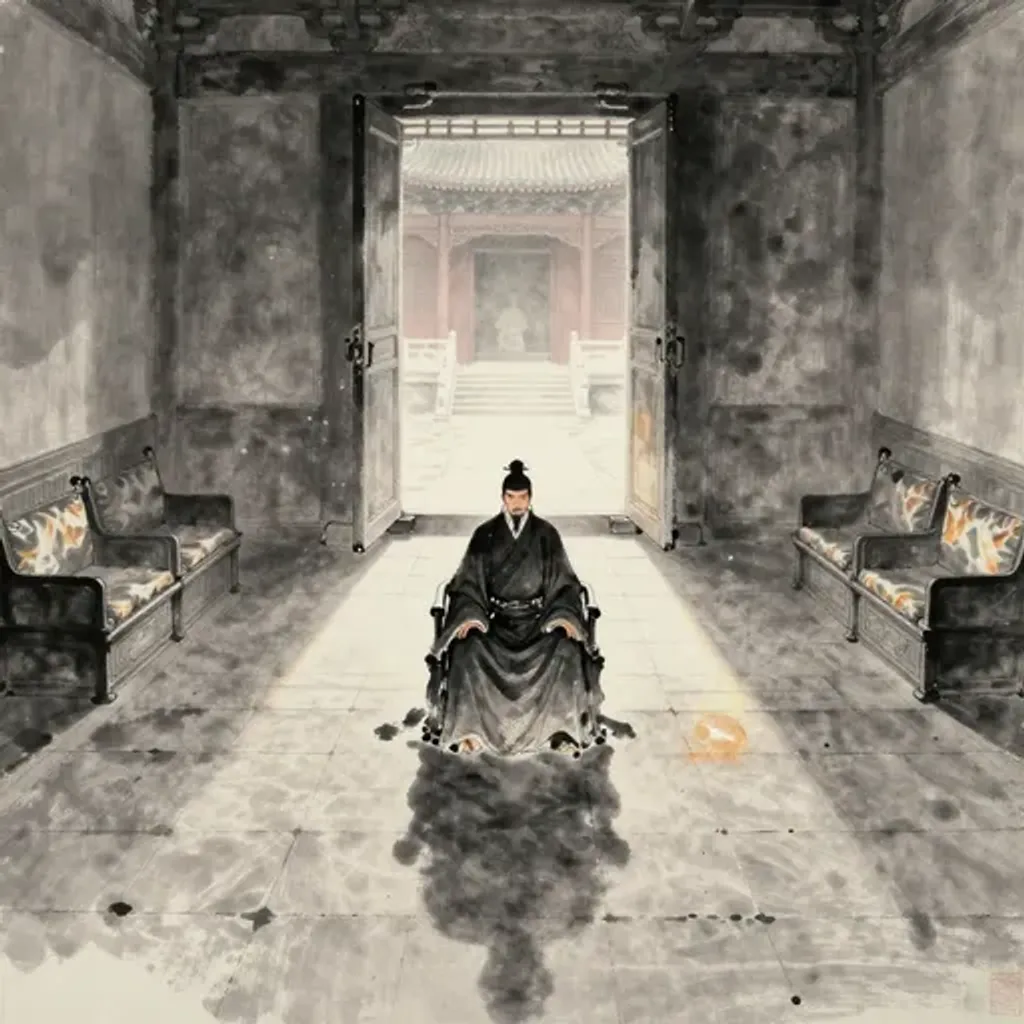
The lord sits alone in solitude, weak and without support; its name is called hardship and suffering.
Read full commentary ↓
Twin mountains stand doubled into absolute stillness — the same hexagram returns to itself. The ruler dwells in isolation, alone and without support; this condition is called suffering. When Gen transforms into Gen, nothing changes: the mountain remains the mountain, and the person who stops remains stopped. There is no release, no new energy, no complementary force to break the stasis. From Keeping Still to Keeping Still, the image is pure recursion. The verse names this plainly: solitude without allies, weakness without reinforcement, the name of which is hardship. The mountain's great virtue is knowing when to stop, but when stopping is the only option and the only outcome, virtue curdles into mere endurance.
中文註釋
兼山為艮,艮歸於艮——同卦自返,無物流轉。君孤獨處,單弱無輔,名曰困苦。艮化艮,無一事改變:山仍是山,止者仍止。無新生之力、無互補之勢可打破此僵局。從艮至艮,純粹之自我重複,如回音在空谷中漸弱而不傳。詩直言不諱:獨而無友、弱而無援,其名曰苦。艮之大德在知止,然當止是唯一之選項亦是唯一之結果時,美德遂化為純然之忍受而已。
Jiao Shi Yi Lin 《焦氏易林》, manuscript from the Wenyuan Pavilion Siku Quanshu, Qianlong period, Qing dynasty.
National Palace Museum, accession nos. 故庫017987–017990
Fascicle 4, page 78
Read from the manuscript leaf
Shown unpunctuated, as in the manuscript.
About this reading
Read from the scanned leaf.
Related Hexagrams
Same upper trigram: Mountain (艮)
Same lower trigram: Mountain (艮)