Upper Trigram
離 Lí
Fire — Clinging
Lower Trigram
艮 Gèn
Mountain — Stillness
Classical Texts
The Goal
Lü 旅 (The Wanderer) is not adventure. It is the condition of displacement — moving through territory where you have no standing, no network, no margin for error. Fire (Li) above Mountain (Gen) shows flame travelling across a mountainside: it lights the slope briefly, consumes what fuel it finds, and moves on without establishing itself. The wanderer has clarity and no foundation; the mountain beneath is unmoved by the fire passing over it. The judgment grants 小亨 — small success — because a stranger's resources are structurally limited. But it does not stop there: 旅貞吉, "constancy in wandering brings good fortune." What is unavailable is scale. What remains fully available is integrity, and the text says so before describing a single hardship. The lines then map the trajectory. 初六 warns against pettiness — 旅瑣瑣,斯其所取災, "the wanderer fusses over trifles, and this is how he draws disaster on himself." 六二 finds shelter, means and a loyal servant. 九三 destroys all three: 旅焚其次,喪其童僕,貞厲 — the inn burns, the servant is lost. 九四 is the subtlest: 旅于處,得其資斧,我心不快 — "lodged somewhere, having got his money and his axe, my heart is not glad." He has the resources and is still not at ease, because provision is not the same as belonging. 上九 completes the arc: 鳥焚其巢,旅人先笑後號咷 — "the bird's nest burns; the wanderer laughs first and afterwards wails." Whoever forgets he is a stranger loses even the nest he managed to build. The goal of Lü is not to end displacement but to move through it without losing inner dignity. The Image gives the wanderer's obligation: 山上有火,旅;君子以明慎用刑,而不留獄 — "the superior person is clear and careful in applying punishment, and does not let cases linger." Fire on the mountain does not stay, and neither should a judgment made by someone passing through — the caution and the refusal to prolong are the same instruction, given to someone who will not be present to see the consequences. In the sequence Lü follows Feng: after the zenith comes the journey through diminished conditions, where character shows itself without the support of position or plenty.
The Judgment
Small fulfillment. The wanderer's sustained orientation resolves well. Small fulfillment. Not great fulfillment — small. The wanderer gets the reduced version of everything: smaller victories, smaller comforts, smaller scope. And that's exactly what resolves well. The person who expects full-sized results while traveling through someone else's territory has confused being a guest with being at home.
The Image
Fire on the mountain: the wanderer. The realized person accordingly is clear and careful in applying penalties, and does not prolong disputes. Fire on a mountain — bright, visible, and moving on. It doesn't stay. It can't stay. And the instruction is: be clear, be careful, be brief. Don't drag things out. The wanderer who lingers in a dispute has forgotten they're a wanderer. Your fire lights the mountain and moves. That's the design.
The Lines
Line 1
The wanderer busies himself with petty things. This is how he invites disaster. Petty, trivial, fussy. And disaster arrives as a direct consequence. The first line of the wanderer: the person who is away from home and wastes their energy on small irritations has attracted exactly the kind of trouble that small behavior attracts. The wanderer's dignity is their only protection. Trade it for pettiness and the road eats you.
Line 2
The wanderer arrives at the inn. Cherishing his resources. Gaining a young servant's loyalty. An inn. Resources intact. A loyal helper found. No verdict — just the image of the wanderer doing it right. Modest, careful, holding what they have close, and earning loyalty through character rather than authority. The second line is the textbook for how to travel: arrive quietly, keep your valuables, treat the people around you well enough that they choose to stay.
Line 3
The wanderer burns down his inn. Losing the young servant's loyalty. Sustained orientation: strained. The inn burns. The servant leaves. Everything the second line built, the third line destroys. Strained. The wanderer who burns their own shelter has committed the essential error of traveling: forgetting that the shelter isn't yours. You burned someone else's roof and lost the only person who was helping you. The road just got much longer.
Line 4
The wanderer rests in a shelter. Gaining resources and an ax. My heart is not at ease. Shelter found. Resources and an ax secured. But the heart isn't happy. The fourth line: you have everything you need and you still don't feel safe. Because the wanderer never feels safe. The ax is for defense, not comfort. The person who has the tools and the shelter but not the peace has understood something essential about traveling: sufficiency is not the same as home.
Line 5
Shooting a pheasant. One arrow lost. In the end, this brings praise and appointment. One shot. The arrow is gone. But the pheasant falls and the result is praise, recognition, appointment. The fifth line of the wanderer: the investment that looks like a loss — one arrow spent — becomes the introduction that changes everything. The wanderer who can offer something real to the place they're passing through stops being a wanderer. They become someone who was invited to stay.
Line 6
The bird burns its own nest. The wanderer first laughs, then wails and weeps. Losing the cow through carelessness. Adverse. The bird sets fire to its own nest. Laughing, then crying. The cow — your patience, your docility, your adaptability — lost through carelessness. Adverse. The top of the wanderer hexagram, and the final image is the traveler who forgot they were traveling. The laughter was arrogance. The tears are the cost. The cow you lost was the only thing keeping you alive on the road.
Yilin: Forest of Changes
From Jiao Yanshou's Forest of Changes (焦氏易林) — the verse for Hexagram 56 in its unchanging form. A Han dynasty collection of four-character verses interpreting every hexagram transformation.
羅網四張鳥無所翔征伐困極饑渴不食
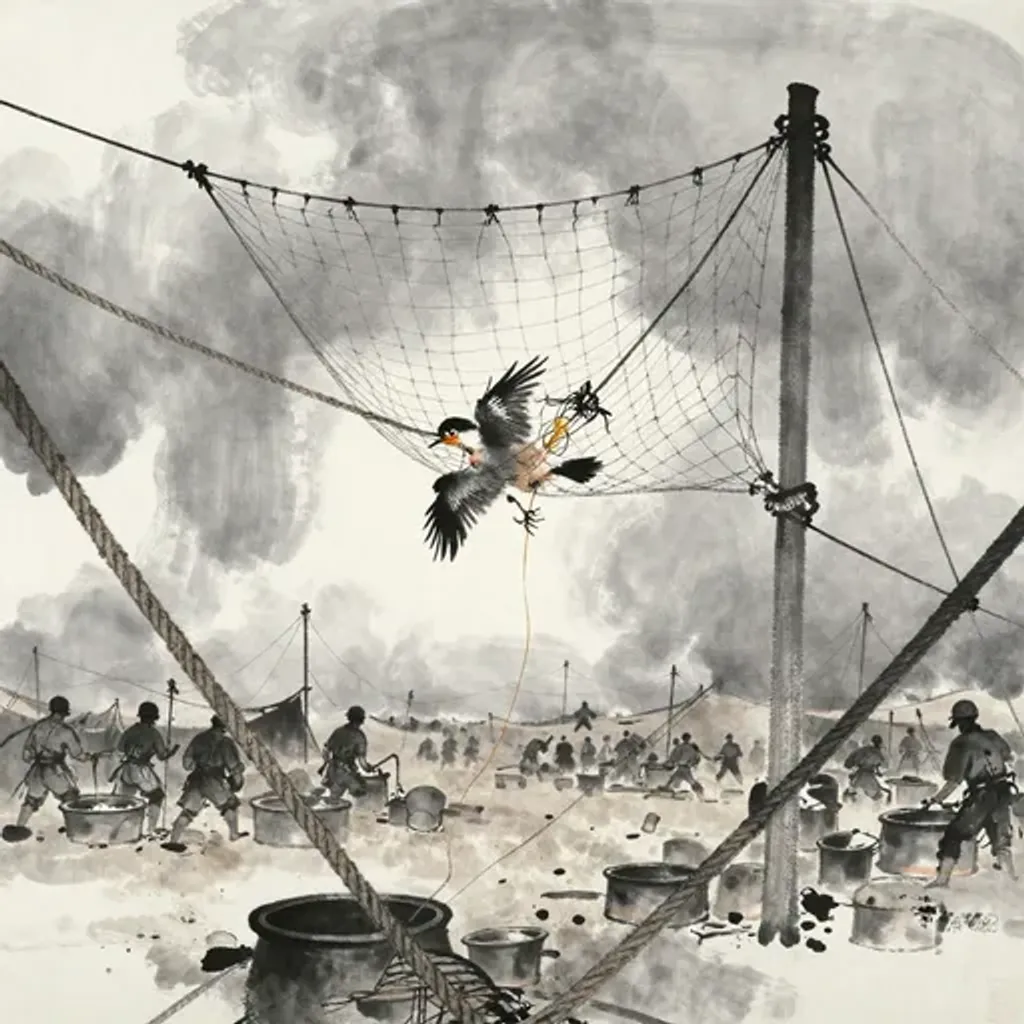
Nets are spread in every direction; the bird has nowhere to fly. Campaign and conquest pushed to the limit; starving and destitute, without food.
Read full commentary ↓
Fire on the mountain returns to fire on the mountain — The Wanderer doubled. Nets spread in all four directions; the bird has nowhere to fly. The traveler, exhausted from endless campaigns, starves in his own destitution. This is the wanderer's condition taken to its logical extreme: when source and target are the same hexagram, the pattern intensifies without relief. No transformation occurs; the fire simply burns on the same mountain. From The Wanderer to The Wanderer, there is no escape from transience. The nets are ubiquitous, the hunger permanent, and the warfare without end. The only shift possible is in the wanderer's stance: even trapped, one may choose how to bear the unbearable.
中文註釋
山上有火復為山上有火——旅之重卦。「羅網四張」——天羅地網,四面封鎖。「鳥無所翔」——飛鳥無處可去。「征伐困極,飢窮不食」——征戰至極,飢困而無食。此為旅人之處境推至極端:源卦與變卦相同,則模式無轉化地反覆加劇。火仍燃於同一座山,無處可變。從旅至旅,流離無解,羅網無隙,飢餓不止,戰事無休。唯一可能之轉變在於姿態:縱被困,仍可選擇如何承受。
This commentary was written against an earlier reading of the verse. Where the reading has since changed, the interpretation itself may no longer apply.
Jiao Shi Yi Lin 《焦氏易林》, manuscript from the Wenyuan Pavilion Siku Quanshu, Qianlong period, Qing dynasty.
National Palace Museum, accession nos. 故庫017987–017990
Fascicle 4, page 120
Read from the manuscript leaf
Shown unpunctuated, as in the manuscript.
About this reading
Read from the scanned leaf.
Related Hexagrams
Same upper trigram: Fire (離)
Same lower trigram: Mountain (艮)