Upper Trigram
兌 Duì
Lake — Joyous
Lower Trigram
離 Lí
Fire — Clinging
Classical Texts
The Goal
Ge is not destruction. It is the structural removal of forms that have exhausted their mandate — the moulting of a skin that can no longer contain what has grown beneath it. The character 革 first meant hide processed by tanning: raw skin turned by treatment into something durable and new. Lake (Dui) above Fire (Li) sets two elements that cannot coexist against each other, and that incompatibility is what drives the change. Revolution in the I-Ching is not chaos. It is the disciplined replacement of a depleted structure by a viable one. The judgment is 巳日乃孚。元亨。利貞。悔亡 — "when the day has come, confidence follows; supreme success; constancy furthers; remorse vanishes." The received text here reads 巳; Wang Bi's reads 已, and his gloss makes the timing the point — 即日不孚,已日乃孚: on the day itself there is no trust, only afterwards. Wang Bi's reason is the best sentence anyone has written about revolutions: 夫民可與習常,難與適變。可與樂成,難與慮始 — people can share a habit but not an adaptation, can enjoy an outcome but not deliberate a beginning. Confidence is what a revolution earns after the fact, never what it starts with. The four virtues appear here, and the Tuan is careful about what they rest on: 革而當,其悔乃亡 — the remorse vanishes when the change is *apt*. Timing and fitness are the conditions, not the reward. A revolution that arrives early, or that changes the wrong thing, keeps its remorse. The architecture runs from restraint to legibility. 初九 binds the actor in yellow oxhide — 鞏用黃牛之革 — because premature action discredits the cause it claims to serve. 九三 warns 征凶貞厲 and requires 革言三就, the case for change put three times before it is acted on. Only at 九五 does 大人虎變,未占有孚 — "the great person changes like a tiger; before the divination, there is confidence." The stripes are visible from a distance; the change is so plainly fitted to necessity that no one needs to consult about it. 上六 is where the common misreading breaks: 君子豹變,小人革面,征凶,居貞吉 — "the superior person changes like a leopard, the small person changes his face; to press on brings misfortune, to settle in constancy brings good fortune." Two sober admissions at the end of a revolution. Most people will change only their outward face, and that has to be accepted rather than corrected by further upheaval. And continuing to push once the change is made is explicitly 凶. The goal of Ge is the most regulated act in the sequence. The Image says what comes after: 澤中有火,革;君子以治曆明時 — "fire within the lake: Revolution. The superior person orders the calendar and makes the seasons clear." The first task after overthrowing the old is not celebration but reorientation — new measures of time, new standards by which things are counted. Building the legitimate successor is the work; the tearing down was the occasion.
The Judgment
On the completed day, then trust. Supreme fulfillment. Sustained orientation is supported. Deviation detected dissolves. Not yet. Not yet. Then: trust. Revolution doesn't get believed on the first day. Or the second. Only on the completed day — when the process has finished — does trust arrive. Supreme fulfillment, but with a delay built in. The text is warning you: if you need to be believed before you've finished, you've chosen the wrong hexagram.
The Image
Fire within the lake: revolution. The realized person accordingly organizes the calendar and clarifies the seasons. Fire inside a lake — the two things that destroy each other, contained in one image. And the response is to organize time. Set the calendar. Clarify the seasons. Because revolution isn't chaos — it's the recognition that one season ended and another began. The person who can name the change has already survived it.
The Lines
Line 1
Bound with yellow oxhide. Wrapped tight in cowhide. Yellow — the color of center, of restraint. No verdict. The first line of revolution and the instruction is: don't move yet. The person at the beginning of a revolution who is held back by the right material at the right time is being saved, not restrained. The hide knows something you don't.
Line 2
On the completed day, then make the change. Advancing resolves well. No fault. Now. The day has arrived and you make the change. Advancing resolves well. No fault. The second line: the restraint of line one has done its work, the timing has ripened, and the revolution proceeds. The person who waited until the day was complete before acting is the one who acts without fault. Patience was never the opposite of revolution. It was the prerequisite.
Line 3
Advancing: adverse. Sustained orientation: strained. When talk of revolution has circulated three times, there is trust. Don't go yet — adverse. The orientation is strained. But when the word has gone around three times, then trust. The third line: the revolution hasn't been tested enough. Three circulations. Three rounds of scrutiny. The impatient revolutionary who acts after the first round gets adverse. The one who waits for three gets trust. Three is not arbitrary. Three is the minimum number of times a truth must be heard before it's believed.
Line 4
Deviation detected dissolves. There is trust. Changing the mandate resolves well. The regret disappears. Trust is established. Changing the mandate resolves well. The fourth line: the revolution is legitimate. The mandate of heaven has shifted. This is the line where the I-Ching says yes — the old order is done, the new one is sanctioned. The person who changes the mandate with trust behind them and deviation dissolved in front of them has found the rarest thing in the book: a justified revolution.
Line 5
The great person transforms like a tiger. Even before divining, there is trust. The tiger. Stripes visible from a mile away, pattern unmistakable, transformation so complete it doesn't need verification. Even before you consult the oracle: trust. The fifth line of revolution, and the great person's change is so clear it precedes confirmation. The tiger doesn't need to explain its stripes. The transformation IS the proof.
Line 6
The realized person transforms like a leopard. The petty change only their faces. Advancing: adverse. Dwelling in sustained orientation resolves well. The leopard — elegant, spotted, less dramatic than the tiger but still transformed. And the petty people? They change their masks. Same person, new face. Advancing from here is adverse. Stay put. The top of the revolution hexagram: the deep change happened. The surface change happened. And the instruction is to stop. Because the person who keeps revolutionizing past the point of completion starts destroying what they built.
Yilin: Forest of Changes
From Jiao Yanshou's Forest of Changes (焦氏易林) — the verse for Hexagram 49 in its unchanging form. A Han dynasty collection of four-character verses interpreting every hexagram transformation.
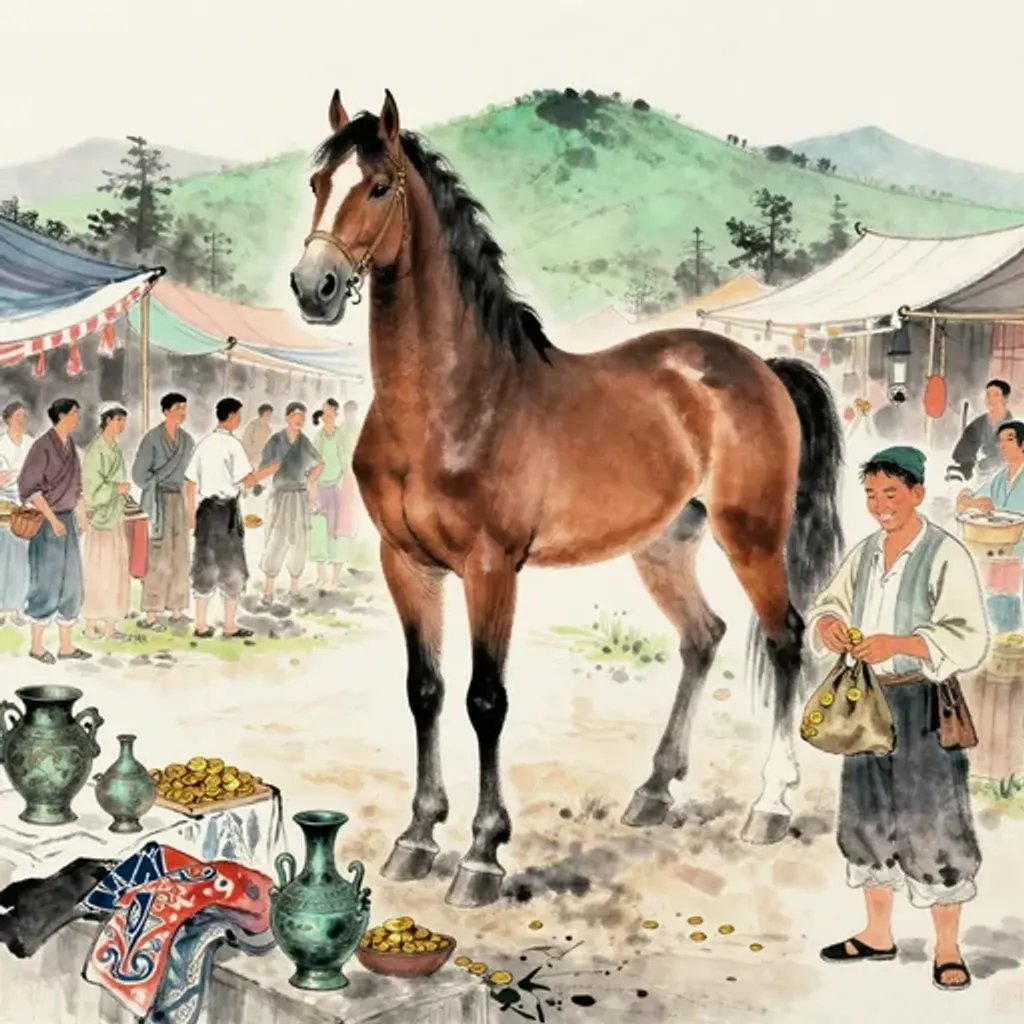
馬眠長股宜行善市皆蒙福佑獲金三倍
The horse, tall with long legs, is fit for travel and good for market. Blessed with favor and a worthy match, the gold earned is fivefold.
Read full commentary ↓
Fire within the lake returns to fire within the lake — Revolution unchanged, the pattern repeating itself. Long-legged horses well suited to their harness, good for travel and commerce. Blessed with fortune and matched with a partner, one gains gold fivefold. When Revolution meets itself, the dynamic is pure transformation without destination: constant molting, constant renewal. The horse with long legs is built for the road; the merchant who matches goods to markets multiplies wealth. There is no resistance, no friction — the pattern flows. From Revolution to Revolution, the message is that some natures are made for change itself: the perpetual trader, the born adapter, profits precisely because nothing stays still.
中文註釋
澤中有火,革之象也。馬服長股,宜行善市。蒙祐諧偶,獲金五倍。革之自變——火湖重疊,革故鼎新循環不已。長腿之馬天生適於行路經商,體格健壯、步伐穩健,善市者因時而動、隨機應變。命運眷顧,得遇良偶,獲利五倍。從革至革,有些天性本就為變革而生——永遠的行商者、天生的適應者,恰因萬物不停而獲利。革卦遇革卦,非動盪之災,乃善變者之福。
This commentary was written against an earlier reading of the verse. Where the reading has since changed, the interpretation itself may no longer apply.
Jiao Shi Yi Lin 《焦氏易林》, manuscript from the Wenyuan Pavilion Siku Quanshu, Qianlong period, Qing dynasty.
National Palace Museum, accession nos. 故庫017987–017990
Fascicle 4, page 50
Read from the manuscript leaf
Shown unpunctuated, as in the manuscript.
About this reading
Read from the scanned leaf.
Related Hexagrams
Same upper trigram: Lake (兌)
Same lower trigram: Fire (離)