The Death of Marat

第49卦

Revolution

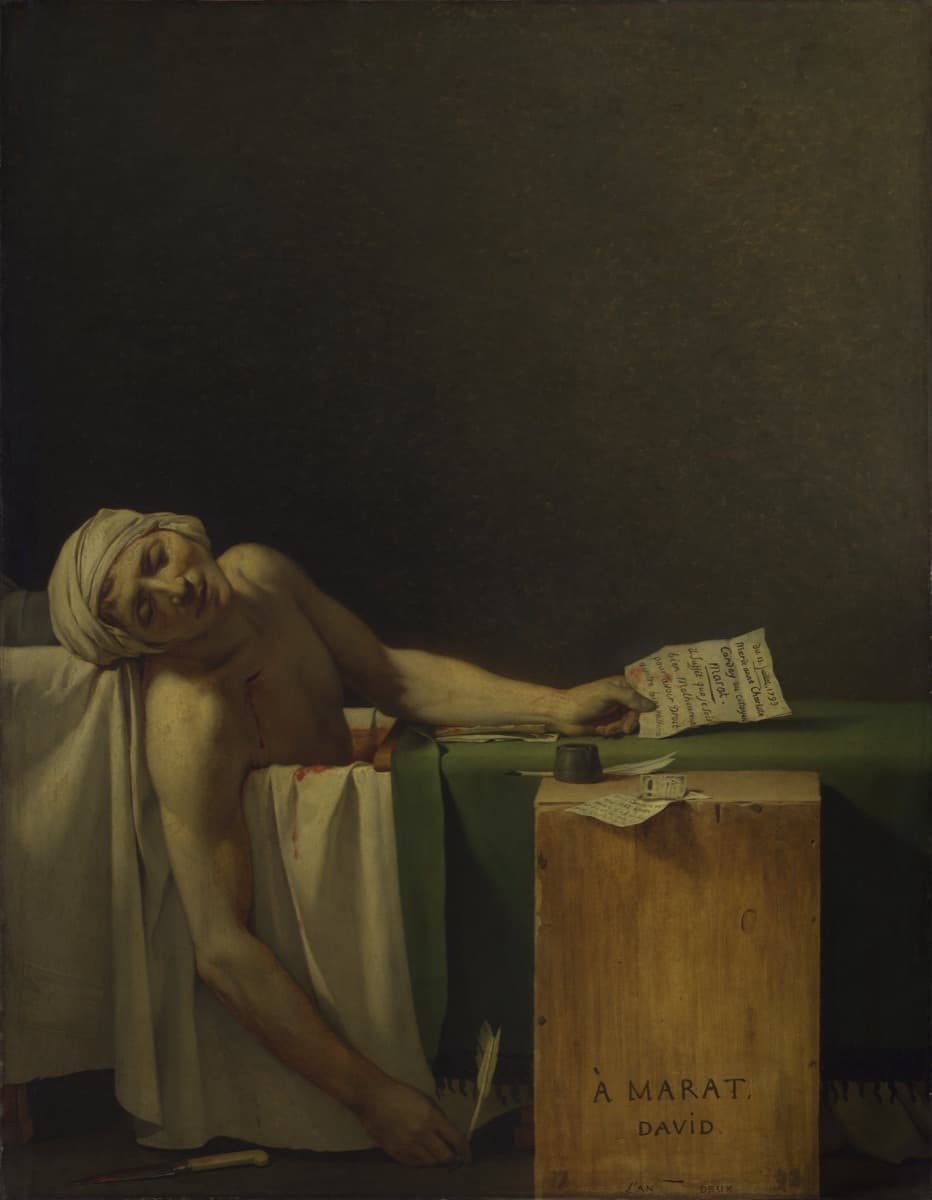
The Death of MaratJacques-Louis David, 1793

David paints a martyr's death as political icon. In his 1793 Neoclassical work, journalist Jean-Paul Marat slumps in his medicinal bath, assassinated knife on the floor, letter still clutched in his hand. Charlotte Corday stabbed him three days into the Reign of Terror, transforming personal murder into revolutionary symbol. The composition strips away chaos to reveal stark geometry—white cloth, green bath wrap, wooden crate as writing desk. David memorializes the moment when violence ruptures the old social order.

阅读完整论述 ↓

This is Gé (革), the Chinese hexagram of Revolution. The character originally meant animal hide tanned and processed—skin transformed through fire and treatment into something new. Ancient diviners saw this configuration when Lake (Dui) sits above Fire (Li): water and flame cannot coexist peacefully, yet their conflict drives transformation. Marat's bath literalizes this image—water meant to soothe his diseased skin becomes the site where fire (political fury) extinguishes his life, even as his death ignites revolutionary fervor. David painted this Neoclassical work commemorating journalist and radical deputy Jean-Paul Marat, assassinated in his medicinal bath during the French Revolution's Reign of Terror. The painting depicts violent political transformation, showing Marat moments after death with the assassin's knife on the floor, connecting to Revolution's theme of sudden, decisive change in the social order. The Judgment text speaks to David's painting directly: "Revolution. On your own day you are believed. Supreme success, furthering through perseverance." Marat died July 13, 1793. Within weeks, David had transformed him into revolutionary saint. The painting appeared at the National Convention that autumn, establishing the visual vocabulary for martyrdom that would sustain the Republic. Zhou Dynasty diviners consulted this hexagram during dynastic transitions, when heaven's mandate shifted from exhausted rulers to vigorous successors. The text promises that revolution succeeds not through chaos but through proper timing—when the old form has truly decayed beyond repair. The Image Text declares: "Fire in the lake: the image of Revolution. Thus the superior man regulates the calendar and clarifies the seasons." After toppling the monarchy, French revolutionaries abolished the Gregorian calendar, replacing saints' days with rational decimal time. David's painting participates in this temporal revolution—Marat becomes not merely dead but eternally dying, frozen in the revolutionary present. In the I-Ching sequence, Revolution follows The Well: after drawing on timeless sources, radical transformation becomes possible. The old skin must be shed completely.

上卦

Duì

LakeJoyous

五行Metal方位Southwest家庭Youngest Daughter性质joyful, reflective, collecting

下卦

FireClinging

五行Fire方位East家庭Second Daughter性质illuminating, dependent, radiant

经典文本

卦旨

Ge is not destruction. It is the structural removal of forms that have exhausted their mandate — the molting of skin that can no longer contain what has grown beneath it. The character 革 originally meant animal hide processed through tanning: raw skin transformed by fire and treatment into something durable and new. Lake (Dui) above Fire (Li) creates an image of elemental incompatibility — water and flame cannot coexist, and their mutual annihilation is what drives transformation. Revolution in the I-Ching is not chaos. It is the disciplined replacement of depleted structures with viable ones. The judgment insists on timing and trust: 巳日乃孚 — "on the appointed day, there is confidence." Revolution fails when it arrives too early or proceeds without legitimacy. The first line binds the revolutionary in yellow cowhide — 鞏用黃牛之革 — enforcing restraint at the outset, because premature action discredits the cause it claims to serve. Only at the fifth line does the great man "change like a tiger" (大人虎變), his stripes visible from afar, his transformation so clearly aligned with necessity that belief precedes consultation. The architecture is precise: revolution must be restrained at the bottom, tested in the middle, and unmistakable at the top. The common misreading treats Ge as license for upheaval. The hexagram teaches the opposite: revolution is the most regulated act in the entire sequence. The Image text — 君子以治曆明時 — instructs the superior person to "regulate the calendar and clarify the seasons." After overthrowing the old, the first task is not celebration but reorientation: establishing new measures of time, new standards of order. The goal of revolution is not the thrill of tearing down but the sober work of building a legitimate successor to what has been removed.

彖辞

On the completed day, then trust. Supreme fulfillment. Sustained orientation is supported. Deviation detected dissolves. Not yet. Not yet. Then: trust. Revolution doesn't get believed on the first day. Or the second. Only on the completed day — when the process has finished — does trust arrive. Supreme fulfillment, but with a delay built in. The text is warning you: if you need to be believed before you've finished, you've chosen the wrong hexagram.

象辞

Fire within the lake: revolution. The realized person accordingly organizes the calendar and clarifies the seasons. Fire inside a lake — the two things that destroy each other, contained in one image. And the response is to organize time. Set the calendar. Clarify the seasons. Because revolution isn't chaos — it's the recognition that one season ended and another began. The person who can name the change has already survived it.

爻辞

第初爻

Bound with yellow oxhide. Wrapped tight in cowhide. Yellow — the color of center, of restraint. No verdict. The first line of revolution and the instruction is: don't move yet. The person at the beginning of a revolution who is held back by the right material at the right time is being saved, not restrained. The hide knows something you don't.

第二爻

On the completed day, then make the change. Advancing resolves well. No fault. Now. The day has arrived and you make the change. Advancing resolves well. No fault. The second line: the restraint of line one has done its work, the timing has ripened, and the revolution proceeds. The person who waited until the day was complete before acting is the one who acts without fault. Patience was never the opposite of revolution. It was the prerequisite.

第三爻

Advancing: adverse. Sustained orientation: strained. When talk of revolution has circulated three times, there is trust. Don't go yet — adverse. The orientation is strained. But when the word has gone around three times, then trust. The third line: the revolution hasn't been tested enough. Three circulations. Three rounds of scrutiny. The impatient revolutionary who acts after the first round gets adverse. The one who waits for three gets trust. Three is not arbitrary. Three is the minimum number of times a truth must be heard before it's believed.

第四爻

Deviation detected dissolves. There is trust. Changing the mandate resolves well. The regret disappears. Trust is established. Changing the mandate resolves well. The fourth line: the revolution is legitimate. The mandate of heaven has shifted. This is the line where the I-Ching says yes — the old order is done, the new one is sanctioned. The person who changes the mandate with trust behind them and deviation dissolved in front of them has found the rarest thing in the book: a justified revolution.

第五爻

The great person transforms like a tiger. Even before divining, there is trust. The tiger. Stripes visible from a mile away, pattern unmistakable, transformation so complete it doesn't need verification. Even before you consult the oracle: trust. The fifth line of revolution, and the great person's change is so clear it precedes confirmation. The tiger doesn't need to explain its stripes. The transformation IS the proof.

第上爻

The realized person transforms like a leopard. The petty change only their faces. Advancing: adverse. Dwelling in sustained orientation resolves well. The leopard — elegant, spotted, less dramatic than the tiger but still transformed. And the petty people? They change their masks. Same person, new face. Advancing from here is adverse. Stay put. The top of the revolution hexagram: the deep change happened. The surface change happened. And the instruction is to stop. Because the person who keeps revolutionizing past the point of completion starts destroying what they built.

焦氏易林

焦延寿《易林》——第49卦本卦之辞。西汉时期以四言诗阐释卦变,为最早的系统性易学占辞集。

Yilin artwork for Hexagram 49
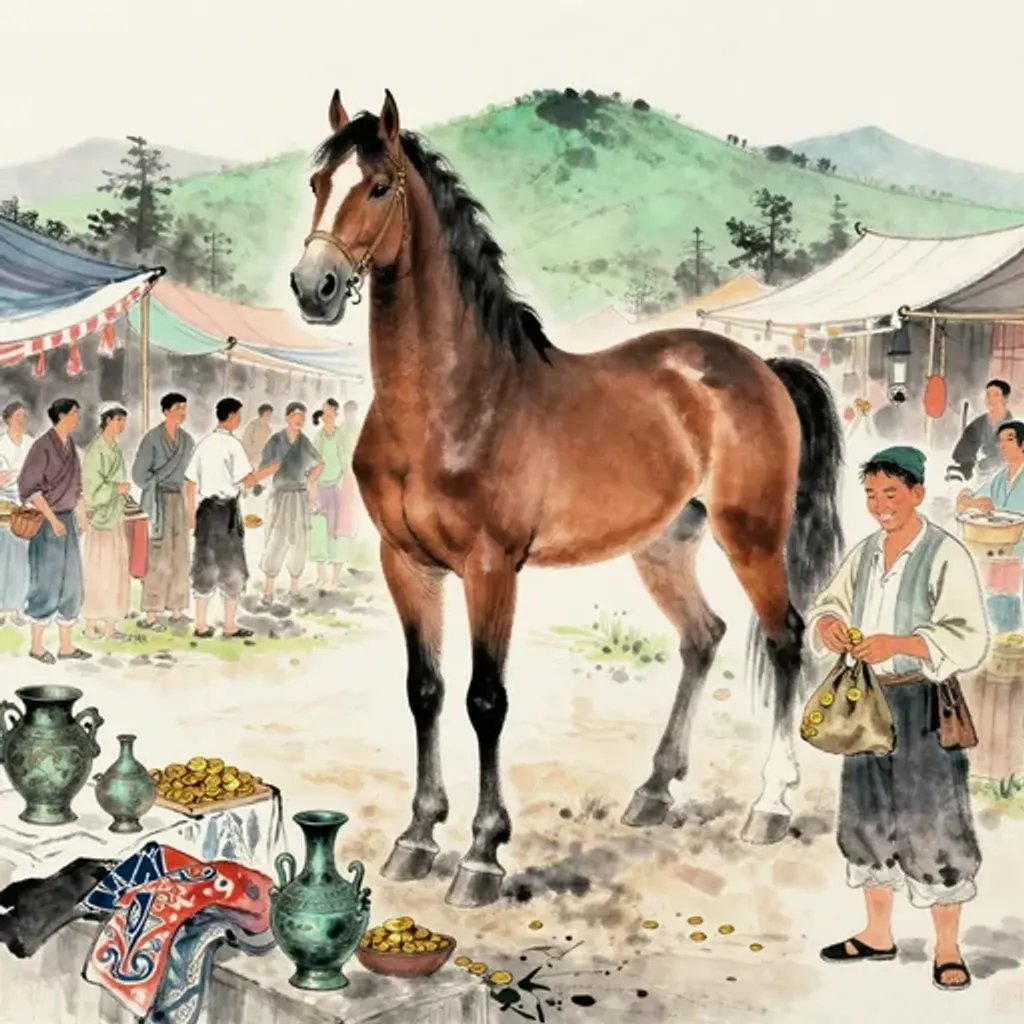
馬服長股,宜行善市。蒙祐諧偶,獲金五倍。

澤中有火,革之象也。

阅读完整注释 ↓

澤中有火,革之象也。馬服長股,宜行善市。蒙祐諧偶,獲金五倍。革之自變——火湖重疊,革故鼎新循環不已。長腿之馬天生適於行路經商,體格健壯、步伐穩健,善市者因時而動、隨機應變。命運眷顧,得遇良偶,獲利五倍。從革至革,有些天性本就為變革而生——永遠的行商者、天生的適應者,恰因萬物不停而獲利。革卦遇革卦,非動盪之災,乃善變者之福。

English commentary

Fire within the lake returns to fire within the lake — Revolution unchanged, the pattern repeating itself. Long-legged horses well suited to their harness, good for travel and commerce. Blessed with fortune and matched with a partner, one gains gold fivefold. When Revolution meets itself, the dynamic is pure transformation without destination: constant molting, constant renewal. The horse with long legs is built for the road; the merchant who matches goods to markets multiplies wealth. There is no resistance, no friction — the pattern flows. From Revolution to Revolution, the message is that some natures are made for change itself: the perpetual trader, the born adapter, profits precisely because nothing stays still.