The Burning of the Houses of Parliament

第30卦

The Clinging Fire

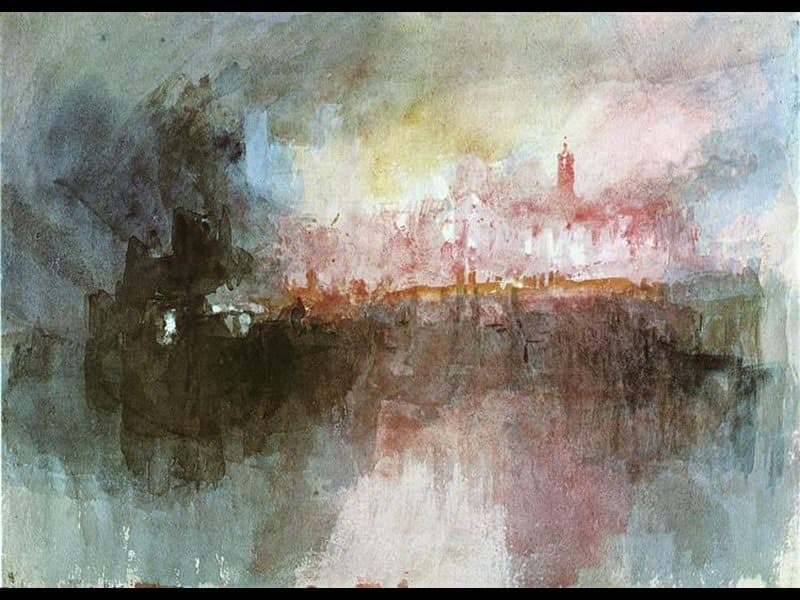
The Burning of the Houses of ParliamentJ.M.W. Turner, 1834

Flames consume the Palace of Westminster, their orange glow reflected in the black Thames as crowds gather on the riverbank. J.M.W. Turner witnessed this 1834 fire and painted multiple versions, capturing how light clings to darkness—the burning buildings illuminate the night sky, flames mirrored in water below, fire and reflection inseparable. The composition doubles illumination: actual conflagration above, its image below, neither existing independently. The crowd stands mesmerized, held by the spectacle of destruction made visible through its own light.

阅读完整论述 ↓

This is Li (離), the Clinging—Fire (Li) doubled, clarity depending on what it consumes. The character depicts a bird clinging to something, emphasizing attachment and dependency. Ancient diviners saw this hexagram as fire needing fuel, light requiring darkness to be perceived, clarity that cannot exist alone. Turner's flames embody this paradox: the fire reveals the palace's architecture in brilliant detail even as it destroys the structure. Each element clings to its opposite—light to dark, revelation to consumption, illumination to annihilation. The painting itself clings to that October night, preserving the event through pigment attached to canvas. Turner witnessed the 1834 fire that destroyed much of the Palace of Westminster and painted multiple versions of the event. The paintings show intense flames reflected in the Thames, with crowds gathered on the riverbank. The imagery of fire and its reflections connects to the hexagram's doubled fire trigram, representing clinging and illumination—the way light both reveals and depends on what it attaches to. The Judgment text states: "It furthers one to be persevering. Success. Care for the cow brings good fortune." The cow image suggests docility and nourishment—fire must be tended carefully, fed regularly, or it either dies or rages destructively. Song Dynasty commentary notes that clarity requires constant maintenance; insights fade without sustained attention, understanding dims without ongoing cultivation. Turner's fire burns uncontrolled, magnificent and terrible, showing what happens when the clinging element escapes proper tending. The palace—seat of British parliamentary power—burns because fire spread beyond its hearth. The painting warns and dazzles simultaneously. The Image Text counsels: "Brightness rises twice. The great person perpetuates the light by illuminating the four quarters." Doubled fire suggests light sustaining itself through succession—one flame lighting the next, clarity passed forward through teaching and transmission. Turner painted this scene but also trained his eye through decades of studying light's behavior. In the I-Ching's sequence, the Clinging follows the Abysmal: after water's formless danger (29), fire's form-giving clarity (30) emerges. But clarity demands attachment—to fuel, to substance, to what it illuminates. The Thames mirrors the burning parliament, light clinging to water's surface, each visible only through the other's presence.

上卦

FireClinging

五行Fire方位East家庭Second Daughter性质illuminating, dependent, radiant

下卦

FireClinging

五行Fire方位East家庭Second Daughter性质illuminating, dependent, radiant

经典文本

卦旨

Li is not brilliance for its own sake. It is the principle of illumination that depends entirely on what it clings to — fire that has no substance of its own and exists only by attaching to fuel. The hexagram doubles Fire: Li above Li, clarity upon clarity. But the defining quality of fire is not its brightness; it is its need. A flame that clings to nothing goes out. The most luminous force in the Yi is also the most structurally dependent. The judgment says 利貞亨 and then specifies 畜牝牛吉 — "keeping a cow brings good fortune." This is the hexagram's corrective instruction, and it is deliberately anticlimactic. After the double fire, after the soaring clarity, the text prescribes the most patient, docile, nourishing image it can find. The cow is the opposite of the flame: slow, steady, giving sustenance without display. Li teaches that brilliance without grounding — intelligence without patience, insight without humility — burns through its fuel and collapses into darkness. The cow is what the fire must cling to. The common misreading celebrates Li as the hexagram of awareness, clarity, and perception. These are its qualities, but its goal is the regulation of those qualities. The doubled structure is a warning as much as an intensification: when fire meets fire, what results is either illumination or conflagration. The difference is attachment. The third line warns of those who do not sustain their light — 日昃之離 — "the fire of the setting sun," brilliance in decline because it failed to attach to something lasting. Li's architecture insists that the brighter the fire, the more essential the question: what are you clinging to? Clarity attached to the enduring illuminates. Clarity attached to the ephemeral consumes itself.

彖辞

Sustained orientation is supported. Fulfillment. Tending the cow resolves well. Fire needs something to burn. That's not a weakness — that's the design. Tending the cow resolves well: the patient, docile, ongoing kind of care. Not the dramatic gesture. The cow. The text is telling you that clarity depends on what feeds it, and the best fuel is the least exciting kind.

象辞

Brightness arises twice: clinging fire. The great person accordingly perpetuates this clarity to illuminate the four directions. Two fires — one after another, like sunrise after sunrise. The great person's job is to keep the clarity going, not to be brilliant once. Illuminating the four directions isn't a spotlight. It's a sun. It doesn't choose where to shine. The continuation is the achievement.

爻辞

第初爻

Treading in confusion. Attending to this with respect: no fault. First steps, everything crisscrossed, nothing clear yet. And the instruction is: respect. Not clarity — you don't have that yet. Respect for the confusion itself. The person who treats their own disorientation with seriousness instead of panic is the one who walks out of it. No fault.

第二爻

Yellow radiance. Supremely resolves well. Yellow. Not white, not red — yellow. The middle color. The balanced light. Supremely resolves well — the best verdict in the book. And it goes to moderation. Not the brightest fire. Not the hottest. The one at the center that sustains without burning. The most powerful version of clarity turns out to be the gentle one.

第三爻

The radiance of the setting sun. Not drumming on clay pots and singing, but the lament of great old age. Adverse. The sun is going down and you have two choices: bang on pots and sing, or wail about getting old. The text says both are adverse. Both. The party and the funeral are equally wrong responses to decline. The setting sun doesn't need your commentary. It needs you to prepare for night.

第四爻

Suddenly it comes. Flaring up. Dying down. Discarded. Arrives suddenly. Burns. Dies. Gone. Four images, no verdict, no advice. Just the description of something that was too bright too fast. The text doesn't even bother telling you this is bad. It just describes the trajectory and lets the silence do the work. You've seen this person. You might be this person.

第五爻

Tears flowing like rain. Grief and lament. Resolves well. Weeping. Real, streaming, uncontrollable tears. And: resolves well. The fifth line of the fire hexagram and the verdict goes to grief. Because this isn't self-pity — this is the kind of crying that happens when you finally see clearly. Clarity and grief arrived at the same time. They usually do.

第上爻

The king deploys a campaign. There is merit in severing the leaders. The captives are not of the same kind. No fault. The king goes to war. Cuts the heads. Spares the rest. No fault. The last line of the clarity hexagram is about surgical force — knowing exactly where the problem starts and stopping there. The captives aren't the enemy. The leaders are. The person who can tell the difference between the disease and the carrier has earned the right to use fire.

焦氏易林

焦延寿《易林》——第30卦本卦之辞。西汉时期以四言诗阐释卦变,为最早的系统性易学占辞集。

Yilin artwork for Hexagram 30
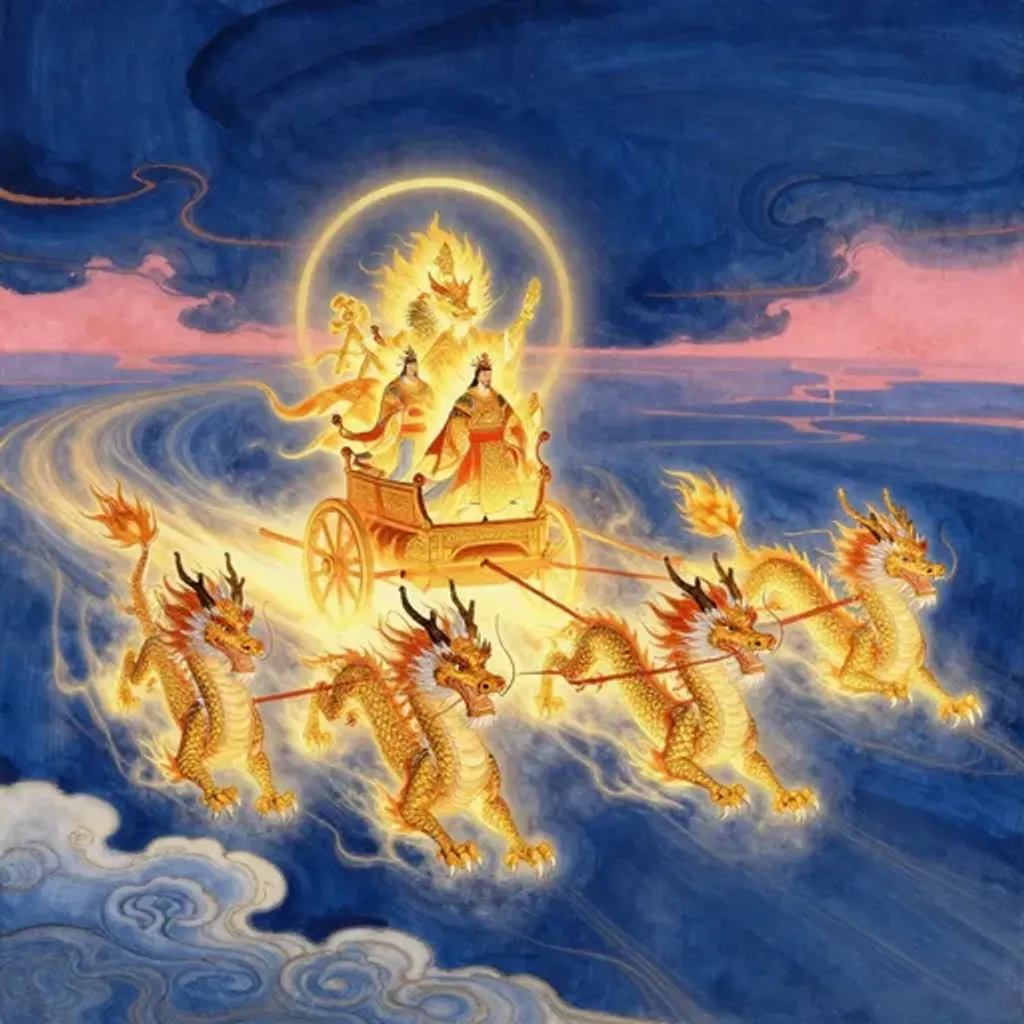
時乘六龍,為帝使東,達命宣旨,無所不通。

明兩作離,離遇離,純明相繼。

阅读完整注释 ↓

明兩作離,離遇離,純明相繼。時乘六龍——出《易經·乾卦·文言》「時乘六龍以御天」。為帝使東——奉天子之命出使東方。達命宣旨,無所不通——宣佈詔令,暢達無阻。從離至離,明兩作,大人以繼明照於四方:離之自身映照。無卦變之張力,唯有光明延續之挑戰。詩以御天之龍為喻,明非自照而是為帝傳光,如使者奉命宣化四方。火之不滅,在於傳遞而非獨燃。

English commentary

Doubled fire meets itself: pure brilliance sustained. Riding the six dragons in season, one serves as the emperor's envoy to the east, proclaiming mandates and conveying edicts with nothing beyond reach. 'Riding the six dragons in season' quotes directly from the I-Ching's Qian hexagram commentary (Wenyan): the sage rides the six dragons to traverse the heavens. Here the envoy carries imperial light in all directions. From The Clinging to The Clinging, fire renews fire in perpetual succession. The great person 'continues brightness to illuminate the four quarters' — this is the hexagram's own image text made flesh. There is no transformation to manage, only the challenge of sustaining radiance without burnout, which the verse resolves through service: light that travels outward on behalf of another never exhausts itself.