Upper Trigram
巽 Xùn
Wind — Gentle
Lower Trigram
兌 Duì
Lake — Joyous
Classical Texts
The Goal
Zhong Fu is not sincerity as emotional display. It is the structural condition of an unobstructed centre — the hollow of the bell that makes the sound possible. Wind (Xun) above Lake (Dui), and the shape says it: two solid lines at the top, two at the bottom, two yielding lines between them, leaving the interior open. 中孚 is centre and confidence together — not confidence as bravado but the trustworthiness that appears when nothing is lodged in the middle. The judgment is 豚魚吉。利涉大川。利貞 — "pigs and fish, good fortune; it furthers to cross the great water; constancy furthers." 豚魚 is read two ways and both are useful: inner truth reaching even the dullest creatures, or the humblest possible offering being accepted. Either way the claim is that what works here is not the scale of the thing offered. 九二 gives the mechanism: 鳴鶴在陰,其子和之,我有好爵,吾與爾靡之 — "a crane calls in the shade; its young answers. I have a good goblet; I will share it with you." The crane does not argue or demonstrate. It sounds its own nature and receives an answering tone, from something it cannot see. Then the goblet: what is true is not diminished by being shared, and the line moves from resonance to hospitality without a break. 九五 completes it — 有孚攣如, "sincerity that binds together" — a binding that needs no enforcement because it works by recognition. 上九 supplies the counter-image, and the hexagram would be sentimental without it: 翰音登于天,貞凶 — "the cock's crow rises to heaven; constancy brings misfortune." Sound climbing where the bird itself cannot follow. The crane calls from the shade and is answered; the cock's cry ascends impressively and is only noise. Same medium, opposite substance — the difference is whether anything is actually behind the sound. Wang Bi puts it in four characters: 音飛而實不從 — the sound flies and the substance does not follow. The goal of Zhong Fu is the inner condition that makes genuine influence possible. The Image: 澤上有風,中孚;君子以議獄緩死 — "the superior person deliberates over criminal cases and delays executions." Where inner truth operates, judgment slows down. The hexagram holds that the strongest influence is not assertion but transparency: letting one's inner reality become visible undistorted, so that whatever can resonate finds its answering tone.
The Judgment
Piglets and fish. Resolves well. Crossing the great river is supported. Sustained orientation is supported. Piglets and fish — the least spiritual, least intelligent creatures available. And inner truth reaches even them. Resolves well. The text starts with the hardest case to make the point: if your sincerity is real enough, it works on pigs. The person whose truth only convinces the already-convinced hasn't tested it. The pig is the test.
The Image
Wind above the lake: inner truth. The realized person accordingly deliberates on criminal cases and delays executions. Wind over the lake — penetrating the surface, reaching the depths. And the instruction is: in criminal cases, take your time. Delay the execution. Because inner truth applied to judgment means understanding before condemning. The person who delays the sentence long enough to understand the crime has done the one thing that justice requires and speed prevents.
The Lines
Line 1
Preparedness resolves well. Having something else brings no peace. Be prepared. Resolves well. But having ulterior motives destroys the peace. The first line of inner truth: sincerity with an agenda isn't sincerity. The moment you add something extra — a hidden purpose, a secret calculation — the inner truth stops working. Preparedness is fine. Preparation for manipulation is not. The text can tell the difference.
Line 2
A crane calling from the shade. Its young answers. I have a fine goblet. I will share it with you. A crane calls from the shadows. Its child responds. You have good wine and you share it. The most beautiful line in the inner truth hexagram — maybe in the whole book. The crane doesn't need to be seen to be heard. The young one recognizes the call from its nature, not from its volume. And the sharing: 'I have something good. Let's drink together.' Inner truth travels like sound in the dark. It finds what belongs to it.
Line 3
Finding a counterpart. Now drumming, now stopping. Now weeping, now singing. You found your match. And now you're a wreck — drumming, stopping, crying, singing. All of it. The third line of inner truth: when your center of gravity depends on another person, your emotional weather depends on theirs. The drum starts and stops with their presence. The tears and songs alternate based on their signals. Beautiful? Maybe. Stable? The text doesn't need to answer that.
Line 4
The moon nearly full. The team horse goes astray. No fault. Almost full moon. One horse breaks from the team. No fault. The fourth line: approaching your peak, and something that was paired with you separates. The horse leaves. And the text says: no fault, because the moon that's almost full must face upward, not sideways at its partner. The separation allows the completion. Letting the horse go is what makes the moon full.
Line 5
Possessing sincerity that bonds. No fault. Truth that binds. That creates a contract just by existing. No fault. The fifth line of inner truth: sincerity so complete it becomes structural. Not a feeling anymore — a bond. The person whose inner truth has become a force that holds things together has stopped being sincere and started being gravity. No fault because there's nothing to fault. It just is.
Line 6
The rooster's cry ascends to heaven. Sustained orientation: adverse. The rooster crows and the sound reaches heaven. Sustained orientation: adverse. The top of the inner truth hexagram, and the failure is: all voice, no flight. The rooster can announce the dawn but it can't reach it. The person who mistakes the power of proclamation for the power of truth has confused the signal with the substance. Keep crowing: adverse. The dawn doesn't need your announcement.
Yilin: Forest of Changes
From Jiao Yanshou's Forest of Changes (焦氏易林) — the verse for Hexagram 61 in its unchanging form. A Han dynasty collection of four-character verses interpreting every hexagram transformation.
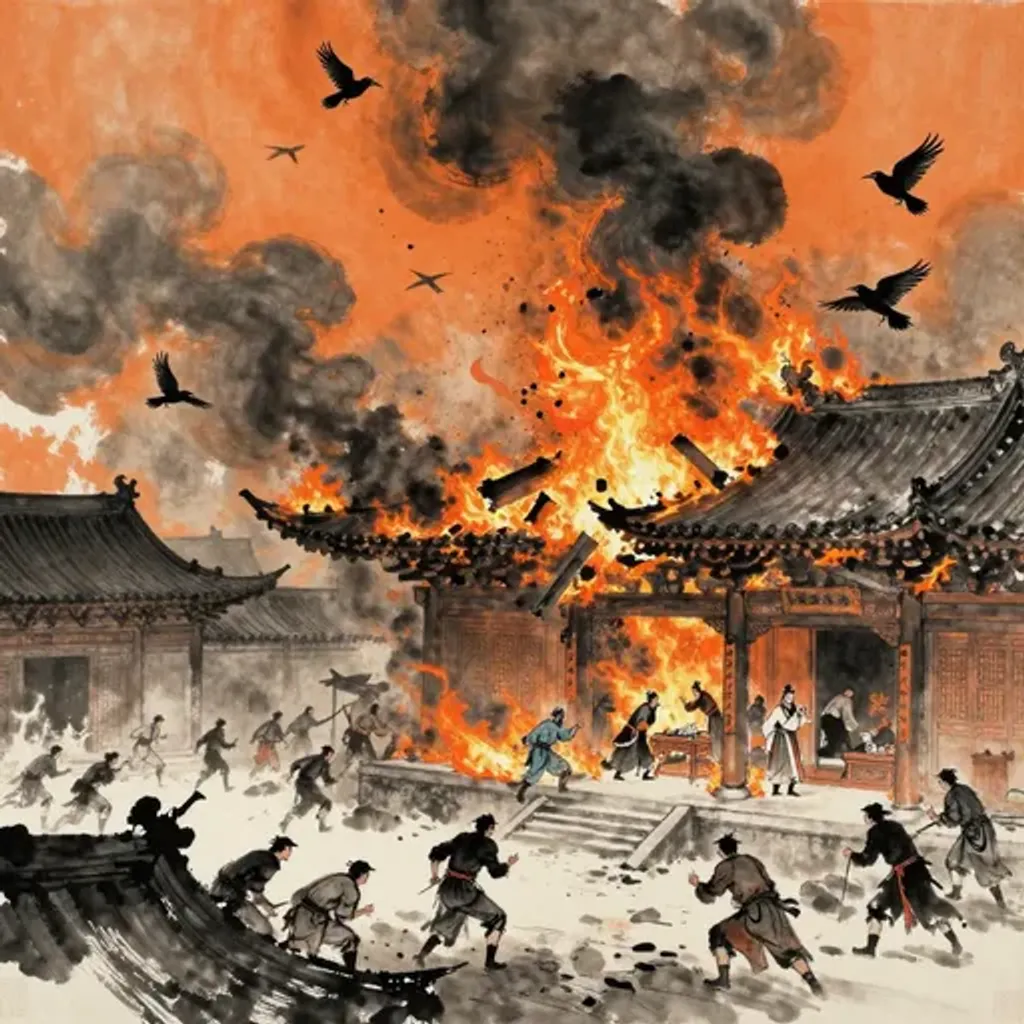
鳥鳴喈喈天火將下燔我屋室災及妃后
Crows crying out alarums; heaven's fire about to fall. Burning my house and chambers; disaster reaches the queen.
Read full commentary ↓
Wind stirs above the lake — and returns to itself. Crows caw their alarm; heavenly fire is about to descend. The house burns; the disaster reaches the queen herself. This is Inner Truth confronting its own mirror: the source hexagram and target are identical, meaning no transformation occurs. The crows (烏鳥) are traditional fire omens, and their cries announce catastrophe for the very center of the household. The 'heavenly fire' consuming the palace may echo the story of Lady Boji, who perished in the Song palace fire of 543 BC because she refused to leave without her chaperone — sincerity carried to fatal extreme. When inner truth doubles upon itself without transformation, conviction calcifies into destruction. The very virtue that defines this hexagram becomes its consummate danger.
中文註釋
澤上有風,中孚歸於自身——源卦與之卦相同,無變化發生。烏鳥譆譆——鴉鳥驚鳴,為火災之凶兆。天火將下——天降大火。燔我屋室——焚毀居所。災及妃后——禍延至后妃。「天火」焚宮或即伯姬之事:前543年宋宮失火,伯姬以傅母不在而不肯出,守禮而死——中孚(誠信)之極端化為致命。中孚自疊而無變,信念凝固為毀滅。定義此卦之美德在無轉化時反成至危——此即中孚之暗面。
This commentary was written against an earlier reading of the verse. Where the reading has since changed, the interpretation itself may no longer apply.
Jiao Shi Yi Lin 《焦氏易林》, manuscript from the Wenyuan Pavilion Siku Quanshu, Qianlong period, Qing dynasty.
National Palace Museum, accession nos. 故庫017987–017990
Fascicle 4, page 174
Read from the manuscript leaf
Shown unpunctuated, as in the manuscript.
About this reading
Read from the scanned leaf.
Related Hexagrams
Same upper trigram: Wind (巽)
Same lower trigram: Lake (兌)