上卦
兌 Duì
Lake — Joyous
下卦
坤 Kūn
Earth — Receptive
经典文本
卦旨
Cui is not mere assembly. It is the gathering of people around a center that holds — and the hexagram's primary concern is what makes that center worthy of congregation. Lake (Dui) above Earth (Kun) shows joyous energy collecting on receptive ground, water pooling in a natural depression. The judgment is unusually dense: 亨。王假有廟。利見大人。亨,利貞。用大牲吉。利有攸往 — "success; the king approaches his temple; it furthers to see the great person; success, perseverance furthers; bringing great offerings creates good fortune; it furthers to undertake something." The repeated 亨 (success) is notable — gathering together is endorsed twice, but each endorsement is immediately qualified. The temple provides the spiritual axis. The great person provides the human center. Offerings provide the material commitment. Without these three elements, assembly drifts into mere crowd. The Image text delivers an unexpected warning: 澤上於地,萃。君子以除戎器,戒不虞 — "the lake over the earth, Gathering Together. The superior person prepares weapons to meet the unforeseen." Where people gather, conflict follows. Where resources concentrate, predation arrives. The hexagram does not romanticize congregation — it insists that gathering requires vigilance. The first line captures the instability of the ungathered: 有孚不終。乃亂乃萃 — "sincerity that does not endure; now disorder, now gathering." Without a strong center, the group oscillates between fragmentation and assembly, never achieving stable form. The remedy follows immediately: 若號一握為笑 — "if you call out, after one clasp of the hand you can laugh again." Connection is restored through direct action, through reaching out, through the physical gesture that converts isolation into belonging. The goal of Cui is to create the conditions under which gathering becomes sustainable rather than temporary. The hexagram regulates the relationship between the center and what gathers around it. The fifth line reveals the test of legitimate authority: 萃有位。无咎匪孚。元永貞。悔亡 — "gathering together in a position of authority; no blame, even if not all are sincere; sublime and enduring perseverance; remorse disappears." Not everyone who gathers does so from genuine loyalty. The center must hold regardless, through constancy rather than through charm, earning trust over time rather than demanding it at once.
彖辞
Fulfillment. The king approaches the ancestral temple. Seeing the great person is supported. Fulfillment. Sustained orientation is supported. Using great sacrificial offerings resolves well. Going forward is supported. The king goes to the temple. Everything is supported — seeing the great person, persistence, great offerings, going forward. The gathering hexagram assembles every positive signal available. But it starts at the temple. Not the marketplace, not the battlefield. The temple. Because a gathering without a center of meaning is just a crowd.
象辞
The lake rises above the earth: gathering together. The realized person accordingly sets aside weapons and tools, and guards against the unexpected. The lake swelling above the earth — gathering rising to the point of overflow. And the instruction is: prepare your defenses. Not because the gathering is hostile. Because wherever people collect, friction follows. Wherever wealth accumulates, theft arrives. The realized person who arms before the trouble starts has understood that gathering is both the achievement and the risk.
爻辞
第初爻
Having sincerity but not to the end. Confusion, then gathering. If you call out, one handclasp restores laughter. Do not worry. Going forward: no fault. Sincerity that wavers — you're in, then you're confused, then you're in again. And the fix is embarrassingly simple: call out, and one handshake brings back the laughter. Don't worry. Go forward. The first line of gathering knows that most wavering isn't about conviction. It's about loneliness. One hand reaching back is enough to resolve it.
第二爻
Being drawn in resolves well. No fault. If sincere, then even the modest spring offering is supported. Let yourself be drawn. Don't overthink the pull — just go toward it. Resolves well. And if you're sincere, even the smallest offering works. The second line: you don't need to earn your place in the gathering. You need to show up with whatever you have. The modest offering from a sincere person outranks the grand offering from a calculating one.
第三爻
Gathering amid sighs. No direction is supported. Going forward: no fault. Small friction. Sighing at the gathering — you're on the outside looking in. No direction works from here, but going forward isn't wrong either. Small friction. The third line is the person who arrives late to a group that's already formed. Awkward. Not catastrophic. The text gives you the kindest possible version of 'just deal with the embarrassment and keep moving.'
第四爻
Great resolve well. No fault. Four characters. Great resolve well. No fault. The fourth line of gathering and the verdict is: this is right. No elaboration, no conditions, no caveats. When the gathering is real and you're working for it without personal ambition, the text doesn't waste words. It just says: yes.
第五爻
Gathering has position. No fault. If some are not yet sincere, supremely enduring sustained orientation — then deviation detected dissolves. You have authority in the gathering. No fault. But some people aren't sincere yet — they're here for the position, not the purpose. The solution: supreme, enduring persistence. Not confrontation. Not purging. Just being so consistently genuine that the insincere ones either become sincere or become visible. Patience as a filter.
第上爻
Offering counsel amid tears and weeping. No fault. Crying at the gathering. Offering advice through tears. No fault. The top of the gathering hexagram and the image is grief mixed with contribution. Because sometimes the sincerest thing you can bring to a gathering is your sorrow. The person who shows up broken and still offers what they have? The text calls that faultless. Because it is.
焦氏易林
焦延寿《易林》——第45卦本卦之辞。西汉时期以四言诗阐释卦变,为最早的系统性易学占辞集。
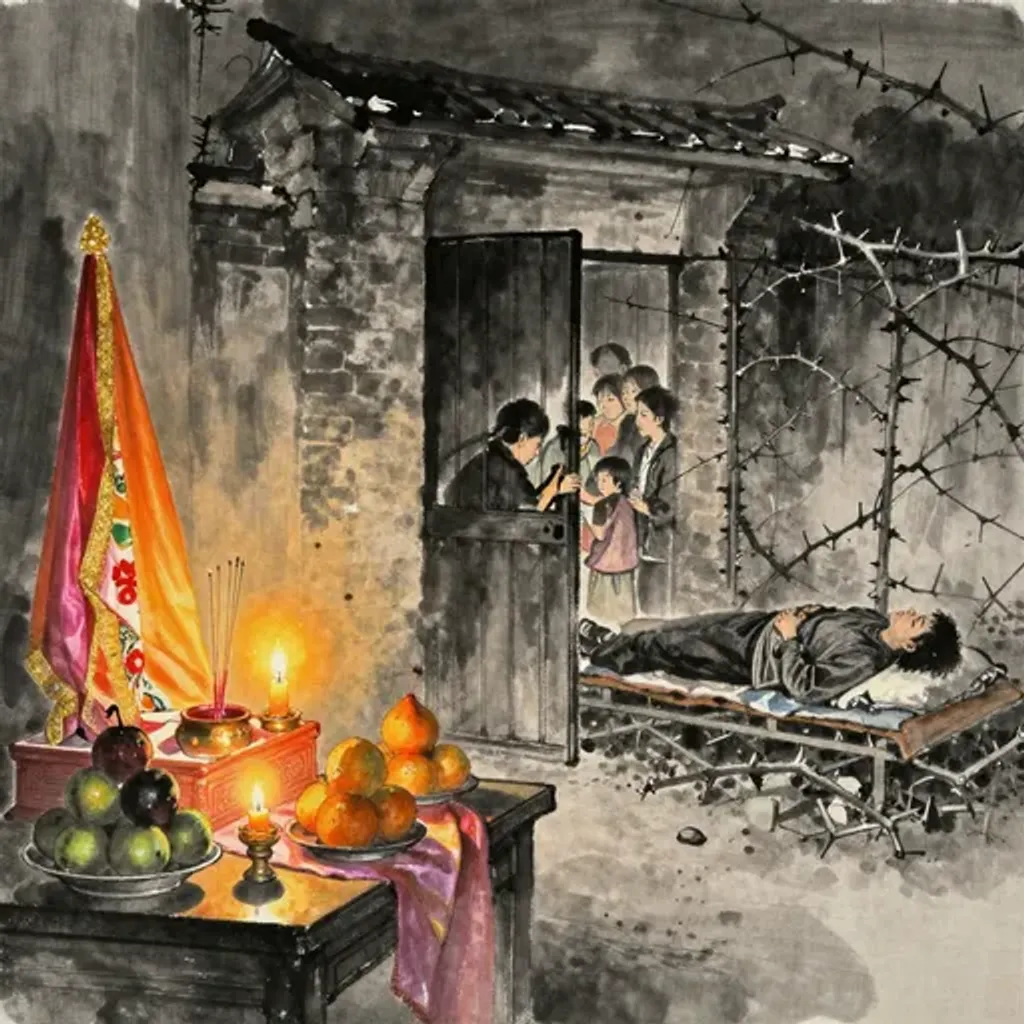
蒙慶受福,有所獲得。不利出城,病人困棘。
澤上於地,萃也,變而仍為萃。
阅读完整注释 ↓
澤上於地,萃也,變而仍為萃。蒙慶受福——承蒙恩澤,有所獲得。不利出城——出城則不利,城外有險。病人困棘——患者困於荊棘之中,動彈不得。詩意截然兩分:城內有福,城外有禍;聚合之處有庇護,離散之途有荊棘。病者之困境更深一層:疾病使人不得不留於原地,而原地之聚合漸成桎梏。從萃至萃,聚合凝固為靜止。社群能護其內而不能及其外,聚合之力不可輸出。需要離開者卻被困住,保護反成囚禁。
English commentary
Lake upon earth remains lake upon earth, Gathering unchanged. Blessed with grace and receiving fortune, there is something gained. But it is not favorable to leave the city walls; the sick person is trapped in thorns. The verse splits cleanly between inside and outside: within the gathered space, blessings arrive; beyond its walls, danger waits. The sick person's predicament intensifies this: illness pins one to a place even as the place itself becomes confining rather than protecting. From Gathering to itself, the transformation is stasis. The community sustains those within but cannot extend its protection beyond its own boundaries. What gathers here cannot be exported, and those who need to move find themselves held fast by the very forces that should help them.
