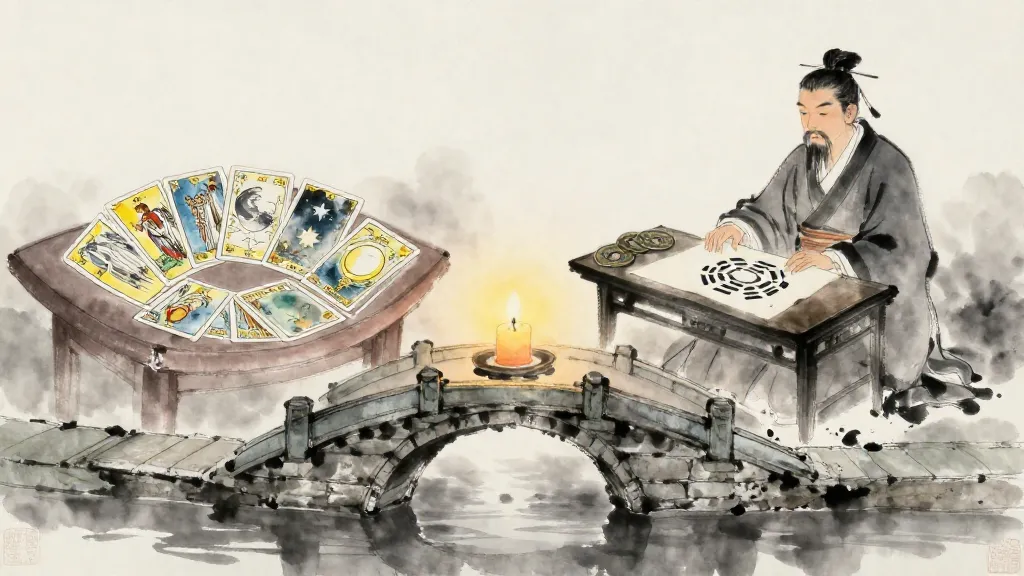
The Other Oracle
Why tarot readers keep finding the I-Ching—and bouncing off it. What nobody told you about the oldest divination system still in daily use.
Part 1 of The Other Oracle — a series for tarot readers who want to understand the I-Ching.
The Pattern You Recognise
You've been reading tarot for a while. Maybe years. You're comfortable with the cards, you trust your relationship with the deck, and you've developed an intuition for how the images speak to you. At some point—through a book, a podcast, a friend, a passing reference in a text about divination—you encounter the I-Ching.
Something about it pulls at you. The age of it, maybe. Three thousand years of continuous use. Or the elegance: sixty-four hexagrams built from just two kinds of lines, broken and unbroken. Or the reputation among people whose judgment you trust—Carl Jung studied it, Leibniz saw binary mathematics in it, and every serious tradition of Chinese metaphysics treats it as the foundational text.
So you try it. You toss three coins. You look up the hexagram in a book. And you read something like this:
“The superior man, in accordance with this, nurtures his virtue and perfects his talent. He waits for the proper time to act.”
You stare at it. You read it again. You feel nothing. No image surfaces, no narrative unfolds, no intuition fires. It's advice—fine advice, probably—but it reads like a fortune cookie written by a Confucian bureaucrat. Where are the images? Where is the story? Where is the feeling you get when you turn over the Tower or the Star?
You close the book. You go back to your deck. And you wonder what everyone else sees in this thing.
If this is your experience, you're not alone. And you're not wrong. But you're also not seeing the whole picture. What happened is that you ran into a translation problem—not just of language, but of framework. The I-Ching was speaking. You just didn't have the ear for it yet.
What Tarot Gives You
Tarot is brilliant at what it does. Let's name what it does, because understanding tarot's strengths is the fastest way to understand what the I-Ching offers instead.
Tarot gives you images. Not abstractions, not principles, but scenes. A blindfolded figure with two swords crossed over her chest. A man walking away from eight stacked cups under a red moon. A tower struck by lightning with two figures falling from its crown. Each card is a painting, and each painting carries a world of symbolic meaning that you can read intuitively, before you consult any book.
Tarot gives you archetypes. The Major Arcana traces a journey—the Fool's journey—from innocence through initiation to completion. It's the hero's journey mapped onto twenty-two stations. You encounter the Magician (mastery of tools), the High Priestess (hidden knowledge), the Empress (abundance), the Emperor (structure), and on through Death (transformation), the Tower (collapse), and finally the World (integration). This is a story about you.
Tarot gives you positions. In a spread, each card occupies a defined role: past, present, future, hopes, fears, outcome. The Celtic Cross gives you ten positions; a three-card pull gives you three. The spread is a stage, and the cards are actors placed upon it. You can see the whole reading at once, laid out on the table.
These are genuine strengths. The I-Ching doesn't have any of them. It has no pictures. It has no hero's journey. It has no spread you can photograph and post. If you come to the I-Ching looking for what tarot does, you will be disappointed every time.
What the I-Ching Gives You Instead
The I-Ching gives you motion.
In tarot, the cards in your spread don't move. The Six of Cups in the past position stays the Six of Cups. It might mean something about change, but the card itself is static. The I-Ching's hexagrams are not static. Some of the lines in your hexagram are stable, and some are in the act of changing—old yang about to break into yin, old yin about to rise into yang. When they change, the hexagram transforms into a different hexagram. Your reading just grew a second chapter, and it did so from the inside—not because you drew another card, but because the original pattern carried its own future within it.
The I-Ching gives you the cosmos, not the hero.
Tarot is magnificently human-centred. The Fool's journey is your journey. The court cards are people in your life. The suits map your inner world: emotion (Cups), thought (Swords), will (Wands), body (Pentacles). Everything revolves around you.
The I-Ching doesn't revolve around you. It shows you the conditions of heaven and earth that you happen to be standing in. It describes the weather, not the traveller. This feels impersonal at first. But for many tarot readers—especially experienced ones—it's a relief. You stop being the centre of every reading. Instead, you see the larger pattern, and you find yourself within it.
The I-Ching gives you combination.
Tarot has seventy-eight cards, and each one is a distinct entity with its own image and meaning. The I-Ching has sixty-four hexagrams, but they're not sixty-four separate things. Each hexagram is built from two trigrams—three-line patterns, of which there are only eight. The eight trigrams are the real vocabulary. The sixty-four hexagrams are every possible conversation between them. This means you don't need to memorise sixty-four meanings. You need to learn eight characters and understand what happens when they meet.
The Translation Problem
So why does the I-Ching feel dead on the page when you first encounter it?
Because most English translations layer on twenty-five centuries of Confucian commentary and present it as the original text. The voice you're hearing—“the superior man,” “the great man,” “it furthers one to cross the great water”—is not the voice of the oracle. It's the voice of court scholars interpreting the oracle for an audience of government officials. The feudal framing is one layer of a much deeper text.
Underneath the Confucian commentary, the I-Ching speaks in images that are closer to poetry than to bureaucratic advice. Dragons rising from the deep. Thunder beneath the earth. Wind over the lake. Ice forming under your feet. A well whose water is clear but that no one drinks from. These are images as vivid as anything in the Major Arcana—but they're buried under centuries of moralising gloss.
Benebell Wen, in her I-Ching, The Oracle, makes a compelling case for recovering the shamanic and magical dimensions that the Confucian layer buried. Our approach here is different—we're going to focus on the structural logic, the system that makes the I-Ching work as an oracle—but both are attempts to get past the “superior man” and hear what the hexagrams are actually saying.
The “Sixty-Four Cards” Misconception
Here's the single most useful thing this series can tell you about the I-Ching: you don't need to learn sixty-four hexagrams.
When tarot readers approach the I-Ching, they naturally think of the sixty-four hexagrams as sixty-four cards, each with its own personality and meaning to be memorised. This framing makes the system feel overwhelming, and worse, it obscures how the I-Ching actually works.
The real unit of meaning in the I-Ching is the trigram—a pattern of three lines, either broken (yin) or unbroken (yang). There are exactly eight possible trigrams. Each one has a name, an element, a family role, a direction, a season, and a personality. Heaven is the creative father. Earth is the receptive mother. Thunder is the eldest son, all sudden movement. Wind is the eldest daughter, gentle but penetrating. Water is danger and depth. Fire is clarity and illumination. Mountain is stillness. Lake is joy.
A hexagram is simply two trigrams stacked: a lower trigram (the inner situation) and an upper trigram (the outer situation). Thunder over Earth tells a different story than Earth over Thunder. Fire beneath Water means something different than Water beneath Fire. If you know the eight characters, you can read the bones of any hexagram by asking: who is below, who is above, and what happens when they meet?
This should sound familiar. Tarot readers already think in terms of elemental combinations—fire and water in tension, earth and air in dialogue. The trigrams work the same way, except there are eight elements instead of four, and the combination is the reading.
What This Series Will Give You
This series is designed for tarot readers who are ready to learn the I-Ching on its own terms—not as a replacement for tarot, but as a second oracle that sees differently.
In Part 2, we'll meet the eight trigrams as characters you can hold in your head after a single reading. We'll map them to the elemental language you already speak—honestly, showing where the systems align and where they don't.
In Part 3, we'll learn what makes the I-Ching truly different: the lines move. Changing lines are the oracle's way of showing you not just where you are, but where you're going. If you've ever wished a tarot spread could evolve on its own, this is the mechanic that does it.
In Part 4, we'll step back and look at why the I-Ching sees the way it does. Where tarot maps the hero's journey, the I-Ching maps heaven, earth, and the space between. This isn't abstract philosophy—it's the reason the oracle answers the way it does.
And in Part 5, we'll do a reading together. Three coins, six throws, a real question, and a real interpretation. By the end, you won't need a book. You'll have the system in your hands.
The I-Ching isn't a replacement for tarot. It's the other oracle—the one that's been waiting for you to learn its language.