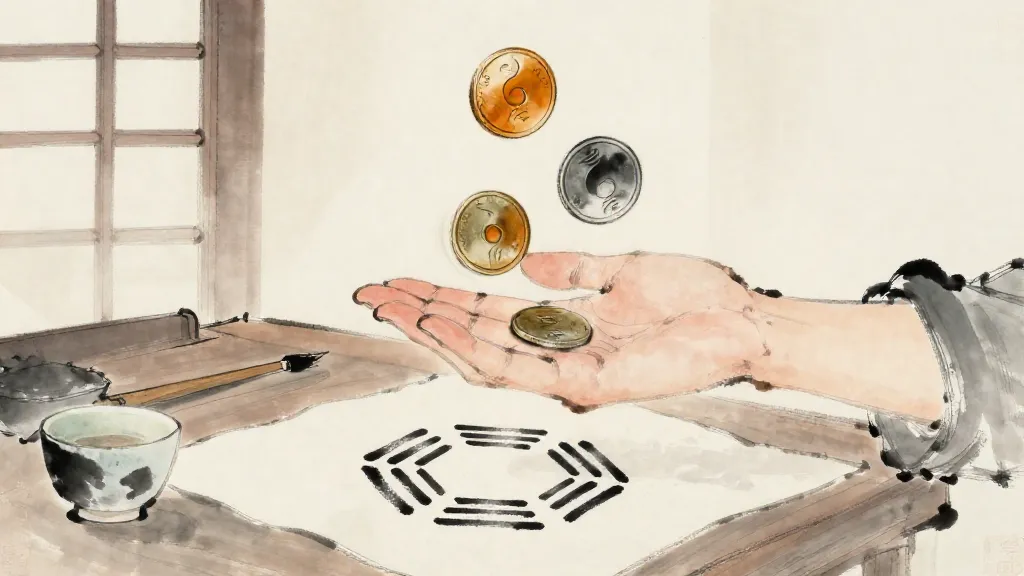
Your First Reading
Three coins, six throws, a real question, and a real interpretation. Everything you need to do your first I-Ching reading—no book required.
Part 5 of The Other Oracle — a series for tarot readers who want to understand the I-Ching.
What You Need
Three coins. That's it.
Any three coins where you can tell heads from tails. Quarters, pennies, euros, yen—whatever is in your pocket. Some practitioners use special Chinese bronze coins with a square hole in the centre. These are beautiful and they feel good in the hand, but they're not required.
Purists use yarrow stalks—the oldest method, involving a ritual sorting of fifty stalks that takes several minutes per line. It produces slightly different probabilities than coins and has a meditative quality that many practitioners value. Benebell Wen describes a full ritual preparation in her I-Ching, The Oracle, including cleansing coins with salt and consecrating them. All of these approaches are valid traditions. You can start with pocket change.
Forming the Question
The I-Ching responds best to questions about conditions, not outcomes. It doesn't predict the future in the way that a yes/no oracle might. It shows you the shape of the present moment and the direction things are moving.
Questions that work well:
- “What do I need to understand about this situation?”
- “What is the nature of this moment?”
- “What should I be aware of as I consider this decision?”
- “What are the conditions around [specific topic]?”
Questions that don't work as well:
- “Will X happen?” (The I-Ching shows conditions, not prophecies.)
- “Should I do A or B?” (Ask about each option separately.)
- “When will this change?” (The hexagram shows whether things are changing, not a timeline.)
If you want to go deeper on question framing, Benebell Wen's “Asking Smarter Questions in Divination” is an excellent framework that applies to both tarot and I-Ching practice.
For your first reading, keep it simple. Think of something genuinely on your mind—a situation, a relationship, a decision you're weighing. Hold the question clearly. Then pick up the coins.
The Coin Method, Step by Step
You will throw three coins six times. Each throw produces one line. The six lines build your hexagram from the bottom up.
Step 1: Assign Values
Heads = 3. Tails = 2. (If using Chinese coins, the side with characters = 3, the blank side = 2.)
Step 2: Throw and Add
Throw all three coins at once. Add their values. You will get one of four results:
| Total | Coins Showed | Line Type | Draw It As |
|---|---|---|---|
| 6 | 3 tails (2+2+2) | Old Yin — changing | ⚊⚊ with ○ |
| 7 | 2 tails, 1 head | Young Yang — stable | ⚊ |
| 8 | 2 heads, 1 tail | Young Yin — stable | ⚊⚊ |
| 9 | 3 heads (3+3+3) | Old Yang — changing | ⚊ with ✕ |
Step 3: Build From the Bottom Up
Your first throw becomes the bottom line (line 1). Your second throw becomes line 2, and so on up to line 6 at the top. This is the most common mistake newcomers make—building from the top down. The hexagram grows upward, like a plant.
Write each line as you throw. Mark the changing lines (6 and 9) clearly—you'll need them in a moment.
Step 4: Identify Your Trigrams
Once you have six lines, split them into two groups: the bottom three lines are your lower trigram, the top three are your upper trigram. Look up each trigram in this reference:
| Pattern | Trigram | Image |
|---|---|---|
| ☰ three yang | Qian 乾 | Heaven |
| ☷ three yin | Kun 坤 | Earth |
| ☳ yang-yin-yin | Zhen 震 | Thunder |
| ☴ yin-yang-yang | Xun 巽 | Wind |
| ☵ yin-yang-yin | Kan 坎 | Water |
| ☲ yang-yin-yang | Li 離 | Fire |
| ☶ yin-yin-yang | Gen 艮 | Mountain |
| ☱ yang-yang-yin | Dui 兌 | Lake |
Now you can name your hexagram: “[Upper trigram] over [Lower trigram].” You can also look it up by number on the hexagram viewer.
Reading Your Hexagram
You now have a hexagram—two trigrams in a relationship. Here is how to read it, in order of importance:
1. Read the Overall Image
Start with the two trigrams. Who is below? Who is above? What happens when these two characters meet?
If you drew Water below and Fire above (Hexagram 63, After Completion): Water rises, Fire descends. They move toward each other. Everything is in its right place—but that very completeness contains the seed of its own unravelling. After completion, the only direction is toward disorder.
If you drew Fire below and Water above (Hexagram 64, Before Completion): Fire rises, Water descends. They move apart. Nothing has come together yet—but everything is in motion toward meeting. The situation is unresolved but full of potential.
Same two characters. Reversed positions. Opposite readings. This is the trigram logic you learned in Part 2.
2. Read the Changing Lines
If you have no changing lines, the hexagram speaks as a whole. The situation is stable. Read the overall image and sit with it.
If you have changing lines (6 or 9), focus there. These are where the oracle is speaking loudest. Each line position has its own character:
- Line 1 (bottom): The beginning. Something emerging, not yet visible.
- Line 2: The inner centre. Your core position. Often favourable.
- Line 3: The transition from inner to outer. A threshold. Often difficult.
- Line 4: The first step into the outer world. A minister approaching the ruler. Cautious.
- Line 5: The ruler's position. Authority, decision, the peak of influence.
- Line 6 (top): The end. Overreaching, departure, or transcendence.
A changing line in position 1 suggests something is stirring at the foundation. A changing line in position 5 suggests the core power dynamic is shifting. A changing line in position 6 suggests something has gone as far as it can go.
3. Read the Transformed Hexagram
Flip all the changing lines. Old yin becomes young yang. Old yang becomes young yin. The new hexagram is where the situation is heading. Read its overall image the same way you read the first: who is below, who is above, what happens when they meet?
The story is: you are here (primary hexagram), this specific part is shifting (changing lines), and you're moving toward there (transformed hexagram).
A Complete Example
Let's walk through a real reading. The question: “What do I need to understand about this new project I'm considering?”
Six throws produce:
Throw 6 (top): heads, heads, tails = 3+3+2 = 8 → young yin ⚊⚊
Throw 5: heads, tails, tails = 3+2+2 = 7 → young yang ⚊
Throw 4: tails, tails, tails = 2+2+2 = 6 → old yin ⚊⚊ ○ (changing)
Throw 3: heads, tails, tails = 3+2+2 = 7 → young yang ⚊
Throw 2: heads, heads, tails = 3+3+2 = 8 → young yin ⚊⚊
Throw 1 (bottom): heads, tails, tails = 3+2+2 = 7 → young yang ⚊
Lower trigram (lines 1-3, bottom to top): yang, yin, yang = ☲ Li, Fire.
Upper trigram (lines 4-6, bottom to top): yin (changing), yang, yin = ☵ Kan, Water.
Water over Fire = Hexagram 63, After Completion. (既濟, jì jì.) Everything has found its place. Water above Fire: water naturally descends, fire naturally rises, so they move toward each other. The situation is complete, ordered, settled. In a new project context: the foundations are good. The conditions are favourable. Things are aligned.
But line 4 is changing. Line 4 is the transition from inner to outer—the first step into the visible world. And it's old yin, about to become yang. Something in the outer situation is shifting from receptive to active.
When line 4 flips from yin to yang, the upper trigram changes from Water (☵, yin-yang-yin) to Wind (☴, yin-yang-yang). Wind over Fire = Hexagram 50, The Cauldron. (鼎, dǐng.) The cauldron is the ritual vessel—a container for transformation, for cooking raw materials into something nourishing. Wind (below in function, providing air) feeds Fire, which transforms what's inside the vessel.
The reading: Your situation is currently well-ordered (After Completion). The foundations are sound. But the transition point—line 4, where inner preparation meets outer action—is changing. The direction is toward the Cauldron: a vessel for transformation, something that takes raw materials and refines them. The project isn't just favourable in its current state; it's moving toward becoming a container for real work. The counsel: the conditions are right, and what's emerging is substantial. Feed it.
After the Reading
Sit with it. The I-Ching doesn't give you instructions. It gives you a picture of conditions. Your job is to recognise yourself inside that picture—to see where you stand in the relationship between what's above and what's beneath, what's stable and what's changing.
This is where tarot readers often have an advantage. You're already trained to sit with symbolic images and let them speak. You know that the first interpretation that jumps to mind isn't always the deepest one. You know that readings reveal themselves over hours and days, not just in the moment of the draw.
The I-Ching works the same way. Let the hexagram sit with you. Return to it. Notice which part of the image keeps pulling your attention. That's where the oracle is speaking to your situation.
Where to Go from Here
You've just done something people have been doing for three thousand years—asking six lines to show you the shape of the moment. If this reading made something click, the rest of the I-Ching is waiting for you.
- The trigram families in depth: Our Eight Palaces series explores how each trigram generates a family of eight hexagrams, showing the structural logic behind all sixty-four.
- The full analytical method: The Liu Yao series teaches the classical Chinese system for reading hexagrams with precision—assigning elements to lines, identifying the “useful spirit,” and reading interactions between changing and stable lines.
- 4,096 poetic verses: The Yilin (Forest of Changes) contains one verse for every possible hexagram transformation—4,096 poems, each a miniature oracle in four lines. If you love the poetic dimension of divination, this tradition will feel like home.
- Explore the hexagrams: Our interactive hexagram viewer lets you browse all sixty-four hexagrams, see their trigram composition, and explore their relationships.
The I-Ching is not a replacement for tarot. It never was. It's the other oracle—the one that shows you the weather instead of the traveller, the landscape instead of the hero, the conditions of heaven and earth instead of the drama of the human heart. Both perspectives are valuable. Having both makes you a better reader of whatever oracle you hold.