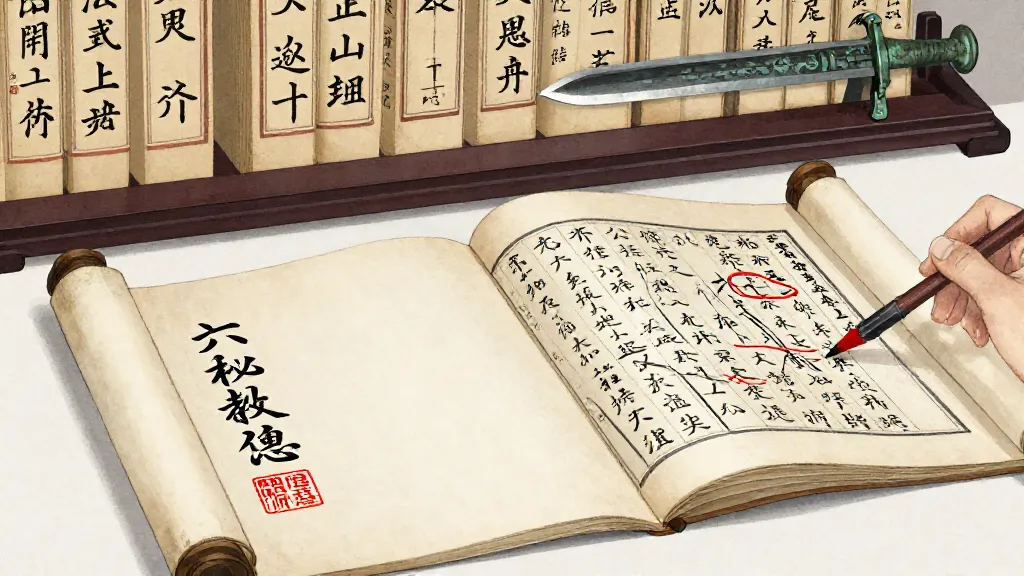
Every Forgery in the Military Canon
The Qing imperial scholars didn't just catalog military texts—they systematically dismantled them. Their methods for detecting forgeries anticipated Western textual criticism by centuries. Here is what they found, and how they found it.
Part 12 of The Emperor's Library — how China reviewed all knowledge.
The Problem with Old Books
Chinese military literature has a forgery problem. By the time Ji Yun's team reached juan 99–100 of the Siku Quanshu Zongmu Tiyao (四庫全書總目提要)—the section filed under Masters (子部), subcategory Military Strategists (兵家類)—they were confronting a tradition in which nearly every major text claimed to be older than it was, attributed to a more famous author than had written it, and padded with material that did not belong.
Out of 67 military texts reviewed, 20 made the main catalog and 47 were relegated to the cunmu (存目). The compilers' preamble to the section opens with a frank acknowledgment: military writings existed in antiquity, but “everything attributed to Feng Hou and earlier figures is fabricated” (風后以前之書皆偽). This is not a diplomatic hedging. This is a senior bibliographer telling you the tradition lied about its own origins.
What makes the compilers remarkable is not that they spotted forgeries—scholars had been questioning attributions for centuries—but that they developed and applied a systematic method. They checked vocabulary against period usage. They traced citation chains across bibliographic records. They compared internal claims against external evidence. And they documented everything, text by text, so that later readers could verify their reasoning.
The Liu Tao: Anatomy of a Prestigious Forgery
The Liu Tao (六韜), the Six Secret Teachings, is attributed to Jiang Taigong (姜太公)—the legendary advisor who helped King Wen of Zhou overthrow the Shang dynasty around 1046 BC. If genuine, it would be one of the oldest military texts in existence. It was canonical: Song Emperor Shenzong included it in the Seven Military Classics (武經七書) in 1080, making it part of the examination curriculum for military officers. Generations of generals studied it as scripture.
The compilers dismantled the attribution with surgical precision. Their case proceeded in layers.
The bibliographic layer. The Han Shu bibliography does not list a “Liu Tao” under military texts. It lists a “Zhou History Six Tao” (周史六弢) under the Confucian category, which the historian Ban Gu dated to the Warring States period. The Tang commentator Yan Shigu later conflated the two, “perhaps following Lu Deming's note and forcing a connection” (毋亦因陸德明之說而牽合附會歟). The compilers separated them: the Han-era text and the received Liu Tao are not the same book.
The vocabulary layer. The text contains the phrase “avoid the main hall” (避正殿), describing a ritual practice that only began in the Warring States period. A text supposedly from the early Zhou should not contain terminology that did not exist until five centuries later. The compilers flag this as a dating marker: whoever wrote this passage lived after the practice was established.
The institutional layer. The title “general” (將軍) appears in the Liu Tao as a standard military rank. The compilers note that this title first appears in the Zuo Zhuan and did not exist in the early Zhou military system. Jiang Taigong could not have used a rank that had not yet been invented.
The technical layer. The Yinfu (陰符) chapter describes a system of signal tallies graded by length—a physical token system for battlefield communication. The compilers deliver their most contemptuous judgment here:
偽撰者不知陰符之義,誤以為符節之符,遂粉飾以為此言,尤為鄙陋。
“The forger did not understand the meaning of yinfu, mistaking it for a physical tally, and then embellished it with this nonsense—this is particularly crude.”
And yet the compilers kept the Liu Tao in the main catalog. “Those who discuss military affairs have always cited it” (談兵之家恒相稱述). The text was too entrenched to remove. So they documented the forgery in full and let the canon stand. A bureaucrat's compromise: the record is corrected, even if the institution cannot be.
Huangshi Gong San Lue: The Legend Meets the Linguist
The San Lue (三略), the Three Strategies, comes wrapped in one of the most famous legends in Chinese history. Zhang Liang (張良)—the mastermind behind the founding of the Han dynasty—supposedly received a mysterious book from an old man on a bridge. The old man tested Zhang Liang's humility by dropping his shoe and making Zhang Liang fetch it three times, then gave him a text on strategy. The old man was later identified as Huangshi Gong (黃石公), the “Old Man of the Yellow Stone,” and the text he gave became the San Lue.
The story is in the Shiji. Sima Qian himself tells it. The compilers do not dispute the legend—they dispute the text. Their verdict is blunt: the San Lue as we have it is “not ancient in its phrasing” (文義不古) and “certainly a later fabrication” (當亦後人所依託). They cite the Qing scholar Zheng Yuan, who called it “derivative of Laozi's remnant ideas, roundabout and scattered, impractical” (剽竊老氏遺意,迂緩支離,不適於用).
The linguistic analysis is specific. The text's vocabulary and phrasing patterns belong to the late Warring States or early Han period, not to the pre-Qin world the legend places it in. The compilers note a particularly interesting puzzle: Emperor Guangwu of the Later Han quoted a passage from the San Lue in an imperial edict. Either the emperor drew on the book, or the book plagiarized the edict—“both are impossible to determine” (雖均無可考). But if the book existed before the edict, why does its language not match the pre-Han period? The simplest explanation: the text was compiled in the Han, incorporating various earlier and contemporary sources, and attached to the Zhang Liang legend for prestige.
Li Weigong Wendui: Identifying the Forger
The Li Weigong Wendui (李衛公問對)—supposedly a dialogue between Tang Taizong and his general Li Jing about military strategy—is the case where the compilers went furthest. They did not just prove it was forged. They identified who forged it.
Multiple Song dynasty sources name the forger as Ruan Yi (阮逸), a scholar who also fabricated the Yuanjing attributed to the philosopher Wang Tong and an I Ching commentary attributed to Guan Ziming. Su Shi reported that his father Su Xun had seen Ruan Yi's drafts. The compilers accepted this: three independent sources all identify the same man. A serial forger, caught by the paper trail.
The critic Hu Yinglin went further, calling the text “vulgar and crude beyond measure” (詞旨淺陋猥俗,最無足采). But the compilers pushed back against this total dismissal. The Wendui, they argued, “distinguishes orthodox and unorthodox formations, maps out attack and defense, and occasionally grasps the subtleties of military thought” (分別奇正,指畫攻守,變易主客,於兵家微意時有所得). Zheng Yuan put it best:
問對之書雖偽,然必出於有學識謀略者之手。
“Though the text is forged, it must have come from a hand with real learning and strategic sense.”
This distinction—between a forgery by a competent military thinker and a forgery by a hack—runs through the entire section. The compilers were not interested in purity. They were interested in whether a text, regardless of its provenance, had something useful to say.
The Wo Qi Jing and the Forgery Factory
Below the famous forgeries sits a stratum of texts that the compilers treated with undisguised contempt. The Wo Qi Jing (握奇經)—the “Grip of the Marvelous Classic”—claims to describe an eight-formation battle array transmitted from the mythological minister Feng Hou. The compilers traced it to Tang dynasty enthusiasts who reverse-engineered Zhuge Liang's famous Stone Sentinel Maze (八陣) and projected it backward to the Yellow Emperor.
The text is exactly 384 characters—the same number as the total lines in the 64 hexagrams. This is not a coincidence. The military formation was conceived as a cosmological diagram, with the eight trigrams mapping to eight tactical positions. The compilers considered this numerological theater, not military science.
The cunmu section is worse. The compilers describe the late Ming output as “especially squalid and chaotic” (尤為猥雜). They review texts proposing wooden men on horses with firecrackers in their bellies (“virtually a children's game”—殆於兒戲), proposals to make ship decks slippery with egg and tung oil so enemies cannot stand, and elaborate astrological battle-timing systems that amount to nothing. Each text follows the same pattern: attribute it to someone famous, fill it with impressive-sounding nonsense, and hope no one checks.
The Detection Method
Reading across all the forgery verdicts, the compilers' method resolves into a clear toolkit. It is worth stating explicitly, because these techniques would not be codified in Western scholarship until the 19th century.
Vocabulary dating. Words and phrases have lifespans. If a text attributed to the early Zhou uses a term that only appears in Warring States sources, the text is not from the early Zhou. The compilers applied this consistently: “general” (將軍) in the Liu Tao, “avoid the main hall” (避正殿) in the same text, and institutional terminology throughout the cunmu texts.
Citation chain analysis. If a text claims ancient authorship but does not appear in early bibliographies, something is wrong. The compilers checked every text against the Han Shu bibliography (漢書藝文志), the Sui Shu bibliography (隋書經籍志), and the Tang and Song catalogs. Gaps in the citation chain—a text that appears nowhere before a certain dynasty—are treated as strong evidence of fabrication after that date.
Internal consistency. A genuine text should not contain institutions, practices, or geographical names from a period after its claimed composition. The compilers cross-checked internal details against their extensive knowledge of institutional history.
Stylistic analysis. The compilers distinguished between texts that “read ancient” (文義古) and texts that do not (文義不古). This is not impressionistic: classical Chinese changed significantly across periods, and the compilers knew the differences. A text written in Han prose claiming to be from the Western Zhou is as obvious to a trained reader as someone writing in Elizabethan English claiming to be Anglo-Saxon.
Author identification. When multiple sources independently identify the same forger—as with Ruan Yi and the Li Weigong Wendui—the compilers treated the identification as established. They did not require physical evidence or confession; converging testimony from independent witnesses was sufficient.
What They Anticipated
Western textual criticism developed its formal methods in the late 18th and 19th centuries—Wolf's Prolegomena ad Homerum (1795), Lachmann's method for reconstructing manuscript stemmata, and the higher criticism of biblical texts that emerged from German universities. These methods are celebrated as the foundation of modern philology.
The Siku scholars were doing the same work, at the same time or earlier, with the same rigor, on a larger corpus. Ji Yun's team reviewed over 10,000 texts. Their military section alone covers 67 works. For each one, they assessed authorship, dating, textual integrity, and intellectual value. They distinguished between total fabrication, partial interpolation, genuine text with corrupt transmission, and authentic works. They documented their reasoning in prose clear enough that a reader 240 years later can follow every step.
The difference is institutional. Wolf and Lachmann became founding figures of academic disciplines. Ji Yun and his team produced an imperial catalog that was filed in the palace library. Western textual criticism generated a self-perpetuating scholarly tradition. Chinese textual criticism, equally sophisticated, remained embedded in a bureaucratic project. The methods were parallel. The institutional afterlives diverged.
The Pragmatist's Canon
The compilers' final position on military forgeries is neither purist nor permissive. It is pragmatic. The Seven Military Classics, by their assessment, contained only three or four genuinely ancient texts: Sun Tzu, Wu Qi, the Sima Fa, and arguably Wei Liaozi. The rest—the Liu Tao, the San Lue, the Li Weigong Wendui—were forgeries of varying quality, preserved because the tradition depended on them.
This is the same logic that led them to keep a forged feng shui text or a fabricated divination manual when it had genuine intellectual content. Authenticity matters for the historical record, but it is not the only thing that matters. A forged text that teaches real strategy is more valuable than a genuine text that teaches nothing. The compilers documented the truth and then let the institution make its own decisions.
For a fuller account of the compilers' reviews of the authentic military texts—Sun Tzu, Wu Qi, the Sima Fa, Wei Liaozi, and Qi Jiguang—see The Imperial Review of Sun Tzu and the Military Canon.
References
Primary Sources
四庫全書總目提要, 卷九十九–一百 (Siku Quanshu Zongmu Tiyao, juan 99–100). Ji Yun et al., compiled 1773–1782. 子部·兵家類. The complete reviews of all military texts in the imperial collection. Wikisource (juan 99) | Wikisource (juan 100)
Secondary Scholarship
Sawyer, Ralph D. The Seven Military Classics of Ancient China. Westview Press, 1993. English translations with extensive commentary on the authenticity debates.
Guy, R. Kent. The Emperor's Four Treasuries: Scholars and the State in the Late Ch'ien-lung Era. Harvard University Press, 1987.
Lewis, Mark Edward. Sanctioned Violence in Early China. State University of New York Press, 1990. On the institutional context of early Chinese military thought.