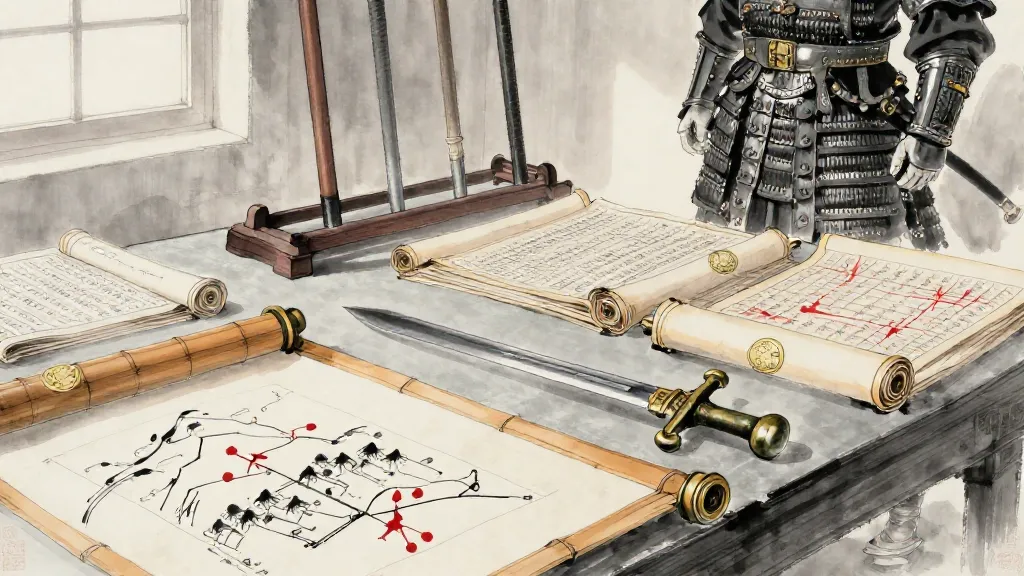
The Imperial Review of Sun Tzu and the Military Canon
In the 1780s, Emperor Qianlong's scholars reviewed every military text in China's possession. Their verdicts on the Seven Military Classics—which were genuine, which were forged, and which were worth reading anyway—remain the sharpest classical criticism of these texts ever written.
Part 1 of From the Imperial Catalog — what Qianlong's scholars thought of the classics.
The Catalog That Judged Everything
Between 1773 and 1782, the Qing court undertook the largest editorial project in Chinese history: the compilation of the Siku Quanshu (四庫全書), a library of every text deemed worth preserving. The companion work—the Siku Quanshu Zongmu Tiyao (四庫全書總目提要)—was in some ways more important than the library itself. Compiled under the supervision of Ji Yun (紀昀) and a team of senior scholars, the Tiyao is a 200-volume critical catalog: for every text considered, the compilers wrote a review assessing its authenticity, quality, and usefulness.
The military section occupies juan 99–100, filed under “Masters” (子部), subcategory “Military Strategists” (兵家類). Twenty texts made the main catalog. Forty-seven more were relegated to the cunmu (存目)—a secondary list meaning roughly “titles preserved for the record,” a polite way of saying the compilers judged them unworthy of the imperial library but not quite disposable. Together, these reviews form the most systematic assessment of Chinese military literature ever conducted by the imperial state.
What makes the Tiyao valuable is its tone. These are not reverent scholars handling sacred texts. They are senior bureaucrats evaluating a professional literature. They praise what works, dismiss what doesn't, and are ruthless about forgeries. Their judgments on the military canon—including the famous Seven Military Classics (武經七書) that formed the examination curriculum for military officers—are worth reading in full.
Sun Tzu: Genuine, and the Ancestor of All
The compilers' verdict on Sun Tzu (孫子) is unequivocal. The Art of War is authentic, it is by Sun Wu, and it is the foundation of the entire tradition:
武書為百代談兵之祖
“Wu's book is the ancestor of a hundred generations of military writing.”
They address the authenticity debate head-on. The Song dynasty scholar Ye Shi (葉適) had questioned whether Sun Wu was real, noting that his name never appears in the Zuo Zhuan. The compilers dismiss this: the Shiji records that King Helu of Wu told Sun Wu, “I have read all thirteen of your chapters” (子之十三篇,吾盡觀之矣). That settles it. The text was “written by Wu himself, not attributed to Wu by later people” (確為武所自著,非後人嫁名於武也).
They note a textual puzzle: Sima Qian records thirteen chapters, but the Han dynasty bibliography lists eighty-two chapters with nine volumes of diagrams. The Tang commentator Du Mu argued that the original text ran to “several hundred thousand words” and Cao Cao cut it down to its essentials. The compilers reject this, pointing out that Sima Qian's record of thirteen chapters predates the Han bibliography: “one cannot take later additions for the original text” (不得以後來附益者為本書). The core text is the real one. The rest was accretion.
Their practical judgment is blunt. Many commentaries existed, but almost none survived. The editions available to military examination candidates were, in their words, “vulgar and crude, without a single thing worth taking” (鄙俚淺陋,無一可取). So they recorded only the base text, without commentary. If you want to read the full thirteen chapters in the original Chinese, the text the compilers deemed worthy of preservation is precisely what survives.
Wu Qi: The Man Was Terrible, but the Book Is Good
On Wu Qi (吳子), the compilers deliver one of their most memorable literary judgments. Wu Qi killed his wife to secure a military command and bit his own arm to swear an oath to his mother. “His personal conduct is scarcely worth discussing” (其行事殊不足道). But:
然嘗受學於曾子,耳濡目染,終有典型,故持論頗不詭於正。
“Yet he once studied under Zengzi. What he absorbed through long exposure left its mark, so his arguments do not stray far from the upright.”
The compilers note that Wu Qi's text emphasizes virtue over terrain (“it lies in virtue, not in strategic ground” — 在德不在險), advocates governing troops through ritual and righteousness, and lists the five things a general must be cautious about: principle, preparation, decisiveness, discipline, and restraint. They cite the Song critic Gao Sisun: “He valued ritual and righteousness, and made clear the importance of training — perhaps he gained something from the Sima Fa” (尚禮義,明教訓,或有得於司馬法者). The verdict: morally compromised author, intellectually serious text.
The Sima Fa: Ancient Ritual, Not Personal Authorship
The Sima Fa (司馬法) receives a careful correction. The Sui and Tang catalogs had attributed it to Sima Rangju himself. Wrong, say the compilers. The Shiji is clear: King Wei of Qi ordered his officials to compile ancient military regulations and then attached Rangju's material to them. The text is a committee product, not one man's work.
But its value is immense precisely because it preserves fragments of something older. The compilers observe that the text is “grounded in the Way, reliant on virtue, rooted in benevolence, and founded in righteousness” (據道依德,本仁祖義). It preserves “one in a thousand” of the military regulations of the Three Dynasties (三代軍政之遺規猶藉存什一於千百). Ban Gu in the Han Shu placed it not among military texts but in the ritual category—because its content overlaps with the Rites of Zhou. The compilers agree: this text is fundamentally about ritual order applied to military affairs, and that makes it categorically different from the strategists.
The Liu Tao: Famous, Canonical, and Almost Certainly Fake
On the Liu Tao (六韜), the Six Secret Teachings attributed to Jiang Ziya (the legendary advisor to King Wen of Zhou), the compilers are devastating. They acknowledge that a text by this name is mentioned as early as the Zhuangzi. But the Han Shu bibliography does not list it under military texts at all—only a “Zhou History Six Tao” under the Confucian category, which Ban Gu dated to the Warring States period. The Tang commentator Yan Shigu conflated the two, “perhaps following Lu Deming's note and forcing a connection” (毋亦因陸德明之說而牽合附會歟).
The textual evidence against authenticity is specific. The phrase “avoid the main hall” (避正殿) describes a practice that only began after the Warring States. The title “general” (將軍) first appears in the Zuo Zhuan—it did not exist in the early Zhou. Most damning, the Yinfu chapter describes a system of signal tallies graded by length, which the compilers call out as an elementary misunderstanding: “The forger did not understand the meaning of yinfu, mistaking it for a physical tally, and then embellished it with this nonsense” (偽撰者不知陰符之義,誤以為符節之符,遂粉飾以為此言,尤為鄙陋).
And yet they keep it. The Liu Tao had been part of the Seven Military Classics since Song Shenzong canonized them in 1080. “Those who discuss military affairs have always cited it” (談兵之家恒相稱述). So they record it, “while documenting its inconsistencies in full.” If you read the Liu Tao in the Warring States Day library, you are reading a text the Qing court formally judged to be a forgery—but one too entrenched to remove from the canon.
Wei Liaozi: Right Principles, Harsh Methods
The review of Wei Liaozi (尉繚子) untangles a bibliographic knot. The Han Shu lists a “Wei Liao” under both the Miscellaneous school (29 chapters) and the Military Strategists (31 chapters). Later scholars, noting the title under Miscellaneous, assumed the military text was lost. The compilers side with Hu Yinglin: the military text is the one that survived; the miscellaneous one is lost; the confusion arose from Ban Gu listing both.
On substance, they praise Wei Liaozi for its moral seriousness: “Do not attack a city that has committed no offense; do not kill a person who has committed no crime” (兵不攻無過之城,不殺無罪之人). These are principles, they note, “that the Warring States military theorists did not speak of” (皆戰國談兵者所不道). But they also observe that the Bingling chapter describes desertion laws in extreme detail—a reminder that the text is not “empty talk of benevolence and righteousness by those without practical experience” (亦非漫無經略,高談仁義者矣).
The Three略and the Li Weigong Wendui: Forgeries of Different Quality
The Huang Shigong San Lue (黃石公三略) and the Li Weigong Wendui (李衛公問對)—the last two of the Seven Military Classics—both receive forgery verdicts, but the compilers distinguish between a useful forgery and a crude one.
The San Lue, attributed to the mysterious Old Man of the Yellow Stone Bridge who gave Zhang Liang a book, is “not ancient in its phrasing” (文義不古) and “certainly a later fabrication” (當亦後人所依託). The Qing scholar Zheng Yuan called it “derivative of Laozi's remnant ideas, roundabout and scattered, impractical” (剽竊老氏遺意,迂緩支離,不適於用). But the compilers hedge: Emperor Guangwu of the Later Han quoted from it in an imperial edict. Either the edict drew on the book, or the book plagiarized the edict—“both are impossible to determine” (雖均無可考). They keep it, with reservations.
The Li Weigong Wendui, supposedly a dialogue between Tang Taizong and his general Li Jing, draws a more interesting verdict. Multiple Song sources attribute it to Ruan Yi, who also forged the Yuanjing attributed to Wang Tong and an I Ching commentary attributed to Guan Ziming. Su Shi said Su Xun had seen Ruan Yi's drafts. The compilers accept this: three independent sources all identify the same forger. Hu Yinglin went further, calling the text “vulgar and crude beyond measure” (詞旨淺陋猥俗,最無足采). But the compilers push back. The Wendui “distinguishes orthodox and unorthodox formations, maps out attack and defense, and occasionally grasps the subtleties of military thought” (分別奇正,指畫攻守,變易主客,於兵家微意時有所得). Zheng Yuan put it best: “Though the text is forged, it must have come from a hand with real learning and strategic sense” (問對之書雖偽,然必出於有學識謀略者之手).
The Preamble: Sorting Military Thought from Occult Nonsense
The most revealing passage in the entire section is the compilers' preamble to the military category. It establishes their editorial principles and, in doing so, draws a line between legitimate military thought and the supernatural traditions that had attached themselves to it:
其間孤虛、王相之說,雜以陰陽五行;風雲、氣色之說,又雜以占候。故兵家恒與術數相出入,要非古兵法也。
“Among [the military texts], the theories of Void and Fullness, of Kings and Ministers, are mixed with Yin-Yang and Five Elements. The theories of wind, clouds, and atmospheric phenomena are mixed with prognostication. Thus military writing has always overlapped with occult arts—but these are not the ancient art of war.”
The compilers are explicit: the authentic core of military thought is “the arts of raising and training troops, and the proper use of strategy and tactics” (生聚訓練之術,權謀運用之宜). Everything involving divination, omen-reading, and cosmological numerology is a later accretion that they will separate out. Texts that mix genuine strategy with supernatural methods get sorted: the strategy goes in the main catalog, the divination goes to the cunmu.
This matters because it reveals how the Qing scholarly establishment understood the relationship between military thought and the mantic arts. They did not deny that military commanders historically used divination—the evidence was too pervasive. But they classified it as a corruption of the tradition, not its essence. Sun Tzu's famous final chapter on espionage, not divination, was what they considered the pinnacle of the art.
Qi Jiguang: The One Ming General They Respected
The compilers' contempt for late Ming military writing is palpable. They describe the period's output as “especially squalid and chaotic” (尤為猥雜). The cunmu section skewers text after text: wooden men on horses with firecrackers in their bellies (“virtually a children's game”—殆於兒戲), proposals to make decks slippery with egg and tung oil so enemies can't stand, elaborate astrological battle-timing systems that amount to nothing.
The sole exception is Qi Jiguang (戚繼光). Both the Lianbing Shiji (練兵實紀) and the Jixiao Xinshu (紀效新書) receive full, admiring reviews. The compilers note that Qi's writing reads like spoken language—“his words are like everyday speech, unpolished” (其詞率如口語,不復潤飾)—because he was writing orders for actual soldiers who needed to understand them. They quote his most famous passage:
開大陣,對大敵,比場中較藝,擒捕小賊不同。千百人列陣而前,勇者不得先,怯者不得後,只是一齊擁進。
“Deploying in a great formation against a great enemy is nothing like martial arts competitions or catching petty bandits. When a thousand men advance in formation, the brave cannot rush ahead, the timid cannot hang back—everyone simply pushes forward together.”
This, the compilers say, is someone who “truly understands the situation” (可謂深明形勢) and does not deal in “stale phrases from strategy manuals” (韜略之陳言). They also note, with evident approval, that Qi beheaded his own eldest son for looking back during battle: “He can be said to have lived up to his own words” (可謂不愧所言矣). Qi's texts are the only Ming-era military works in the main catalog. You can read his source texts alongside the other classical military texts at Warring States Day.
Military Strategy and the I Ching
Readers of this site will notice something the compilers take for granted: the deep entanglement between military thought and the Book of Changes. The Tiyao's preamble acknowledges that military texts have “always overlapped with the occult arts” (恒與術數相出入). The cunmu section is full of texts mixing strategy with liu ren divination, qimen dunjia, stellar prognostication, and wind-reading. The compilers sort these into separate categories, but the historical reality is that generals used all of it.
The Grip of the Marvelous Classic (握奇經)—the very first text reviewed—illustrates the pattern. Attributed to the mythological minister Feng Hou, it describes an eight-formation battle array. The compilers trace it to Tang dynasty enthusiasts who reverse-engineered Zhuge Liang's famous Stone Sentinel Maze (八陣) and projected it back to the Yellow Emperor. The text itself is exactly 384 characters—the same number as the total lines in the 64 hexagrams. This is not a coincidence. The military formation was conceived as a cosmological diagram, with the eight trigrams mapping to eight tactical positions.
The compilers consider this nonsense, and they are right that the text is a forgery. But the impulse it represents—mapping the I Ching's structure onto practical decision-making under uncertainty—is one of the oldest uses of hexagram thinking in Chinese civilization. The generals who used divination before battle were not being superstitious in the way we might assume. They were using the best decision-support system available to them: a structured method for considering all possible states of a situation before committing to action.
What the Imperial Reviewers Got Right
Reading the Tiyao's military section 240 years later, what stands out is how modern the compilers' critical method feels. They check texts against bibliographic records. They flag anachronistic vocabulary. They compare multiple witnesses to the same text. They distinguish between “a forgery by someone who knew what they were doing” and “a forgery by a village pedant.” They are willing to preserve a text they know is fake if it has genuine intellectual content.
Their overall verdict on Chinese military literature can be summarized in a hierarchy. At the top: Sun Tzu, authentic and foundational. Just below: Wu Qi, the Sima Fa, and Wei Liaozi—genuine texts with real insight. In the middle: the Liu Tao, the San Lue, and the Li Weigong Wendui—forgeries of varying quality, preserved because the tradition depends on them. At the bottom: everything from the late Ming, which they regard as a swamp of plagiarism, fantasy weapons, and astrological quackery, with Qi Jiguang as the sole island of competence.
The Seven Military Classics, as a canon, thus contained—by the Qing court's own assessment—only three or four genuinely ancient texts. The rest were institutional tradition: texts that had been on the military examination syllabus for so long that removing them would have caused more disruption than keeping them. The compilers documented the facts and let the canon stand. It is a pragmatism that any bureaucrat can appreciate.
References
Primary Source
四庫全書總目提要, 卷九十九–一百 (Siku Quanshu Zongmu Tiyao, juan 99–100). Ji Yun et al., compiled 1773–1782. 子部·兵家類. The complete reviews of all military texts in the imperial collection. Wikisource (juan 99) | Wikisource (juan 100)
Texts Discussed
The military texts reviewed in this article are available in the original Chinese at warringstates.day/library, including Sun Tzu's Art of War, the Wu Zi, the Sima Fa, the Liu Tao, and the Wei Liaozi.