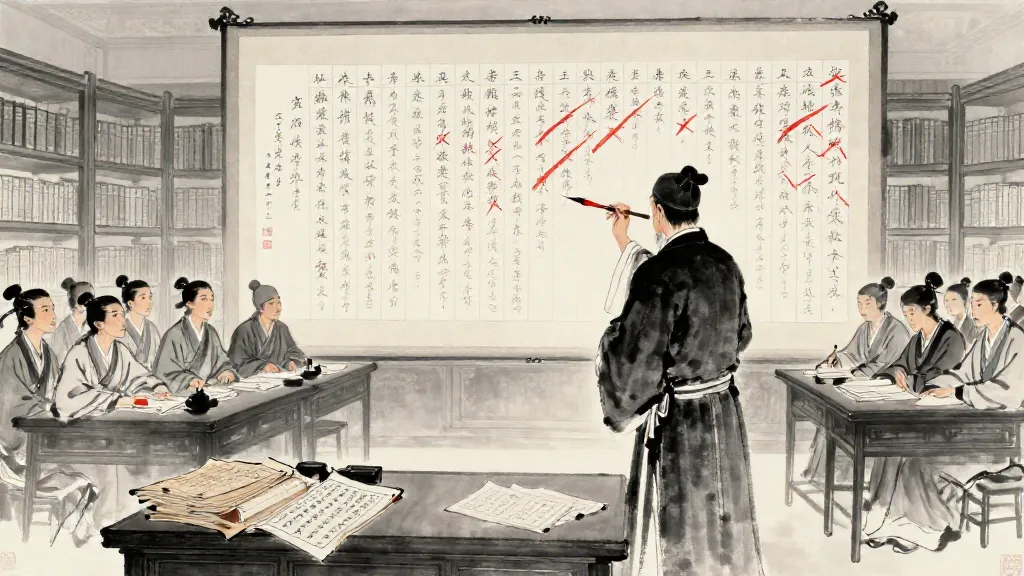
When the Imperial Scholars Called Bullshit: 27 Rationalist Critiques from the Qing Court
Volume 36 of the Xieji Bianfang Shu is the final chapter of Emperor Qianlong's imperial almanac project. It contains 27 entries where the court's own scholars systematically dismantle the folk practices that had accumulated around date selection—naming names, showing the math, and declaring the results “deeply detestable.”
The Tradition Had Quality Control
Here is the thing that people miss about Chinese date-selection traditions, the thing that gets lost in the Western framing of it all as “superstition”: the tradition had its own quality control. Not the vague, hand-waving kind. Not “well, the wise ones knew better.” Actual, documented, line-by-line quality control, commissioned by the emperor himself and executed by a team of scholars who were not, to put it mildly, impressed by what they found.
The Xieji Bianfang Shu (欽定協紀辨方書) is a 36-volume compendium completed in 1739 under Emperor Qianlong. The first 35 volumes lay out the standardized system for date selection—the solar terms, the stems and branches, the stars and spirits that govern which days are suitable for which activities. Volume 36 is different. Volume 36 is titled 辨論 (Bianlun)—“Critical Debates”—and it does exactly what the title promises. Twenty-seven entries. Twenty-seven folk practices dragged into the light and examined.
The scholars' opening statement sets the tone:
術士好奇而嗜利,論言繁興。比以為吉,彼以為凶。
“Diviners love novelty and crave profit. Theories and pronouncements have proliferated. What one calls auspicious, another calls inauspicious.”
They trace the problem back to the Han dynasty and note it has only gotten worse through the Six Dynasties, Tang, Song, Yuan, and Ming. By Qianlong's time, there were over a thousand spirit-taboos distributed across just 24 compass directions, and over a hundred competing methods for a single 60-day cycle. The result, in the scholars' words: “books that confuse the world and deceive the people” (惑世誕民之書). These books, the scholars declare, “cannot go unexamined” (不可不辨).
The 27 Targets
The table of contents for Volume 36 reads like an indictment. Here are all 27 topics the scholars took on, and what they found:
1. Auspicious Marriage Months (男女合婚大利月). The longest critique in the volume. The folk system assigned each month the ability to “harm” a specific family member—the matchmaker, the parents-in-law, the bride's parents, the husband, or the bride herself—in a rotating six-month cycle based on the bride's birth year. The scholars ask: by what principle does one month harm the matchmaker and another the father-in-law? They check every recognized metaphysical framework—yin-yang, five phases, nine palaces, eight trigrams, geomancy, the jianchu system. Not a single one can account for the assignments. Their verdict: 荒誕不經之至—“the most absurd of absurdities.” Imperial approval was obtained to delete these rules from the official almanac.
2. Various Emperor Star Systems (諸家鸞駕星曜). Over a dozen competing “emperor star” systems used in date selection—Jade Emperor Imperial Carriage, Purple Tenuity Emperor Star, Gold Wheel, Fire Wheel, Water Wheel, and more. The scholars point out that none of these “stars” correspond to actual celestial objects. Each school fabricated its own Jade Emperor to outrank the others (各捏一玉皇以壓之). The political analogy is sharp: having five or six Jade Emperors each guarding a direction is “like the Six Dynasties splitting the empire or the Five Dynasties each claiming the throne”—is this reasonable?
3. Mountain-Patrolling 24 Spirit-Sha (巡山二十四神煞). A system that distributes 24 spirits across the compass, cycling annually. The scholars publish the complete table and deliver their judgment: “Examining the names and considering their meaning, investigating the examples and measuring the reasoning—it is already obvious that this was fabricated by occult practitioners” (術士捏造已屬曉然). They retain only one element—the 巡山羅睺 (Patrol Mountain Rahu)—because its logic of placing the strongest negative influence nearest to Tai Sui is “still close to reason.”
4. Post-Horse Encounters Official (驛馬臨官). The same position—“before the post-horse”—is simultaneously called auspicious (as Linguan) and inauspicious (as Six Harms). The scholars note the self-contradiction and delete the whole thing.
5. Knife-Block-Fire-Blood (刀砧火血). A family of taboos with terrifying names: Hidden Blood Blade, Thousand-Gold Blood Blade, Five-Sons Robbery Blood Blade, Mountain House Fire-Blood. The scholars cite an earlier critical source, the Xuanze Zongjing: “Among the common people, the most feared is Knife-Block-Fire-Blood, but this is merely a frightening name fabricated by diviners to scare people” (民間最畏刀砧火血, 術士捏造惡名以嚇人耳).
6. Reverse Blood Blade / Nine Good Stars / Hidden Knife Sha (逆血刃、九良星、暗刀煞). The Reverse Blood Blade system fills all 60 days of the sexagenary cycle with directional taboos, meaning every single day has a “blood blade” somewhere. The Nine Good Stars assigns a taboo location for every day of the 60-day cycle. The Hidden Knife Sha goes further: 12 taboo locations per month, cycling over five years. The scholars' approach here is devastating in its simplicity—they publish the complete tables and note: “Observe the table and you will immediately see the absurdity. No deep debate is needed” (觀表即知其妄,無須深辨也).
7. Branch-Retreat Flowing Wealth (支退流財). A directional system claiming that a retreating yin-yang force creates wealth or poverty in specific compass directions. The scholars check the tables against the system's own derivation rules and find that most years don't even match. The system contradicts itself.
8. Same Position, Different Names (神煞同位異名). This is perhaps the most important critique in the entire volume. The scholars demonstrate that the apparent proliferation of spirit-taboos is largely an illusion created by renaming. One taboo called 浮天空亡 (Floating Heavenly Void) also goes by 頭白空亡 and 八山空亡—three names, one taboo. The Six Harms (六害) is rebranded as 陰中太歲. The twelve-god system gets alternative star names, and through a chain of phonetic drift, the originally auspicious Azure Dragon (青龍) becomes the fearsome-sounding Thunder Duke (雷公), while the originally inauspicious Celestial Prison (天牢) morphs through 天獄 → 訟獄 → 訟岳 → 天岳 into something that sounds majestic. The scholars call this “deeply detestable” (深可厭惡).
The Remaining Nineteen
The pattern continues through all 27 entries. Topics 9 through 27 cover:
Dipper-Head Five Elements (斗首五行)—a feng-shui date-selection method attributed to Yang Yunsong but shown to contain internal inconsistencies. Honored Star and Emperor Star (尊星帝星)—noble star systems for date selection with contradictory starting points. Where the Spirit Resides (神在)—a deity-location system that the scholars trace to errors in the Xuanze Zongjing. Supreme Auspicious / Seven Sages (上吉七聖)—37 “Seven Sages Days” attributed to Huangdi, the Mysterious Woman, King Wen, Duke of Zhou, Confucius, and two others. The scholars note that the “Mysterious Woman” (元女) is a cosmological concept, not a person, and adding Dong Zhongshu to round out the count to seven sages is “even more absurd.”
Hidden Severance Days (伏斷日)—a system the scholars identify as originating from Western (Indian) astronomical traditions, noting it uses the 28 lunar mansions in a way incompatible with Chinese customs. Upper and Lower Cycles (上元下元)—office-taking taboos with a Song dynasty anecdotal origin. Four Inauspicious (四不祥)—based on monthly new moon clashes, dismissed as unfounded. Red Sand (紅沙)—analyzed through pre-heaven numbers and found to be an arbitrary derivation from existing systems. Zhang-Guang (章光)—shown to be just another name for the “do not use” zone around the Monthly Oppression star.
Five Unions and Five Separations (五合五離)—arbitrary mappings of heavenly stems to “sun-moon conjunction” and “river separation” with no explainable principle. Target-Calling Days (的呼日)—funeral customs with fabricated day assignments. Calamity-Sha Departure Direction (殃煞出去方)—methods for determining safe directions to remove a coffin, shown to be self-contradictory. Full Virtue Auspicious Celebration (滿德吉慶)—a fortune-naming system mapped onto the twelve jianchu positions. Ice-Melting / Gate-Destroying Calamity (冰消瓦解滅門大禍)—terrifying names for ordinary day-pillar combinations, debunked using the Heavenly Virtue combination.
Yang Gong's Taboo Days (楊公忌)—one of the most widely feared folk taboos, traced by the scholars to a misidentification of the lunar mansion “Room” (室) with “pig” (豬), because the full mansion name is 室火豬 (Room-Fire-Pig). The taboo on pig days grew from this misunderstanding. Celestial Dog (天狗)—a marriage taboo involving the head, belly, back, and feet of a cosmic dog, fabricated by taking the twelve-branch positions of existing stars (Celestial Joy, Red Phoenix) and relabeling them as body parts. The scholars note that the name itself comes only from the fact that 戌 is the Dog in the Chinese zodiac—“which is laughable” (可笑). Six Paths (六道)—a Heaven-Earth-Man-Soldier-Ghost-Death directional cycle. Five Talisman Time Selection (五符擇時) and Nine Immortals Time (九僊時)—hour-selection methods that the scholars document and dismiss as the final entries in the volume.
The Methods of Demolition
What makes Volume 36 remarkable is not just that the scholars called bullshit. It is how they called it. Their methods are recognizably modern in their empiricism:
Statistical reductio. The marriage-matching critique calculates that the naying five-element system condemns 25,920 possible birth combinations within a three-month window as “harming the spouse.” Extend it to six months and the number doubles to 51,840. “To say they all harm their spouses,” the scholars write, “even a three-foot child would not believe it” (雖三尺童子亦不信也). This is proto-statistical reasoning—taking a folk claim seriously enough to calculate its implications, and then showing that the implications are absurd.
Internal consistency checks. The scholars repeatedly test systems against their own stated rules. The Branch-Retreat Flowing Wealth system claims to derive positions from a specific yin-yang progression, but when the scholars check the actual tables, most years don't match the derivation. The system fails its own test.
Source criticism. The marriage-matching system is attributed to the Tang scholar Lu Cai (呂才). The scholars note that Lu Cai's own biography shows he was famous for debunking yin-yang arts—so the attribution is almost certainly a forgery by the very practitioners Lu Cai criticized.
Naming analysis. The “Same Position, Different Names” critique is essentially a form of what we would now call ontology deduplication. The scholars show that what appears to be a vast ecosystem of independent taboos is actually a small number of systems renamed and remixed. The apparent complexity is fake.
Publication as refutation. For the Nine Good Stars and Hidden Knife Sha, the scholars do not argue point by point—they simply publish the complete tables and let the reader see for themselves that every day has a taboo somewhere, making the entire system meaningless. This is an empiricist's move: show the data, and the conclusion follows.
The Vocabulary of Contempt
The scholars' language is not neutral. These are not footnotes suggesting that further research might be warranted. These are verdicts:
術士捏造 (fabricated by diviners). 荒誕不經 (absurd and groundless). 毫無理路 (absolutely no rational basis). 自相矛盾 (self-contradictory). 恐嚇愚人 (frightening the ignorant). 深可厭惡 (deeply detestable). 惑世誕民 (confusing the world, deceiving the people).
And perhaps the most pointed phrase of all, used to describe how diviners exploit the fear of birth complications to sell their services: 有俗術因產厄之可畏而捏此名以嚇人,誠可惡也—“There are vulgar arts that exploit the fear of birth calamities, fabricating these names to frighten people—truly despicable.”
This is not detached academic critique. These scholars were angry. They saw real harm: marriages delayed past the proper season because families could not find a month that satisfied every contradictory taboo. The poet Mei Dongchu (梅東楚) is cited as having lamented the social damage. Imperial approval was obtained not just to critique these practices but to delete them from the official almanac.
Working Inside the Tradition
Here is what makes Volume 36 genuinely interesting rather than just amusing: the scholars were not skeptics. They were not debunking date selection itself. They were debunking bad date selection from inside the tradition.
The same team that wrote these 27 critiques also wrote the other 35 volumes of the Xieji Bianfang Shu, which constitute the most comprehensive and rigorous systematization of Chinese date-selection practice ever produced. They believe in the stems and branches. They believe in the five phases. They believe in the jianchu twelve-god system and the yellow-black road stars and the 28 lunar mansions. What they do not believe in is the thousand-plus folk additions that have no basis in these classical systems.
Their position is clear: a date-selection taboo is legitimate only if it can be derived from recognized cosmological principles. If a spirit-sha has no astronomical correlate, it is fabricated. If a marriage-matching rule cannot be explained by any known system, it is fabricated. If a terrifying name was invented purely to frighten clients into paying for more consultations, it is fabricated and despicable.
This is a critical distinction. The scholars are not saying “divination is nonsense.” They are saying “most of what passes for divination is nonsense, and here is the proof, and here are the rules for telling the difference.” They are, in effect, peer-reviewing the entire tradition and finding that roughly 90% of the accumulated practice fails review.
What Survived the Review
Volume 36 is not purely destructive. The scholars are careful to note when something has partial legitimacy. The Patrol Mountain Rahu is retained because its placement logic is defensible. The marriage compatibility system attributed to Lu Cai—the version using eight-trigram configurations (生氣, 天醫, 福德)—is documented in full, even though the surrounding folk additions are demolished. The tables for every debunked system are preserved for scholarly reference, following the principle they state elsewhere in the volume: document everything, even what you reject.
What the scholars leave standing is the system encoded in Volumes 1 through 35: date selection based on the solar terms, the sexagenary cycle, the jianchu twelve-god system, the 28 lunar mansions, and the yellow-black road stars. These are the elements they consider derivable from classical cosmological principles. Everything else is noise.
The Irony That Still Matters
Nearly three centuries later, the folk practices that Qianlong's scholars demolished are still in circulation. Open a popular Chinese almanac app and you will find marriage-month taboos, fearsome-sounding spirit-sha, and directional prohibitions that were officially debunked in 1739. The tradition's own quality-control apparatus produced a clear verdict, and the market ignored it.
This is not unique to Chinese traditions, of course. Every knowledge system that involves practitioners selling services to anxious clients faces the same dynamic: complexity is profitable, and fear is profitable, and the most effective business strategy is to make the system as opaque and terrifying as possible so that clients keep coming back. What is unusual about the Xieji Bianfang Shu is that someone with the authority and resources to push back actually did push back, and left a written record of exactly what they found.
Volume 36 is that record. Twenty-seven entries. Twenty-seven folk practices examined, named, and judged. Not by outsiders dismissing a tradition they don't understand, but by insiders who understand it thoroughly and are genuinely offended by what has been done to it.
References
Primary Source
欽定協紀辨方書 (Qinding Xieji Bianfang Shu), 卷三十六: 辨論. Compiled under Emperor Qianlong, completed 1739. 四庫全書 (Siku Quanshu) edition.
Secondary
Smith, Richard J. Fortune-tellers and Philosophers: Divination in Traditional Chinese Society. Westview Press, 1991.
Smith, Richard J. Chinese Almanacs. Oxford University Press, 1992.
See also
The Xieji Bianfang Shu: The Imperial Almanac Behind Six Lines — overview of the full 36-volume compendium.
The Xieji Bianfang Shu: An Emperor's Attempt to End Almanac Chaos — how the project came together and what it standardized.