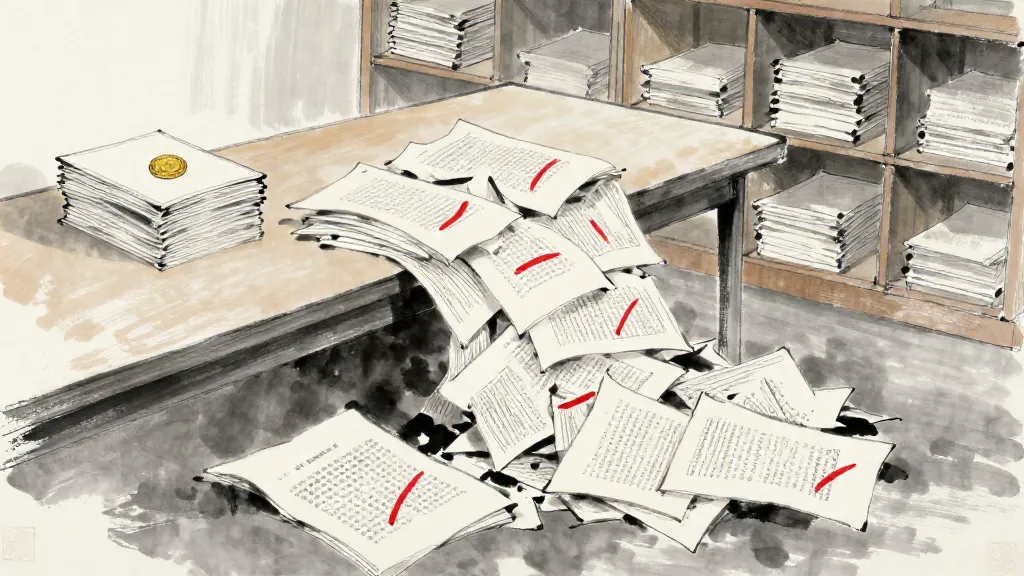
319 Rejected Yijing Texts
The cunmu section of the Siku catalog contains the compilers' takedowns of rejected Yijing commentaries. Some are polite. Most are devastating one-paragraph demolitions of centuries of scholarship.
Part 8 of The Emperor's Library — how China reviewed all knowledge.
The Second Shelf
Every library has a system for what it includes. The Siku Quanshu Zongmu Tiyao (四庫全書總目提要) had two. The first tier—the main catalog—listed the 166 Yijing commentaries that the compilers considered worthy of hand-copying into the imperial library. The second tier—the cunmu (存目, preserved titles)—listed everything else they had reviewed and decided was not worth the scribes' labor. For the Yijing section, that second tier runs to 319 entries across four juan.
The cunmu is often described as a list of rejected books. This understates what it actually is. A list rejects silently. The cunmu rejects with commentary. For each of the 319 titles, the compilers wrote a review—sometimes two sentences, sometimes a full paragraph—explaining precisely why the text did not merit inclusion. These reviews are specific, technical, and frequently brutal. They constitute one of the most remarkable collections of critical demolitions in the history of bibliography.
The distinction between inclusion and cunmu preservation was not trivial. Texts selected for the main catalog (收入) were physically copied by teams of scribes into each of the seven manuscript sets of the Siku Quanshu, distributed to imperial libraries across the empire. They became part of the permanent literary canon as defined by the Qing state. Cunmu texts received only a review. They were acknowledged, assessed, and then left on whatever shelf they had been sitting on. The review was the only form of immortality the compilers were willing to grant.
The Taxonomy of Rejection
Reading through the 319 cunmu entries, the reasons for rejection cluster into recognizable categories. The compilers did not have a formal rubric—each review is written as continuous prose—but the patterns are unmistakable.
Fraudulent attribution. This is the category that produces the most entertaining reviews. A text claims to be by an ancient authority—Confucius's disciple Bu Zixia, or the Wei dynasty sage Guan Lang, or the Song master Shao Yong—but the compilers detect anachronisms that expose the forgery. Vocabulary from the wrong period. Institutional terminology that did not exist when the claimed author was alive. Citations of books that had not yet been written. The compilers are forensic about this: they check dynastic bibliographies, cross-reference citation chains, and compare prose style across known works by the same author.
Derivative scholarship. This is the largest category by volume, and the one that receives the least colorful treatment. A commentary is judged derivative when it restates positions already better expressed by earlier scholars without adding anything original. The compilers have read the earlier scholars. They can tell. A typical review of this type might note that the author “mostly follows Cheng Yi and Zhu Xi” (大抵本程朱之說) and then adds that the work “does not go beyond what its predecessors already said” (不出先儒範圍). Two sentences. Judgment rendered. Next book.
Heterodox interpretation. Some texts are rejected not because their scholarship is poor but because their interpretive framework is judged illegitimate. Commentaries that import Daoist alchemy, Buddhist meditation theory, or folk religious concepts into the Changes are treated as contaminations. The compilers do not object to the existence of these traditions—they catalog Daoist and Buddhist texts elsewhere without hostility—but they insist that the Changes is a Confucian classic and should be interpreted within that tradition.
Poor craftsmanship. Some rejections are simply about quality. A text might have a defensible interpretive position but execute it badly: muddled argumentation, careless textual work, confusion about what the original text says. The compilers are not gentle about this. One review notes that an author “attempted to reconcile the image-number and meaning-principle schools but succeeded only in confusing both” (欲兼取象數義理而兩無所據).
The Forgery Showcase
The most spectacular cunmu entries are the forgery exposures. The compilers approach these with a combination of scholarly precision and barely concealed satisfaction.
The Zixia Yizhuan (子夏易傳) takes the prize for most thoroughly debunked text. Attributed to Bu Zixia (卜子夏), a disciple of Confucius, it claims an unbroken lineage stretching back to the sage himself. The compilers trace its actual history through multiple layers of fabrication:
易傳之名最古,其偽亦最古。而偽中又有偽焉,殆無盡矣。“Among all schools of Yijing commentary, none claims greater antiquity than this book. Yet none has also generated forgery upon forgery, layer upon layer without end.”
The original text attributed to Bu Zixia was already recognized as a fabrication in the Tang dynasty. But then someone in the Song period produced a new version, claiming it was the real one. The compilers demonstrate that this second version is probably by the Tang-era writer Zhang Hu (張弧)—but the text that circulated in their own time does not even match what Song scholars describe seeing. It is a forgery of a forgery of a forgery: “然則今本又出偽託,不但非子夏書,亦並非張弧書矣”—“the current text is yet another fabrication; not only is it not Bu Zixia's book, it is not even Zhang Hu's.”
The Guanshi Yizhuan (關氏易傳), attributed to Guan Lang (關朗) of the Northern Wei dynasty, receives a different kind of demolition. The compilers note that this text is “not listed in either the Sui or Tang dynastic bibliographies” (隋唐經籍志皆不著錄). This is a significant absence. If a book by a Northern Wei scholar actually existed, it would have been cataloged by the Sui dynasty librarians who came immediately after. Its absence from their records means one of two things: either the book was lost and then miraculously rediscovered, or it was written later and attributed backward. The compilers examine the text's vocabulary and philosophical framework and conclude it is a Song-dynasty composition dressed up in Wei-dynasty clothing.
The method is consistent. For each suspected forgery, the compilers check three things: Is the text mentioned in contemporary bibliographies? Does its vocabulary match its claimed period? Do its citations reference works that existed when the claimed author was alive? Fail any one of these tests and the attribution is rejected. Fail all three and the review becomes a brief essay in textual forensics.
The One-Paragraph Demolition
Not every rejection gets a forensic analysis. Many of the cunmu entries are exercises in compressed devastation—a single paragraph that identifies the problem and moves on. The compilers had 319 texts to review in this section alone, and the sheer volume enforced a kind of brutal efficiency.
A typical entry might read: the author claims to have reconciled the image-number and meaning-principle schools. He has not. His treatment of the image-number tradition is superficial and his treatment of the meaning-principle tradition is derivative. The book adds nothing to what Cheng Yi and Zhu Xi have already said, and subtracts from it by mixing in unreliable numerological claims. Four sentences. The book is dismissed. The compilers move to the next one.
Some reviews manage to be devastating in even fewer words. When a Ming-dynasty author produces a commentary that the compilers judge as entirely reliant on Zhu Xi's Zhouyi Benyi (周易本義), they sometimes note simply that the work “does not depart from Zhu Xi's established interpretation” (不出朱子之說) and offer no further comment. The implication is clear: if you want Zhu Xi's interpretation, read Zhu Xi. This book is unnecessary.
Other reviews turn a single observation into a death sentence. One author is noted as having “consulted neither the Han commentaries nor the Song philosophical tradition, but produced his interpretations entirely from his own speculation” (不考漢儒之說,亦不用宋儒之義,惟以臆見為斷). The compilers do not need to say more. In a tradition where engagement with predecessors is a baseline scholarly obligation, admitting that you ignored both major schools is an admission that you have nothing to contribute.
The Political Dimension
Not all rejections were purely scholarly. The Siku project operated within a political environment, and some cunmu decisions reflect ideological pressures as much as intellectual ones.
The most obvious political influence was the Qing dynasty's relationship with the Ming. Several Yijing commentaries by late-Ming scholars—particularly those associated with the Donglin Academy (東林書院) and its political activism—received harsher treatment than their scholarship alone would have warranted. When a Ming loyalist scholar used the Changes to encode criticism of the political order, the Siku compilers had every reason to find the commentary “derivative” or “confused” regardless of its actual quality.
The Qing court's preference for evidential scholarship (考證學) over speculative philosophy also shaped the reviews. Commentaries in the Wang Yangming (王陽明) tradition—which emphasized personal insight over textual analysis—are consistently judged more harshly than comparable works from the Cheng-Zhu school. The compilers regarded the Yangming tradition as intellectually self-indulgent: its practitioners, they complained, “abandoned the text and spoke only from the mind” (離經而空談心學). Whether this reflects genuine scholarly judgment or institutional bias is a question the catalog does not invite you to ask.
There is also the delicate matter of the three imperial-sponsored Yijing works that open juan 6 of the main catalog. The Kangxi emperor's Zhouyi Zhezhong (周易折中), the Yongzheng emperor's Zhouyi Shuyi (周易述義), and the Qianlong emperor's Yujuan Zhouyi Shuyi (御纂周易述義) all receive enthusiastic praise. No commentary by a private scholar receives comparable treatment. One does not need to be a cynic to observe that reviewing the emperor's own intellectual contributions while employed by the emperor might introduce a certain bias into the proceedings.
The Compilers' Mistakes
The Siku compilers were brilliant, but they were not infallible. Subsequent scholarship has shown that some cunmu judgments were wrong—sometimes significantly so.
Several texts dismissed as derivative or confused have proved to preserve important readings found nowhere else. When a Ming-dynasty compiler gathered variant interpretations from local scholarly traditions that the Siku compilers had never encountered, his work might look derivative from the capital but contain unique material from the provinces. The compilers were working in Beijing with access to the imperial collection and the books submitted from across the empire, but they could not have seen everything. Some local traditions were underrepresented in the submissions, and their representatives in the cunmu were judged against a standard that did not account for what the judges had not read.
More substantially, the compilers' preference for the meaning-principle tradition led them to undervalue certain image-number works that later scholars have found important. The Song-dynasty tradition of hexagram diagrams—treated by the Siku compilers as an intellectual dead end—has proved relevant to the history of mathematics and combinatorics. Shao Yong's binary-like ordering of the hexagrams, which the compilers relegated to the category of cosmic speculation, attracted the attention of Leibniz in the seventeenth century and has continued to interest historians of mathematics since. The compilers were right that these texts are not central to understanding the Changes as moral philosophy. They were wrong to suggest they have no intellectual value at all.
The lesson is not that the compilers were careless. It is that a bibliography compiled under a specific set of intellectual assumptions will always reflect those assumptions. The Siku project privileged textual rigor, historical accuracy, and practical moral instruction. Texts that served those values were praised; texts that did not were dismissed. This is a legitimate set of criteria. It is not the only possible set.
Preserving in Order to Expose
One of the most revealing aspects of the cunmu is that it exists at all. The compilers did not have to review the rejected texts. They could have simply excluded them from the catalog and said nothing. Instead, they wrote 319 reviews explaining why each text failed. This was not bureaucratic excess. It was a deliberate intellectual strategy.
The compilers state the principle explicitly in their review of Yang Jian's Yijing commentary, a work so radical in its claims that Zhu Xi himself said it “could be burned” (楊敬仲文字可毀). The compilers preserve it anyway, citing a precedent from Zhu Xi's own editorial practice:
存之正所以廢之。“Preserving them is precisely what exposes them.”
This is the logic of the cunmu. A forgery that is simply ignored will resurface. A derivative commentary that is merely excluded will be rediscovered by someone who does not know it is derivative. By writing a review—by putting on record exactly what is wrong with a text—the compilers ensure that the next generation of scholars does not have to make the same discovery independently. The cunmu is not a list of failures. It is an inoculation against future error.
In this sense, the 319 rejected Yijing texts are as valuable as the 166 accepted ones. They constitute a negative map of the tradition—a detailed account of where the interpretive paths lead to dead ends. Future scholars can read the cunmu reviews and know which attributions are false, which arguments have been tried and found wanting, and which lines of inquiry the most thorough readers in Chinese history judged unpromising. This is not censorship. It is quality control with a paper trail.
References
Primary Sources
四庫全書總目提要 (General Catalog of the Complete Library of the Four Treasuries, with Critical Abstracts), juan 7–10: 經部·易類存目. The cunmu (preserved titles) entries for the Yijing section, containing the 319 reviews discussed in this article. Chinese Text Project
子夏易傳 (Zixia's Commentary on the Changes). The multiply-forged text discussed in this article, attributed to Bu Zixia but identified by the Siku compilers as a layered fabrication spanning the Tang through Ming dynasties.
Secondary Scholarship
Guy, R. Kent. The Emperor's Four Treasuries: Scholars and the State in the Late Ch'ien-lung Era. Harvard University Press, 1987. Essential context for understanding the political dynamics of inclusion and exclusion in the Siku project.
Elman, Benjamin A. From Philosophy to Philology: Intellectual and Social Aspects of Change in Late Imperial China. Harvard University Asia Center, 2001. Background on the evidential scholarship movement that shaped the compilers' standards for textual criticism.
Smith, Richard J. Fathoming the Cosmos and Ordering the World: The Yijing (I-Ching, or Classic of Changes) and Its Evolution in China. University of Virginia Press, 2008. Traces the full arc of Yijing commentary traditions, including many works that appear in the Siku cunmu.