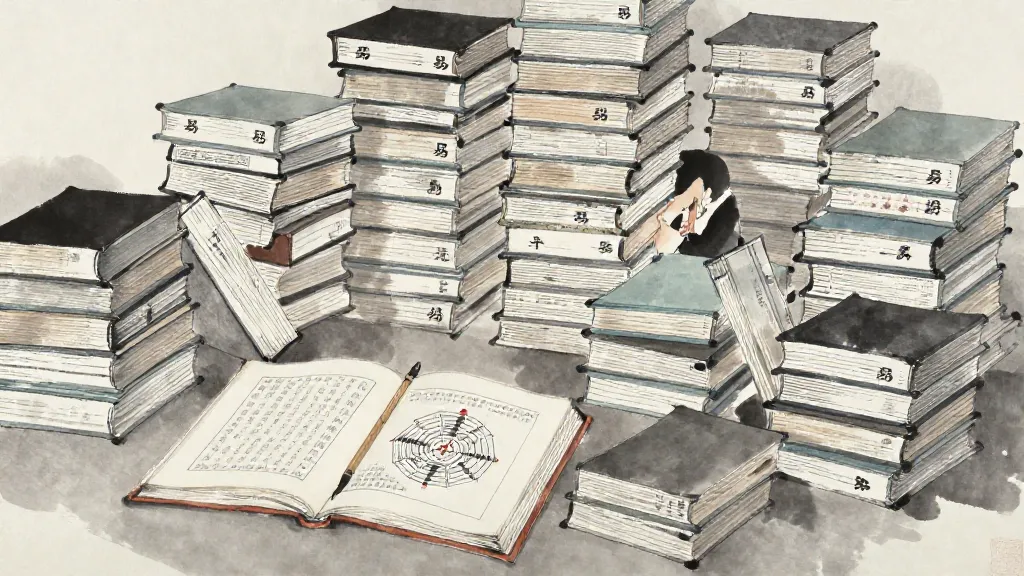
485 Books About One Book
The Siku scholars reviewed 485 commentaries on the Book of Changes—more than any other single text in the entire catalog. The sheer volume reveals the Yijing as the most contested intellectual territory in Chinese history.
Part 6 of The Emperor's Library — how China reviewed all knowledge.
The Most Annotated Book in the World
Open the Siku Quanshu Zongmu Tiyao (四庫全書總目提要) to the first page of the Classics section and you will find a number that tells its own story. The Yi Lei (易類)—the section devoted to commentaries on the Book of Changes—stretches across ten juan. Six of those volumes cover the 166 commentaries that passed review and were copied into the imperial library. The remaining four cover the 319 texts that the compilers reviewed, judged, and then declined to include. Total: 485 entries devoted to a single canonical text.
No other book in the catalog comes close. The Shijing (詩經, Classic of Poetry) section runs to about 130 entries. The Chunqiu (春秋, Spring and Autumn Annals)—itself the subject of three major commentary traditions and centuries of interpretive controversy—accounts for roughly 160. The Lunyu (論語, Analects) manages about 80. The Yijing has more entries than any two of these combined.
The compilers knew this was unusual. Their general preface to the Yi Lei opens with an observation that reads almost like an apology for what is about to follow:
易道廣大,無所不包。“The Way of the Changes is vast and all-encompassing.”
That single phrase explains why the section is so enormous—and also why it is so contentious. The Yijing is a text that can be read as a divination manual, a philosophical treatise, a cosmological model, a mathematical system, and a guide to statecraft. Every one of those readings generated its own school. Every school generated its own commentaries. Every commentary generated its own response. And Ji Yun's team had to read them all.
Two Factions, Six Schools
The preface to the Yi Lei does not just catalogue the chaos. It explains it. The compilers identify what they call “two factions, six schools” (兩派六宗)—a framework that accounts for two thousand years of Yijing scholarship as a series of intellectual reactions, each arising from the excesses of the one before.
The first faction is image-and-number (象數派). This is the school that takes the hexagram images, their trigram components, and the numerical relationships between them as the primary data of the Yijing. Its practitioners believe the book encodes a systematic model of the cosmos, and that interpreting it correctly requires understanding that model. Within this faction, the compilers trace three distinct phases:
First came the Han dynasty image school (象). Scholars like Meng Xi (孟喜) and Jing Fang (京房) interpreted the hexagrams through elaborate systems linking them to the calendar, the seasons, and correlative cosmology. Each hexagram was assigned to a specific time period; each line corresponded to a day; the entire system was meant to mirror the structure of heaven and earth. The compilers acknowledge that this approach has roots in genuine antiquity. The oldest layers of the Yi tradition do connect hexagrams to natural phenomena. But the Han scholars formalized these connections into rigid systems of omen-reading (禨祥), and once you start reading every earthquake as a hexagram line in motion, you have left interpretation behind and entered prognostication.
Second came the Song dynasty numerologists. Chen Tuan (陳摶) and Shao Yong (邵雍) pushed the numerical dimension of the Yijing to its logical extreme. Shao Yong's Huangji Jingshi Shu (皇極經世書) mapped the entire arc of human history onto a vast cycle of hexagram-derived periods—one yuan (元) of 129,600 years, subdivided into hui (會), yun (運), and shi (世). The compilers note that this was intellectually impressive but practically useless: “易遂不切於民用”—“the Changes thus ceased to have practical relevance for ordinary people.” When your theory of the Yijing requires a 130,000-year timeline to make its point, you have drifted rather far from the text.
Third came the diagram tradition. This is where the Hetu and Luoshu controversies enter—scholars who believed that the foundations of the hexagram system lay in two cosmic diagrams, and who spent generations arguing over which diagram was which and whether they had been swapped. The compilers regard this entire enterprise with polite skepticism, noting that the evidence for the original form of either diagram is irrecoverably lost.
The second faction is meaning-and-principle (義理派). This is the school that treats the Yijing as a philosophical text whose value lies in its ideas, not its numerical structure. Its practitioners read the hexagram and line statements as wisdom literature and interpret them through ethical and metaphysical frameworks. Again, three phases:
First came Wang Bi (王弼), the third-century prodigy who died at twenty-three and changed the course of Yijing studies forever. Wang Bi threw out the entire Han apparatus of image-number correlation and read the Changes through the philosophical vocabulary of Laozi and Zhuangzi. His commentary is brilliant, economical, and often correct. But the compilers note that in abandoning images entirely for Daoist metaphysics, he introduced a different kind of distortion: “祖尚虛無”—“he venerated emptiness and nothingness.”
Second came the Neo-Confucian revolution. Hu Yuan (胡瑗) and Cheng Yi (程頤) redirected Yijing interpretation toward Confucian moral philosophy. Cheng Yi's Yizhuan (易傳) became the most influential philosophical commentary of the second millennium, read by every educated person in China for centuries. But the compilers note that this school, too, generated excess. Followers of the Cheng-Zhu orthodoxy began treating the Changes as nothing more than a repository of moral lessons, stripping away the divinatory and cosmological dimensions that are plainly present in the original text.
Third came the historical-illustration school. Scholars like Li Guang (李光) and Yang Wanli (楊萬里) began using the Changes not to illuminate the text but to illustrate historical episodes—finding in each hexagram a parable about some incident in Chinese history. The compilers are dry about the result: “易遂日啓其論端”—“the Changes became an occasion for endless argumentation.”
Why This Text and Not Others
The question the compilers do not ask directly—but which the 485-entry section forces you to confront—is why the Yijing attracted more commentary than any other Chinese classic. The Analects had Confucius's explicit words. The Spring and Autumn Annals had his editorial judgments. The Classic of Poetry had his selection criteria. All three were central to the examination system. All three mattered for career advancement. Yet none of them generated anywhere near 485 commentaries.
The answer lies in the Yijing's structural openness. The book is built on 64 hexagrams, each consisting of six lines. The hexagram statements and line statements are terse, imagistic, and deliberately ambiguous. “The flying dragon is in the heavens”—what does that mean? It can mean whatever you need it to mean, and that productive ambiguity is not a flaw in the text; it is the text's design.
The Ten Wings (十翼)—the commentary layers traditionally attributed to Confucius—compound the problem. The Xici Zhuan (繫辭傳) ranges freely over cosmology, ethics, mathematics, and the philosophy of language. The Shuogua (說卦) maps the eight trigrams onto animals, body parts, family relations, compass directions, and seasons. The text practically invites systematic elaboration. If you are an astronomer, you can find astronomy in the Changes. If you are a military strategist, you can find strategy. If you are a numerologist, the numbers are waiting for you. If you are a moral philosopher, every hexagram is a lesson in conduct.
The compilers put it plainly:
好異者又援以入易。“Lovers of the exotic imported all of it into the Changes.”
By the time the Siku project began, scholars had dragged astronomy, geography, music theory, military strategy, phonology, mathematics, medicine, and Daoist internal alchemy into the Yijing's interpretive orbit. Each importation required new commentaries. Each commentary required responses. The 485 entries are the accumulated debris of two millennia of intellectuals finding in a short, ancient, deliberately enigmatic text exactly what they were looking for.
166 Accepted: What Made the Cut
Of the 485 entries, 166 were judged worthy of inclusion in the imperial library. These are the texts that were hand-copied by teams of scribes into the seven manuscript sets of the Siku Quanshu. To make this list, a commentary had to demonstrate genuine scholarship: careful engagement with the primary text, awareness of the existing interpretive tradition, and some contribution that the compilers judged original or useful.
The accepted works span the full chronological and intellectual range. They include Wang Bi's third-century philosophical commentary, which the compilers credit with rescuing the Changes from the swamp of Han-dynasty omen-reading. They include Cheng Yi's eleventh-century moral-philosophical commentary, which they acknowledge as the most influential single work in the later tradition. They include Li Dingzuo's eighth-century anthology Zhouyi Jijie (周易集解), which preserves the interpretations of thirty-five earlier commentators who would otherwise be lost—a book the compilers call “truly a treasure of the ancient library” (眞可寶之古笈也).
But the accepted list also includes surprises. Su Shi's Dongpo Yizhuan (東坡易傳) is admitted over Zhu Xi's objections. Sima Guang's fragmentary notes on the Changes—a manuscript so obscure it had been lost for centuries—earn praise because his observations on human character are “如布帛菽粟之切於日用”—“as essential as cloth and grain to daily life.” The compilers are not enforcing a party line. They are applying a standard: does this text help you understand the Changes better? If yes, it stays, regardless of which school produced it.
319 Rejected: The Cunmu Graveyard
The remaining 319 texts were relegated to the cunmu (存目)—the “preserved titles” appendix. This did not mean they were destroyed. It meant the compilers acknowledged their existence, wrote a review explaining why they were not worth copying, and moved on. The reviews range from a few lines to several paragraphs, and they constitute one of the most extraordinary collections of critical demolitions in the history of bibliography.
The reasons for rejection cluster into recognizable categories. Some texts are exposed as forgeries—attributed to ancient authorities but betrayed by anachronistic vocabulary, citation chains that do not exist, or institutional terminology from the wrong dynasty. Some are dismissed as derivative—competent restatements of positions already better expressed by earlier scholars. Some are rejected for intellectual overreach—texts that import alchemy, military strategy, or medical theory into the Changes without adequate justification. And some are simply judged poor: muddled in argument, careless in textual work, or confused about what the original text actually says.
The ratio itself is striking. For every commentary the compilers judged worth preserving, they rejected roughly two. This is not a gentle winnowing. It is a statement about the state of Yijing scholarship: after two thousand years of accumulation, nearly two-thirds of the tradition failed to meet the standard of a team of eighteenth-century philologists who had read everything.
The Compilers' Corrective
What is most striking about the Yi Lei preface is not its analytical framework but its prescription. After surveying two thousand years of faction and counter-faction, the compilers arrive at an elegantly simple conclusion. They point to the hexagram images themselves: every single one of the 64 Da Xiang (大象, Great Image) texts in the Xiang Zhuan (象傳) contains the phrase “the gentleman thereby” (君子以). This, they argue, is the original purpose of the entire enterprise.
The Changes was meant to be a tool for moral reflection grounded in concrete images, addressed to real people making real decisions. The gentleman sees the image of Thunder over Lake and draws a lesson about how to act. He does not calculate the cosmic position of the hexagram in a 130,000-year cycle. He does not trace its derivation from a river diagram carried by a dragon-horse. He does not use it to predict earthquakes. He reads the image, he reflects, and he decides.
Everything else—the numerology, the cosmology, the alchemy, the historical allegories—is what the compilers call “易之一端,非其本也”: “one facet of the Changes, not its foundation.” This is the verdict of scholars who have read all 485 commentaries. The foundation is moral instruction. The rest is elaboration.
The Exasperation Beneath the Erudition
Read the individual entries carefully and you begin to detect something human beneath the magisterial prose. The compilers are tired. They have read 485 books about the same sixty-four hexagrams, and a significant proportion of those books say the same things in slightly different ways. The cunmu reviews in particular develop a kind of weary efficiency—a scholar whose work is merely derivative gets two sentences; a scholar whose work is derivative and fraudulently attributed gets four.
There is a passage in the general preface to the Classics section (經部總敍) that captures this mood. The compilers are describing the cycle of intellectual factionalism—how each school attacks the previous one and then hardens into its own orthodoxy—and they propose a solution:
消融門戶之見而各取所長,則私心祛而公理出。“Dissolve factional views and take the best from each; then private bias is dispelled and public truth emerges.”
This is the principle that governs the entire catalog. It is why Wang Bi is praised for his philosophical clarity and criticized for his Daoist tendencies in the same paragraph. It is why Cheng Yi is honored as a landmark commentator and noted as having left his work unfinished. It is why Su Shi's commentary is preserved over Zhu Xi's objections. The compilers are not looking for the right school. They are looking for what is useful in every school.
And that, perhaps, is the real lesson of the 485-entry section. The Yijing resists monopoly. It is simultaneously too old, too terse, and too structurally open for any single interpretive tradition to own it. Every school that tried to claim exclusive authority over the Changes was eventually corrected by the next generation. The compilers saw this pattern play out across two millennia and drew the only sensible conclusion: read widely, judge carefully, and do not mistake your school's framework for the text itself.
The 485 commentaries are the evidence. The Changes is, and has always been, a book that generates more books. The Siku compilers' achievement was not to stop the proliferation but to make sense of it—to map the entire landscape and show you where the ground is solid and where it is not.
References
Primary Sources
四庫全書總目提要 (General Catalog of the Complete Library of the Four Treasuries, with Critical Abstracts), juan 1–10: 經部·易類. Compiled under the direction of Ji Yun (紀昀), completed 1798. Chinese Text Project
經部總敍 (General Preface to the Classics Section). The compilers' framework for evaluating two thousand years of classical scholarship, including the six-phase model of interpretive overcorrection.
Secondary Scholarship
Smith, Richard J. Fathoming the Cosmos and Ordering the World: The Yijing (I-Ching, or Classic of Changes) and Its Evolution in China. University of Virginia Press, 2008. Comprehensive study of the Yijing's intellectual history, with extensive treatment of the image-number and meaning-principle traditions.
Hon, Tze-ki. The Yijing and Chinese Politics: Classical Commentary and Literati Activism in the Northern Song Period, 960–1127. SUNY Press, 2005. Detailed study of how Song scholars transformed Yijing interpretation from cosmological speculation into political philosophy.
Guy, R. Kent. The Emperor's Four Treasuries: Scholars and the State in the Late Ch'ien-lung Era. Harvard University Press, 1987. The standard study of the Siku Quanshu project and its political context.