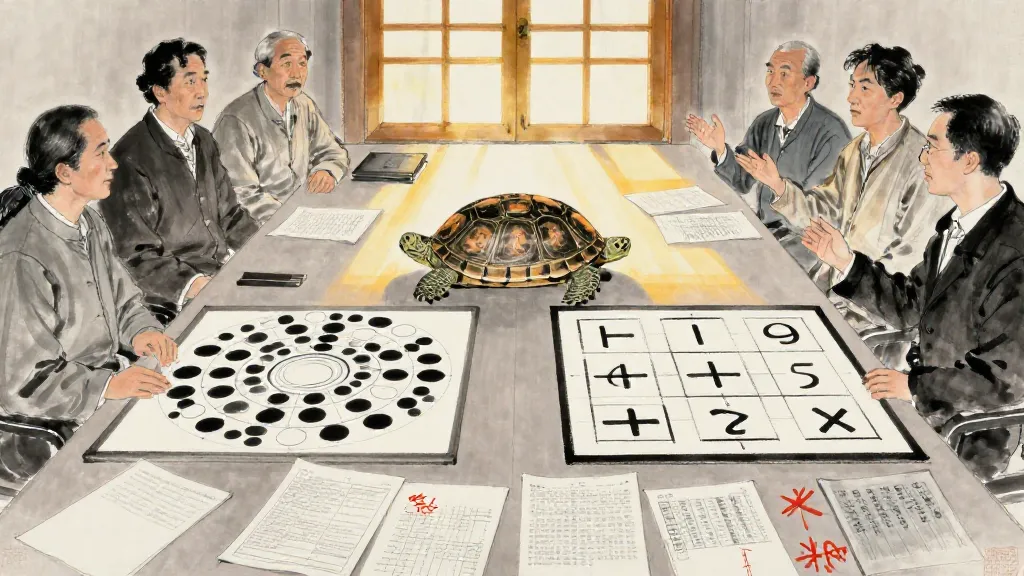
The River Diagram Wars
For centuries, scholars fought over two diagrams—the Hetu and the Luoshu—and whether they were the original cosmic blueprints or later inventions. The Siku compilers weighed in with a verdict that satisfied nobody.
Part 10 of The Emperor's Library — how China reviewed all knowledge.
The Myth
The story is told in the Xici Zhuan (繫辭傳), one of the oldest commentary layers of the Yijing:
河出圖,洛出書,聖人則之。“The River produced the Diagram, the Luo produced the Writing, and the sages modeled upon them.”
In the mythic account, a dragon-horse (龍馬) emerged from the Yellow River bearing on its back a pattern of dots—the Hetu (河圖, River Diagram). Later, a divine turtle (神龜) rose from the Luo River carrying a second pattern—the Luoshu (洛書, Luo Writing). The sage king Fu Xi (伏羲) saw the Hetu and derived from it the eight trigrams (八卦), which became the foundation of the entire hexagram system. The sage king Yu (大禹) saw the Luoshu and derived from it the ordering principles of governance—the nine sections of the Hongfan (洪範), the “Great Plan” of the Shangshu.
This much was common ground for nearly two millennia of Chinese scholarship. The Hetu was the origin of the hexagrams. The Luoshu was the origin of political cosmology. The sages received cosmic blueprints from nature and built civilization upon them. The question that tore the tradition apart was not whether the diagrams existed. It was which pattern was which.
The Two Patterns
By the Song dynasty, two specific dot-patterns had been associated with the Hetu and Luoshu. Both are arrangements of black and white dots representing numbers. The first is a cross-shaped pattern with five pairs of numbers arranged on the cardinal points and the center: 1 and 6 at the bottom (north), 2 and 7 at the top (south), 3 and 8 at the left (east), 4 and 9 at the right (west), and 5 and 10 at the center. The second is a 3×3 grid where the numbers 1 through 9 are arranged so that every row, column, and diagonal sums to 15—what modern mathematics calls a magic square.
The traditional assignment, codified in the Song, held that the cross-shaped pattern was the Hetu and the magic square was the Luoshu. This made intuitive sense: the Hetu, as the origin of the hexagram system, should be the more cosmologically fundamental pattern, and the cross-shaped arrangement of complementary number pairs does map neatly onto the yin-yang structure of the trigrams. The magic square, with its emphasis on numerical balance, seemed appropriate for the Hongfan's nine categories of governance.
Then Liu Mu (劉牧) disrupted everything.
Liu Mu's Reversal
Liu Mu (劉牧, 1011–1064) was a Northern Song scholar who specialized in Yijing numerology. He argued that the traditional assignment was backward: the magic square was actually the Hetu, and the cross-shaped pattern was the Luoshu. His reasoning was intricate, drawing on the numerological properties of each pattern and their fit with the cosmological claims of the ancient texts. The magic square's property of summing to 15 in every direction, Liu Mu argued, better represented the generative completeness that the Xici Zhuan attributes to the River Diagram. The cross-shaped pattern, with its five paired numbers, better matched the Hongfan's system of five phases.
Liu Mu's reversal ignited a controversy that lasted seven hundred years. What made it so explosive was not the technical argument about dot patterns. It was what the argument implied about the foundation of the entire Yijing tradition. If the Hetu was the cosmological source of the hexagram system, then getting the Hetu wrong meant getting the origin of the hexagrams wrong. And if the origin of the hexagrams was wrong, every numerological system built on that origin—the entire image-and-number tradition—was built on a false foundation.
The stakes were not academic. The Yijing was a state classic. Its interpretation was embedded in the imperial examination system. The question of which diagram was the Hetu was a question about the legitimacy of the cosmological framework that underwrote political authority. Getting the cosmic blueprint right mattered because the entire system claimed to derive from that blueprint.
The Camps
The controversy divided Yijing scholars into two camps that can be roughly labeled the “traditionalists” and the “reversers.”
The traditionalist camp maintained the older assignment: the cross-shaped pattern is the Hetu, the magic square is the Luoshu. Their strongest argument was lineage. The assignment was old and widely accepted. Overturning it required positive evidence, not merely a clever reinterpretation of the same sources everyone had always read. Zhu Xi (朱熹), the most influential Neo-Confucian philosopher, initially followed this position in his early writings.
The reverser camp followed Liu Mu: the magic square is the Hetu, the cross-shaped pattern is the Luoshu. Their strongest argument was textual. The descriptions of the Hetu in the Xici Zhuan and other ancient sources, they claimed, better matched the properties of the magic square. The way the Xici speaks of the “fifty great numbers of heaven and earth” (天地之數五十有五) and the “completion of changes and transformations” seemed to point toward the more mathematically complete magic square rather than the simpler cross-pattern.
Zhu Xi complicated matters by changing his mind. In his later work Yixue Qimeng (易學啓蒙, Introduction to the Study of the Changes), he accepted the reversal, adopting Liu Mu's position that the magic square was the Hetu. This created an intellectual earthquake. Zhu Xi's authority was enormous—his commentaries were the official basis for the imperial examinations for centuries. When Zhu Xi accepted the reversal, it became the orthodox position within the Cheng-Zhu school, and scholars who rejected it found themselves arguing against the most powerful intellectual institution in Chinese learning.
The Skeptics
The controversy generated a third position that was, in some ways, more radical than either side: the claim that neither diagram was ancient. Skeptics argued that both the cross-shaped pattern and the magic square were Song-dynasty constructions projected backward onto the mythic past. The ancient texts spoke of a “River Diagram” and a “Luo Writing,” but no text before the Song actually specified what they looked like. The dot patterns were the invention of the Chen Tuan (陳摶) lineage—a tradition of Daoist numerologists who claimed to have received esoteric transmissions from antiquity but whose transmission histories were suspiciously undocumented.
This skeptical position had strong textual support. The Han dynasty scholars who wrote the earliest Yijing commentaries never describe the Hetu and Luoshu in terms that match either dot pattern. When Kong Anguo (孔安國) and Ma Rong (馬融) discuss the River Diagram, they describe it as a text or decree from heaven, not as a mathematical diagram of dots. The specific dot-patterns that Liu Mu and his opponents were fighting about appeared in the intellectual record only with the Song-dynasty revival of cosmological numerology—a tradition that traced itself to Chen Tuan, who claimed to have received them from a lineage of Daoist hermits on Mount Hua. The chain of transmission was unverifiable. The diagrams had no independent attestation before Chen Tuan's circle produced them.
The skeptics did not deny that the ancient texts mentioned the Hetu and Luoshu. They denied that the texts described what the Song numerologists claimed to see. The phrase “the River produced the Diagram” might refer to a written document, a pattern of cracks on a turtle shell, or something else entirely. The leap from that phrase to a specific arrangement of dots required assumptions that no ancient source warranted.
The Compilers' Verdict
When Ji Yun's team reached the Hetu-Luoshu controversy in their review of the 485 Yijing commentaries, they had to take a position. Seven hundred years of argument lay before them. Both camps had produced substantial scholarship. The skeptics had raised questions that neither camp could fully answer. The compilers did what they did best: they assessed the evidence, identified what could be established and what could not, and rendered a judgment that was rigorous, balanced, and satisfying to no one.
Their core finding was that the controversy was ultimately unresolvable. The original evidence was lost. No text from the pre-Song period specifies the visual form of either the Hetu or the Luoshu with enough precision to settle the question of which pattern is which. The Song numerologists who produced the diagrams claimed ancient authority but could not document the chain of transmission. Both the traditionalist and reverser positions were built on interpretive inferences from ambiguous ancient passages, not on direct evidence.
The compilers observed that the debate had consumed an extraordinary amount of scholarly energy for an extraordinarily meager result. Scholars had written entire books arguing about the arrangement of dots in diagrams whose antiquity could not be verified. Meanwhile, the actual text of the Yijing—the hexagram statements, the line texts, the Da Xiang, the Xici—sat there waiting to be read by people who were too busy fighting about cosmological prehistory to attend to the book in front of them.
The verdict was pragmatic rather than theoretical. The compilers did not declare one side right and the other wrong. They declared the entire question secondary. Whether the cross-shaped pattern or the magic square is the “real” Hetu is less important than whether either diagram actually helps you understand the Changes. And on that question, the compilers were clear: the diagrams are “易之一端,非其本也”—“one facet of the Changes, not its foundation.”
Why the Debate Mattered
To a modern reader, the Hetu-Luoshu controversy can look like the quintessential angels-on-a-pinhead debate—scholars fighting for centuries about the arrangement of dots in a mythical diagram. But this reading misses why the debate was so heated and why the compilers devoted so much attention to it.
The Yijing is not just a text. It is a system. The hexagrams are not arbitrary symbols; they are structured combinations of yin and yang lines that are supposed to model the patterns of change in the cosmos. The image-and-number school believed these patterns had a mathematical foundation—that the hexagram system was derived from a more fundamental numerical structure, and that this structure was encoded in the Hetu. If that is true, then knowing the correct form of the Hetu is not a matter of antiquarian curiosity. It is a matter of understanding the mathematical basis of the hexagram system itself.
The meaning-and-principle school did not care about the Hetu because they did not believe the hexagrams needed a mathematical foundation. For Wang Bi and his successors, the hexagrams were meaningful because of the philosophical truths they expressed, not because of any underlying numerical structure. You do not need a cosmic diagram to explain why Hexagram 1 (Qian, the Creative) represents pure yang energy. The meaning is in the text, not in a dot pattern on a turtle's back.
The Hetu-Luoshu debate was therefore also a proxy war between the two factions. Every argument about which diagram was which was also an argument about what kind of knowledge the Yijing contains. Is it a mathematical system encoded in cosmic blueprints, or a philosophical text that can be read without reference to numerology? The compilers' verdict that the controversy is secondary was also a verdict about which kind of knowledge they considered primary.
The Individual Reviews
The compilers' general position on the Hetu-Luoshu controversy is stated in the Yi Lei preface. But the individual reviews of specific texts are where the judgment gets concrete.
Liu Mu's own works receive careful but critical treatment. The compilers acknowledge that his arguments are technically sophisticated and based on close reading of the numerological passages in the Xici. But they note that his entire system depends on an unverifiable premise: that the dot patterns transmitted by the Chen Tuan lineage are authentic representations of what Fu Xi saw on the dragon-horse's back. If that premise fails—and the compilers are clearly skeptical that it holds—then the question of which pattern is which becomes meaningless.
Zhu Xi's Yixue Qimeng is reviewed with the characteristically balanced treatment that the compilers reserved for major figures. They note Zhu Xi's adoption of the reversal position and acknowledge that his authority gave it enormous influence. But they also note that Zhu Xi himself expressed uncertainty about the diagrams in his later correspondence, and that his acceptance of the reversal was tentative rather than absolute. The compilers use Zhu Xi's own doubts as evidence that the question remains open.
The texts most harshly treated are those that built elaborate cosmological systems on the Hetu and Luoshu without acknowledging the uncertainty of their foundations. A commentary that assumes the Hetu is the magic square and then derives a complete cosmological theory from that assumption is building on sand. The compilers say so. A commentary that assumes the Hetu is the cross-pattern and then does the same thing is building on different sand. The compilers say that too.
The Aftermath
The Siku compilers' pragmatic verdict did not end the debate. Scholars in the nineteenth and twentieth centuries continued to argue about the Hetu and Luoshu, and the controversy has been reinvigorated by archaeological discoveries. Numerical diagrams found on Shang dynasty oracle bones and Western Han tomb artifacts have been interpreted—controversially—as early forms of the Hetu and Luoshu, potentially providing the pre-Song evidence that the compilers noted was missing.
Modern scholarship has generally validated the compilers' skepticism about the Song transmission claims. The Chen Tuan lineage's diagrams cannot be traced with confidence before the Song dynasty, regardless of the lineage's claims about ancient origins. The specific dot-patterns that Liu Mu and his opponents fought about were almost certainly Song-dynasty creations—which does not necessarily mean they have no relation to older traditions, but does mean that the seven-hundred-year debate about which pattern was the “real” Hetu was a debate about Song-dynasty artifacts, not about pre-historical cosmic blueprints.
What the compilers got right was the principle. You do not need to resolve the Hetu-Luoshu controversy to read the Yijing productively. The hexagram texts, the line statements, the Great Images, the Xici—all of these are available without reference to any diagram. The Changes is, as the compilers said, a book whose primary purpose is moral instruction grounded in concrete images. The cosmic diagrams are interesting. They may even be historically significant. But they are not the foundation.
Seven hundred years of argument about the arrangement of dots, and the best minds of the Qing dynasty concluded: read the text instead. It is a verdict that still holds.
References
Primary Sources
四庫全書總目提要 (General Catalog of the Complete Library of the Four Treasuries, with Critical Abstracts), juan 1–10: 經部·易類. Reviews of Hetu-Luoshu-related texts and the Yi Lei general preface. Chinese Text Project
劉牧, 易數鉤隱圖 (Hidden Diagrams of the Numbers of the Changes). Liu Mu's foundational work arguing for the reversal of the Hetu and Luoshu assignments, the text that launched seven centuries of controversy.
朱熹, 易學啓蒙 (Introduction to the Study of the Changes). Zhu Xi's systematic treatment of Yijing numerology, including his acceptance of the Hetu-Luoshu reversal.
Secondary Scholarship
Smith, Richard J. Fathoming the Cosmos and Ordering the World: The Yijing (I-Ching, or Classic of Changes) and Its Evolution in China. University of Virginia Press, 2008. Chapter 4 covers the Hetu-Luoshu controversy in the context of Song-dynasty Yijing numerology.
Nielsen, Bent. A Companion to Yi Jing Numerology and Cosmology: Chinese Studies of Images and Numbers from Han (202 BC–AD 220) to Song (960–1279). Routledge, 2003. The most detailed English-language study of the Hetu-Luoshu tradition and its development across dynasties.
Guy, R. Kent. The Emperor's Four Treasuries: Scholars and the State in the Late Ch'ien-lung Era. Harvard University Press, 1987. Context for how the Siku compilers approached unresolvable scholarly controversies.