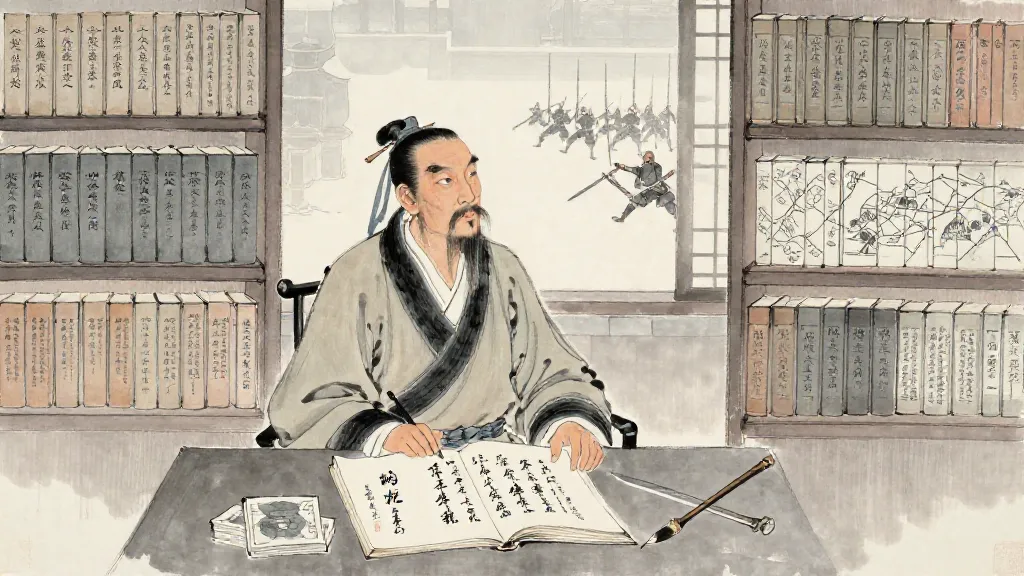
Confucians Review the Art of Killing
The scholars who compiled the imperial catalog were trained in the Confucian classics. Benevolence, righteousness, ritual propriety—these were their intellectual coordinates. Then they had to review thirty-five centuries of texts about how to win wars. The tension is on every page.
Part 13 of The Emperor's Library — how China reviewed all knowledge.
The Philosopher's Problem
Confucius taught benevolence (仁). Mencius argued that a truly benevolent ruler would have no enemies, because neighboring peoples would flock to his banner voluntarily. The Confucian intellectual tradition, at its most idealistic, holds that virtue makes violence unnecessary—that the perfected ruler governs by moral example and has no need of the sword.
The Siku Quanshu Zongmu Tiyao (四庫全書總目提要) was compiled by men who had passed the imperial examinations by demonstrating mastery of this tradition. Ji Yun (紀昀) and his team of 360 scholars were Confucians by training, by profession, and by institutional affiliation. When they reached the military section (兵家類) in juan 99–100, they were confronting a body of literature that exists precisely because virtue alone does not keep the borders secure.
The preamble to the military section is where this tension becomes visible. It is one of the most philosophically revealing passages in the entire 200-volume catalog, because the compilers have to explain—to themselves as much as to anyone else—why an imperial library built on Confucian principles should preserve texts about deception, ambush, and the strategic uses of cruelty.
The Preamble: Squaring the Circle
The compilers open with history. Military texts, they acknowledge, have existed since antiquity. The Rites of Zhou (周禮) mentions a “Minister of War” responsible for military training and field tactics. The Spring and Autumn Annals record warfare as a constant feature of political life. Even the Yijing—the Book of Changes, foundation of all Chinese learning—contains hexagrams about armies and conflict. War is not an aberration in the classical tradition. It is part of the furniture.
But then comes the distinction that lets the compilers breathe:
其間孤虛、王相之說,雜以陰陽五行;風雲、氣色之說,又雜以占候。故兵家恒與術數相出入,要非古兵法也。
“Among the military texts, the theories of Void and Fullness, of Kings and Ministers, are mixed with Yin-Yang and the Five Elements. The theories of wind, clouds, and atmospheric phenomena are mixed with prognostication. Thus military writing has always overlapped with the occult arts—but these are not the ancient art of war.”
This is the compilers' escape hatch. There is a legitimate military tradition and an illegitimate one. The legitimate tradition deals with “the arts of raising and training troops, and the proper use of strategy and tactics” (生聚訓練之術,權謀運用之宜). The illegitimate tradition mixes strategy with divination, omen-reading, and cosmological numerology. The compilers will separate the two. Strategy belongs in the main catalog. Divination goes to the occult arts section.
The Texts They Praised
The compilers' highest admiration went to texts that managed to talk about war in morally serious terms. This was not a Confucian imposition on the material—several of the military classics genuinely engage with questions of justice, restraint, and the conditions under which violence is legitimate.
Sun Tzu (孫子) received the highest possible verdict. The compilers called it “the ancestor of a hundred generations of military writing” (武書為百代談兵之祖). What they admired was not just tactical brilliance but philosophical depth. Sun Tzu's insistence that the highest victory is the one won without fighting—that “to subdue the enemy without battle is the supreme excellence” (不戰而屈人之兵,善之善者也)—is a proposition a Confucian can endorse. War is necessary but regrettable. The best general is the one who makes it unnecessary.
Wu Qi (吳子) posed a different challenge. Wu Qi the man was morally appalling—he killed his wife to secure a military command. “His personal conduct is scarcely worth discussing” (其行事殊不足道). But his text emphasizes virtue over terrain (“it lies in virtue, not in strategic ground”—在德不在險), advocates governing troops through ritual and righteousness, and lists five things a general must guard: principle, preparation, decisiveness, discipline, and restraint. The compilers quoted the Song critic Gao Sisun: “He valued ritual and righteousness, and made clear the importance of training—perhaps he gained something from the Sima Fa” (尚禮義,明教訓,或有得於司馬法者).
The verdict on Wu Qi is the compilers at their most Confucian and their most honest: a terrible person can produce a morally serious text, because ideas are not hostages to their author's character. The Confucian tradition has always been more comfortable with this distinction than outsiders assume.
The Sima Fa: War as Ritual
The text the compilers found most congenial to their worldview was the Sima Fa (司馬法). They described it as “grounded in the Way, reliant on virtue, rooted in benevolence, and founded in righteousness” (據道依德,本仁祖義). This is not typical language for a military text. It is the vocabulary of Confucian moral philosophy, applied to the question of how armies should be organized.
The compilers noted that the Han historian Ban Gu classified the Sima Fa not under military texts but under ritual (禮)—because its content overlaps with the Rites of Zhou. This reclassification delighted them. The Sima Fa preserves “one in a thousand” of the military regulations of the Three Dynasties (三代軍政之遺規猶藉存什一於千百). It represents a time when war was governed by ritual rules: when there were protocols for declaring hostilities, treatment of prisoners, and limits on destruction.
Whether the Three Dynasties actually observed such rules is historically dubious. What matters is that the compilers wanted it to be true. The Sima Fa gave them a text that proved—or at least asserted—that military affairs could be conducted within a moral framework. This was the bridge between Confucian ethics and the pragmatic necessity of maintaining armies.
The Texts They Condemned
If the compilers praised texts that treated war with moral seriousness, they condemned texts that mixed military strategy with supernatural claims. The preamble's distinction between legitimate strategy and occult accretion was not theoretical—they applied it relentlessly.
The cunmu section (存目)—the “noted but excluded” appendix—is a catalogue of contempt. Text after text is dismissed for contaminating military thinking with divination, astrological timing, spirit calculations, and magical devices. The late Ming period drew special venom. The compilers described its military literature as “especially squalid and chaotic” (尤為猥雜), a swamp of plagiarism, fantasy weapons, and astrological quackery.
The philosophical objection was specific. Confucianism holds that human affairs should be governed by human judgment—by virtue, wisdom, and practical experience. A general who consults the stars before deciding whether to attack is, in the compilers' view, abdicating his responsibility. He is substituting mechanical ritual for genuine strategic thought. The compilers do not phrase it in modern terms, but what they are objecting to is essentially the replacement of judgment with algorithm.
This is why they reserved their harshest language for texts that were not merely bad strategy but morally irresponsible: texts that encouraged generals to base life-and-death decisions on cosmological numerology rather than on assessment of actual conditions. The wooden men with firecrackers were laughable. The astrological timing systems were dangerous.
Wei Liaozi: The Uncomfortable Middle
Between the texts they praised and the texts they condemned lay works that gave the compilers genuine difficulty. Wei Liaozi (尉繚子) is the most interesting case.
On one hand, the text contains principles that any Confucian could endorse: “Do not attack a city that has committed no offense; do not kill a person who has committed no crime” (兵不攻無過之城,不殺無罪之人). The compilers praised these as principles “that the Warring States military theorists did not speak of” (皆戰國談兵者所不道)—a moral standard that elevated Wei Liaozi above its contemporaries.
On the other hand, the Bingling chapter describes desertion laws in extreme detail—the penalties for soldiers who flee, the collective punishment of their units, the mechanisms of military discipline enforced through terror. The compilers note this without flinching: Wei Liaozi is “not empty talk of benevolence and righteousness by those without practical experience” (亦非漫無經略,高談仁義者矣). The phrase is revealing. The compilers are acknowledging that a text which merely repeats Confucian platitudes about benevolence is actually less valuable than one that grapples with the ugly realities of military discipline. Practical military wisdom requires moral seriousness and moral compromise, and pretending otherwise is its own form of dishonesty.
Qi Jiguang: When Theory Meets Practice
The sole Ming-era general to earn the compilers' full respect was Qi Jiguang (戚繼光), whose Lianbing Shiji (練兵實紀) and Jixiao Xinshu (紀效新書) received admiring reviews. What the compilers valued was exactly what a Confucian would value: a man who lived by his words.
Qi Jiguang's most famous passage describes the reality of formation combat:
開大陣,對大敵,比場中較藝,擒捕小賊不同。千百人列陣而前,勇者不得先,怯者不得後,只是一齊擁進。
“Deploying in a great formation against a great enemy is nothing like martial arts competitions or catching petty bandits. When a thousand men advance in formation, the brave cannot rush ahead, the timid cannot hang back—everyone simply pushes forward together.”
The compilers said Qi “truly understands the situation” (可謂深明形勢) and does not deal in “stale phrases from strategy manuals” (韜略之陳言). They also noted, with evident approval, that Qi beheaded his own eldest son for looking back during battle: “He can be said to have lived up to his own words” (可謂不愧所言矣).
For Confucians, the relationship between words and conduct (言行) is the ultimate test of character. A general who writes about discipline and then enforces it—even at the cost of his own son—embodies the Confucian ideal of moral consistency. The story is appalling by modern standards. For the compilers, it proved Qi Jiguang was genuine.
The Resolution They Never Stated
Reading the entire military section of the Tiyao, a resolution emerges that the compilers never quite articulate but clearly operate by. War is a necessary function of the state. Military texts are professional literature for a professional activity. The Confucian framework does not forbid warfare—it insists that warfare be conducted with moral awareness, strategic intelligence, and an understanding that the goal is always the restoration of order, not the glorification of violence.
By this standard, Sun Tzu is the ideal military text: it treats war as a problem to be solved rather than a spectacle to be enjoyed. Wu Qi and the Sima Fa are nearly as good, for different reasons. The forgeries fail not because they are forged but because they substitute mystification for genuine thought. And Qi Jiguang succeeds because he writes from experience, addresses reality, and backs his words with his conduct.
The compilers never resolved the fundamental tension between Confucian benevolence and military necessity. No one has. But they found a working position: evaluate military texts the same way you evaluate any text—by the quality of the thinking, the honesty of the engagement with reality, and the moral seriousness of the author. This is why a text about killing people could earn a place in an emperor's library curated by Confucian scholars. The library was not about endorsement. It was about intelligence.
For the compilers' detailed verdicts on individual military texts, including the forgery analysis, see The Imperial Review of Sun Tzu and the Military Canon and Every Forgery in the Military Canon.
References
Primary Sources
四庫全書總目提要, 卷九十九–一百 (Siku Quanshu Zongmu Tiyao, juan 99–100). Ji Yun et al., compiled 1773–1782. 子部·兵家類. Wikisource (juan 99) | Wikisource (juan 100)
Secondary Scholarship
Sawyer, Ralph D. The Seven Military Classics of Ancient China. Westview Press, 1993.
Lewis, Mark Edward. Sanctioned Violence in Early China. State University of New York Press, 1990.
Johnston, Alastair Iain. Cultural Realism: Strategic Culture and Grand Strategy in Chinese History. Princeton University Press, 1995. On the tension between Confucian idealism and strategic pragmatism.