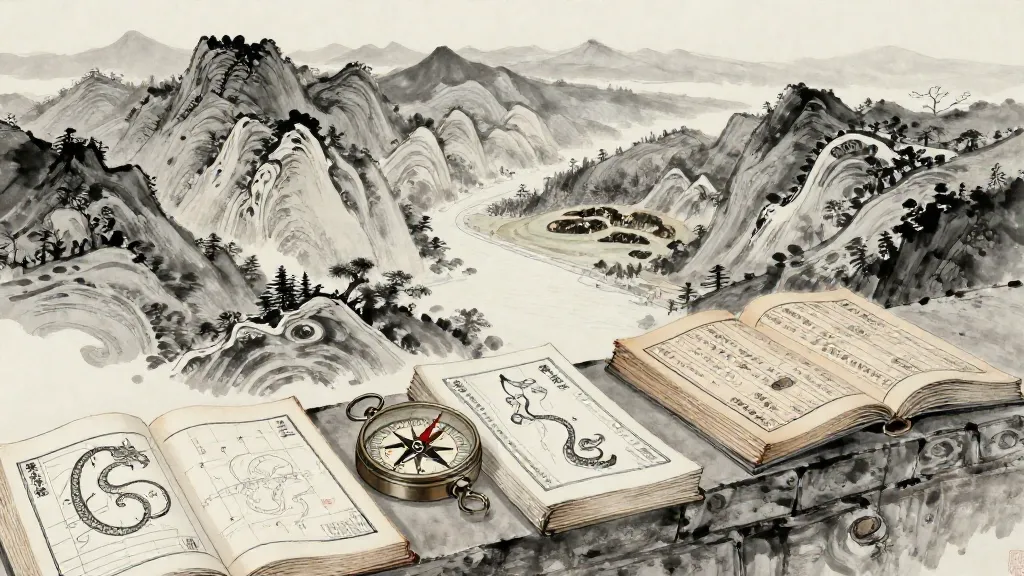
The Geomancer's Bookshelf
The Qing imperial scholars authenticated exactly eight feng shui texts and rejected eighteen others. Their criteria for telling the difference—and the paradox of an Emperor who relied on geomancy judging which geomancy texts were real—reveal how a tradition polices its own boundaries.
Part 16 of The Emperor's Library — how China reviewed all knowledge.
The Emperor's Tombs
Before the Siku scholars wrote a single word about geomancy texts, the Qing court had already committed to the tradition in stone. The Eastern Qing Tombs (清東陵) and Western Qing Tombs (清西陵) were sited according to dragon-vein theory (龍脈). The Forbidden City itself was oriented and positioned using principles drawn from the geomantic tradition. Every major construction project undertaken by the court involved consultation with experts in the siting of buildings and graves.
This created an unusual reviewing condition. The scholars could not dismiss geomancy as baseless without implying that the dynasty's most important architectural decisions were founded on nonsense. But they also could not accept every geomancy text that crossed their desk, because most of them contradicted each other, claimed false authorship, or contained evident fabrications. They had to draw a line—and the line they drew tells us more about how the tradition understood itself than any theoretical treatise.
Guo Pu's Zangshu: The Foundation
The foundational text of Chinese geomancy is the Zangshu (葬書), the “Book of Burial,” attributed to Guo Pu (郭璞, 276–324 AD). Guo Pu was a polymath—poet, lexicographer, commentator on the Shanhaijing and the Erya, and according to tradition, the greatest diviner of his age. His biography in the Jin Shu records that he could predict the future, find lost objects, and choose burial sites that would bring fortune to descendants.
The compilers authenticated the Zangshu. Their reasoning was characteristically careful. They acknowledged that the text as received is not pure Guo Pu—it has been interpolated over centuries, with later practitioners adding material and attributing it to the master. But the core text, they argued, is genuine. Their evidence: the Zangshu's central concept of qi (氣)—that burial sites should be chosen where the earth's vital energy collects rather than disperses—is consistent with the natural philosophy of Guo Pu's era. The vocabulary and intellectual framework belong to the Eastern Jin, not to later periods.
The key passage from the Zangshu that the compilers endorsed as the foundation of legitimate geomancy is the definition of qi flow:
葬者,乘生氣也。氣乘風則散,界水則止。古人聚之使不散,行之使有止,故謂之風水。
“Burial is the harnessing of living qi. Qi disperses when it rides the wind; it halts when it meets water. The ancients gathered it so it would not disperse, directed it so it would halt—hence the name feng shui [wind and water].”
This is the passage that gives feng shui its name. The compilers treated it as the theoretical core of the tradition—a statement about landscape, energy, and the relationship between the living and the dead that is grounded in natural observation rather than supernatural claims. Whether one accepts the metaphysics, the method it describes—reading terrain for water flow, wind patterns, and topographic form—is observational. It asks you to look at the landscape, not consult a spirit table.
The compilers noted, however, that the received text contained significant corruption. Later editors had added material that did not match Guo Pu's style or period. They accepted the Zangshu as authentic in its foundation while flagging the accretions—a verdict they applied to many texts across the catalog: genuine core, corrupt transmission.
Yang Yunsong: The Dragon-Vein Master
After Guo Pu, the most important figure in the geomantic tradition is Yang Yunsong (楊筠松), a Tang dynasty practitioner whose texts systematized dragon-vein theory (龍脈)—the idea that mountains and ridges form continuous lines of qi, like the veins of a dragon, and that the art of geomancy is finding where these veins collect their energy.
The compilers accepted two of Yang Yunsong's texts: the Hanlong Jing (撼龍經), the “Classic of Shaking the Dragon,” and the Yilong Jing (疑龍經), the “Classic of Questioning the Dragon.” Both texts describe methods for reading mountain ranges as dragon forms—identifying where a dragon “turns its head,” where it “opens its jaws,” where it “holds a pearl.” The language is metaphorical, but the underlying practice is topographic survey: following a ridgeline from its origin to its terminus, reading the shape of the terrain, and identifying the point where the landform creates a sheltered, well-watered position.
The compilers' verdict on Yang Yunsong's texts was more cautious than their verdict on Guo Pu. They accepted the dragon-vein framework as the practical method of the geomantic tradition, but they did not endorse it with the same warmth they gave the Zangshu's theoretical foundation. Yang Yunsong's texts were admitted because they were the standard reference for a practice the court itself relied on—and because their textual lineage was traceable to the Tang dynasty, making them old enough to qualify as classical rather than folk.
Classical Geomancy vs. Folk Practice
The distinction the compilers drew between the texts they accepted and the texts they rejected maps onto a larger distinction in the tradition itself: between classical geomancy, which reads landscape and terrain through the framework of qi theory, and popular feng shui, which relies on compass formulas, spirit calculations, and numerical taboos.
The classical approach, as represented by Guo Pu and Yang Yunsong, is fundamentally observational. It asks the practitioner to walk the land, follow the ridgelines, read the watercourses, and feel the terrain. The compass (羅盤) is a tool for recording what you observe, not a substitute for observation. The dragon-vein metaphor is a way of training the eye to see landscape as a system of connected forms rather than isolated features.
The popular approach, as represented by the texts the compilers rejected, replaces observation with calculation. It gives you formulas: take the compass bearing, look up the corresponding element, check it against the year's pillar, determine whether the direction is auspicious or inauspicious. No need to walk the land. No need to read the terrain. Just plug the numbers in and get an answer.
The compilers' contempt for the formulaic approach is consistent with their treatment of similar systems elsewhere in the catalog. In the Xieji Bianfang Shu's rationalist critiques, they demolish spirit-sha taboos and directional prohibitions using the same reasoning: systems that claim to determine outcomes through mechanical calculation, without reference to actual conditions, are fabrications.
The Rejected Texts
Eighteen geomancy texts were relegated to the cunmu (存目)—noted for the record but excluded from the imperial library. The compilers' reviews of these texts show their detection methods at work.
The Yuchi Jing (玉尺經), one of the most famous geomancy manuals in popular circulation, was attributed to the Yuan polymath Liu Bingzhong (劉秉忠) with commentary by the Ming strategist Liu Ji (劉基, also known as Liu Bowen). The compilers exposed it through a single anachronism: the commentary mentions Guizhou province (貴州) by name, but Guizhou was not established as a province until the Yongle reign (1402–1424)—decades after Liu Ji's death in 1375. The forger had used a contemporary geographical term without checking whether it existed in Liu Ji's lifetime.
Other rejected texts fell to different tests. Some contained terminology from periods later than their claimed authorship. Some described compass methods that did not exist before the Song dynasty while claiming to be Tang or earlier. Some were identified as compilations of material from known sources, reshuffled and attributed to famous names for commercial value.
The compilers reserved particular disdain for texts that mixed geomancy with date-selection taboos—systems that claimed not just to identify good sites but to specify which days, hours, and directions were safe for construction or burial. These hybrid texts drew criticism from both sides: the geomancy was formulaic rather than observational, and the date selection violated the classical systems documented in the Xieji Bianfang Shu. They failed on both counts.
The Paradox of Imperial Geomancy
The deepest irony in the compilers' geomancy reviews is this: the texts they authenticated describe a practice that the Emperor actually used. The dragon-vein theory of Yang Yunsong is the same theory that determined the placement of Qing imperial tombs. The qi-flow principles of Guo Pu's Zangshu are the same principles that court geomancers applied when siting palace expansions.
But the texts they rejected also describe practices that real people used every day—compass formulas for house orientation, directional taboos for grave placement, spirit calculations for construction timing. The difference, in the compilers' framework, is not between geomancy that works and geomancy that doesn't. It is between geomancy with a legitimate textual pedigree and geomancy without one.
This is a bibliographic criterion, not an empirical one. The compilers did not test whether Guo Pu's methods produced better outcomes than the Yuchi Jing's methods. They tested whether the texts were genuine. Authenticity was the proxy for quality, because in a tradition where knowledge is transmitted through texts, a corrupted text transmits corrupted knowledge. If the foundation is forged, everything built on it is unreliable.
Whether this is a satisfying standard depends on your epistemology. For the compilers, it was the only standard they could apply consistently. They were bibliographers, not experimentalists. They could determine when a text was written and by whom. They could not determine whether burying your grandfather on a dragon vein actually benefits your descendants. So they evaluated what they could evaluate and left the rest to the practitioners.
What Survived
The geomancer's bookshelf, as curated by the Siku scholars, is narrow and focused. At its foundation: Guo Pu's Zangshu, with its definition of qi flow as the theoretical basis of the entire tradition. Above that: Yang Yunsong's dragon-vein texts, providing the practical method of terrain reading. And a handful of supporting texts that extend or elaborate the classical framework without contradicting it.
Everything else—the compass formulas, the spirit calculations, the directional taboos, the hybrid date-selection systems—was excluded. Not destroyed, not banned, but officially judged unworthy of the imperial library. The popular feng shui tradition that millions of people relied on was, by the court's own assessment, mostly fabricated.
Nearly 250 years later, the popular tradition remains dominant. The compass formulas the scholars rejected are in every feng shui app. The directional taboos they demolished are in every almanac. The dragon-vein theory they endorsed is practiced mainly by specialists and scholars. The market, as usual, preferred the formulas to the fieldwork.
For the broader context of how the imperial scholars evaluated all divination traditions, see The Emperor's Guide to Divination and When Rationalists Review the Occult.
References
Primary Sources
四庫全書總目提要, 卷一〇九–一一〇 (Siku Quanshu Zongmu Tiyao, juan 109–110). Ji Yun et al., compiled 1773–1782. 子部·術數類·相宅相墓. Wikisource (juan 109)
葬書 (Zangshu). Attributed to Guo Pu (郭璞, 276–324 AD). Siku Quanshu edition.
撼龍經 / 疑龍經 (Hanlong Jing / Yilong Jing). Attributed to Yang Yunsong (楊筠松, Tang dynasty).
Secondary Scholarship
Bruun, Ole. Fengshui in China: Geomantic Divination Between State Orthodoxy and Popular Religion. University of Hawai'i Press, 2003.
Field, Stephen L. Ancient Chinese Divination. University of Hawai'i Press, 2008.
Smith, Richard J. Fortune-tellers and Philosophers: Divination in Traditional Chinese Society. Westview Press, 1991.