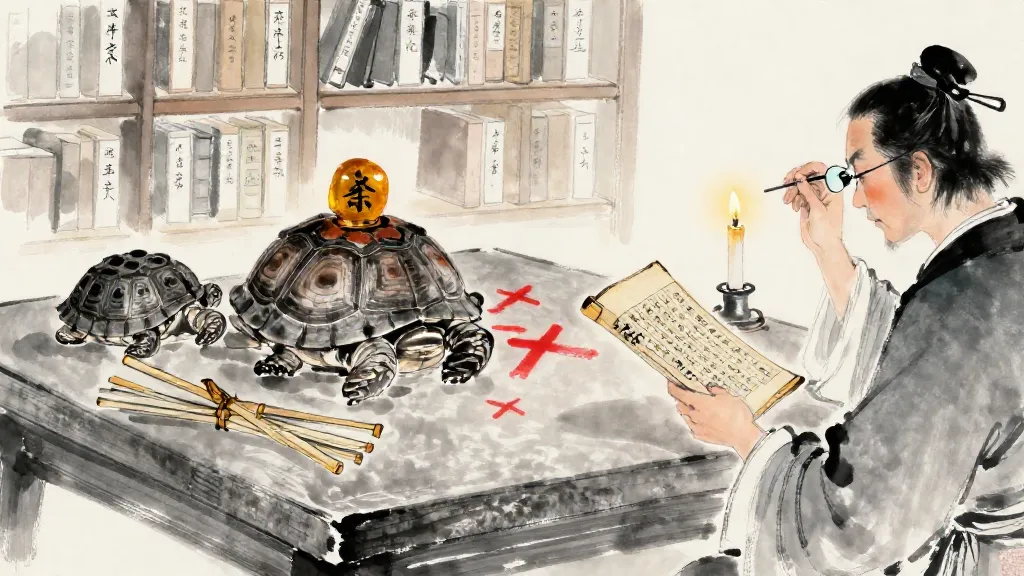
The Emperor's Guide to Divination: What Survived Imperial Review
In the 1780s, Qianlong's scholars cataloged every divination text in the empire. Their judgments—what they endorsed, what they dismissed, and the framework they used to tell the difference—reveal a surprisingly rationalist approach to the supernatural.
Part 2 of From the Imperial Catalog — what Qianlong's scholars thought of the classics.
The Sorting Machine
The Siku Quanshu Zongmu Tiyao (四庫全書總目提要) is a 200-volume catalog compiled under Emperor Qianlong between 1773 and 1782. Led by the chief editor Ji Yun (紀昀) and a team of elite scholars, it reviewed every significant book in the empire and rendered a verdict: include it in the imperial library, or relegate it to the "noted but excluded" (存目) appendix. Inclusion was an honor. Exclusion was not destruction—the book was still acknowledged—but it was a judgment that the work lacked sufficient rigor, authenticity, or value to deserve a place on the shelves of the Wenyuan Pavilion.
Juan 108 through 111 cover the Shushu Lei (術數類), the "Arts of Calculation" section, filed under the Masters division (子部). This is where every divination, numerology, astrology, geomancy, and fate-calculation text in the empire gets its day in court. The scholars sorted them into six sub-categories: numerology (數學), prognostication (占候), geomancy (相宅相墓), divination (占卜), fate-calculation and physiognomy (命書相書), and a catch-all for yin-yang and five-phase cosmology (陰陽五行). Then they passed judgment on each book individually.
The results: 45 texts admitted to the imperial library. 122 texts noted but excluded. The ratio alone tells a story—roughly three out of four divination books failed imperial review.
The Framework: A Branch of the Yijing, Not Its Own Tradition
Before reviewing a single book, Ji Yun's team laid out their analytical framework in a remarkable general preface to the section. It opens with a statement that would surprise anyone who assumes imperial-era scholars were credulous about divination:
術數之興,多在秦漢以後。要其旨,不出乎陰陽五行,生克制化,實皆《易》之支派,傅以雜說耳。
"The rise of the occult arts mostly postdates the Qin and Han. In essence, they do not go beyond yin-yang and the five phases, generation and conquest, control and transformation—all of which are really branch streams of the Yijing, overlaid with miscellaneous theories."
This is the scholars' core move: divination is not an independent tradition. It is a downstream derivative of the Book of Changes, mixed with accumulated folk belief. That framing allowed them to evaluate every text against a clear standard—does it preserve something of the original principle, or has it drifted into pure fabrication?
Their next observation is even more striking:
中惟數學一家為《易》外別傳,不切事而猶近理。其餘則皆百偽一真,遞相煽動。
"Among these, only numerology constitutes a genuine alternative transmission of the Yijing—it does not directly engage with practical affairs yet still approaches principle. The rest are ninety-nine parts falsehood to one part truth, each inflaming the next."
"Ninety-nine parts falsehood to one part truth." This is not mystical reverence. This is a bureaucratic quality assessment.
What Got In: Numerology as Legitimate Scholarship
The sub-category that fared best was Shuxue (數學), which in this context means not modern mathematics but the tradition of cosmological number theory—texts that use numerical systems to model the structure of the universe. Sixteen texts were admitted. The scholars treated this as the most intellectually respectable branch of the occult arts.
The star of the section is Yang Xiong's Tai Xuan Jing (太玄經), the Han dynasty classic that mirrors the Yijing with a ternary system of 81 "houses" instead of 64 hexagrams. The scholars note that while Wang Dang's Tang-era account claims the Tai Xuan was used for divination and "achieved more hits than the Yijing," no one else in the tradition actually used it that way. Their verdict: it is a work of number theory, not divination, and should be classified accordingly. "故今仍隸之數學,不入占卜"—"Therefore we still assign it to numerology, not to divination."
The most fascinating inclusion is Shao Yong's Huangji Jingshi Shu (皇極經世書), the 12-volume cosmological opus that maps all of human history onto a vast cycle of hexagram-derived periods. The scholars acknowledge that Zhu Xi himself praised it as the most complete intellectual construction since the Yijing, yet they also note that Zhu Xi called it "a separate transmission outside the Yijing" (易外別傳). They relocate it from the Confucian philosophers section (where previous catalogs had placed it out of respect for Shao Yong) to the occult arts, arguing that since its method is number-based calculation, that is where it belongs—regardless of the author's stature.
This was a bold reclassification. The scholars justified it with an analogy: Zhu Xi's commentaries on Daoist texts belong in the Daoist section even though Zhu Xi was a Confucian, because classification follows method, not author.
Prognostication: Preserved for Their Citations, Not Their Predictions
The prognostication sub-category (占候) admitted only two texts to the library—the lowest count of any section. Both were ancient astronomical compendia: the Lingtai Miyuan (靈台秘苑), originally compiled under the Northern Zhou, and the Tang-era Kaiyuan Zhanjing (唐開元占經) in 120 juan.
The scholars' reasoning for including them is revealing. They explicitly state that prognostication is unreliable as a practice:
作《易》本以垂教,而流為趨避禍福;占天本以授時,而流為測驗災祥。皆末流遷變,失其本初。
"The Yijing was originally created to transmit teachings, but devolved into fortune-seeking and disaster-avoidance. Celestial observation was originally for regulating time, but devolved into testing for auspicious and inauspicious omens. Both are downstream corruptions that lost their original purpose."
The two texts were saved not because their predictions work, but because they preserve quotations from older works that are otherwise lost. The Kaiyuan Zhanjing alone contains substantial fragments of Han-dynasty apocrypha (緯書) and the complete text of the Indian-derived Jiuzhi Li (九執曆) calendar, which no other source preserves. The scholars explicitly say: "其術可廢,其書則有可采"—"The art can be discarded, but the book has material worth salvaging."
Divination Proper: Jiao Yanshou Gets His Due
The divination sub-category (占卜) admitted five texts. Two are especially relevant to the I Ching tradition that Six Lines works within.
First, the Lingqi Jing (靈棋經), an ancient divination manual using 12 tokens that the scholars trace to the Six Dynasties period. They praise Ming scholar Liu Ji's (劉基) commentary as "elegant and refined" (馴雅), noting that it "truly differs from those who use generation and conquest as their entire technique" (誠異乎世之生克制化以為術者矣). The text was preserved as an example of a genuinely ancient divination method.
Second, and most significantly for the Yijing tradition: Jiao Yanshou's Yi Lin (焦延壽《易林》), the 16-volume Han-dynasty divination text that generates 4,096 omen verses by combining each of the 64 hexagrams with every other. The scholars engage in careful textual criticism, weighing arguments by Zheng Xiao and Gu Yanwu that certain verses contain anachronisms suggesting post-Han interpolation. They conclude that the core text is authentic—citing the Dong Guan Han Ji's record of Emperor Ming using the Yi Lin in 62 AD as definitive proof—while acknowledging that "practitioners of occult arts may have added interpolations over time" (方伎家輾轉附益,竄亂原文).
The scholars also make a crucial historical point: they reclassify the Yi Lin from the Yijing commentary section (where Zhu Yizun's bibliography had placed it) to the divination section. Their reasoning: Jiao Yanshou's tradition "does not originate from the classical Yijing lineage" (其源實不出於經師), so it belongs with the practitioners, not the commentators.
The Excluded: A Graveyard of Forgeries
The 存目 (noted but excluded) sections across juan 110 and 111 are where the scholars' skepticism truly shines. They document over a hundred texts and dismantle most of them.
The Zhengyi Xinfa (正易心法), attributed to the legendary Mayi Daozhe (Linen-Robed Taoist) and supposedly transmitted through Chen Tuan, is demolished using Zhu Xi's own detective work. Zhu Xi had tracked down the actual author—a minor official named Dai Shiyu—and found his private notes, which matched the text's style exactly. The scholars quote Zhu Xi's verdict approvingly: "its language is vulgar and modern, nothing like writing from one or two hundred years ago."
Geomancy (fengshui) texts suffer particularly harsh treatment. The scholars admit eight texts to the library but exclude eighteen more. The famous Yuchi Jing (玉尺經), attributed to the Yuan polymath Liu Bingzhong with commentary by Liu Ji (Liu Bowen), is exposed as a late Ming fabrication. The scholars note that Liu Ji's commentary mentions Guizhou province by name—but Guizhou did not exist as a province until the Yongle reign, decades after Liu Ji's death.
The fate-calculation texts get similar scrutiny. The Li Xuzhong Mingshu (李虛中命書), foundational to the tradition of "eight characters" (八字) astrology, is accepted but with extensive caveats. The scholars note that the early portions discuss only year, month, and day—consistent with Han Yü's description of Li Xuzhong's method—while later sections reference the four-pillar system that only emerged in the Song dynasty. Their conclusion: genuine Tang-era material contaminated by later additions.
The Imperial Texts: Where the Emperor Speaks
Two works in the yin-yang and five-phase section carry special authority: the Xingli Kaoyuan (星曆考原), compiled under the Kangxi Emperor, and the Xieji Bianfang Shu (欽定協紀辨方書), compiled under Qianlong himself. These are the emperor's own contributions to the field, and the catalog treats them with appropriate deference—but their inclusion also reveals the court's position on divination practice.
The Xieji Bianfang Shu's review describes it as a systematic correction of centuries of accumulated error in the official almanac tradition. Where popular practice had proliferated contradictory taboos and spirit calculations, the Qianlong-era project "reduced everything to the principle of the four seasons and five phases, generation and conquest, flourishing and declining" (舉術家附會不經、繁碎多礙之說,一訂以四時五行生克衰旺之理). The scholars note that the emperor's own preface frames the project around two principles: "revering the regularity of heaven" and "revering the orientation of earth"—and locates human fortune not in spirit calculations but in the quality of one's reverence (敬).
What the Catalog Reveals
Reading through all four juan of the Shushu Lei, a clear picture emerges of what 18th-century Qing scholarship actually thought about divination. Their position was neither blanket credulity nor blanket dismissal. It was something more interesting: a sophisticated framework for distinguishing signal from noise within a tradition they recognized as largely corrupt.
Their core principles:
Antiquity earns a hearing, not automatic respect. A text attributed to Zhuge Liang or Liu Bowen is not credible simply because of the name on the cover. The scholars systematically check whether vocabulary, institutional terminology, and geographical names are consistent with the claimed period of authorship.
Method determines classification, not authorship. Shao Yong may have been a great Confucian, but his Huangji Jingshi belongs in the occult arts because it uses numerological methods. Jiao Yanshou's Yi Lin may look like Yijing commentary, but it belongs with the diviners because its tradition is separate from the classical lineage.
A text can be valuable for the wrong reasons. The Kaiyuan Zhanjing is preserved not because celestial prognostication works, but because it contains irreplaceable historical records. Several fate-calculation texts are preserved not because the scholars believe in astrology, but because they document the methods clearly enough to be studied.
The tradition has a legitimate core and an illegitimate periphery. That core is the Yijing itself, and the numerological tradition that extends its logic. The periphery is everything that claims the authority of antiquity while actually originating in the workshops of Ming-era publishers and itinerant fortune-tellers.
The catalog concludes its general preface with a passage that captures this entire sensibility:
然眾志所趨,雖聖人有所弗能禁。其可通者存其理,其不可通者姑存其說可也。
"Yet where the multitude's inclinations tend, even a sage cannot wholly prohibit them. Where the reasoning is sound, preserve the principle. Where it is not, preserve the account and leave it at that."
This is not mystification. It is curatorial pragmatism. The emperor's scholars knew they could not stop people from consulting diviners. What they could do was establish which texts in the tradition had genuine intellectual content and which were fabrications—and make that judgment part of the permanent record.
Why This Matters for Six Lines
Six Lines implements the Xieji Bianfang Shu, one of the two imperial texts that the catalog endorses as the culmination of the legitimate tradition. The Meihua Yishu (梅花易數) tradition and the hexagram calendar methods that Six Lines draws on descend from exactly the numerological lineage that the catalog treats as the most intellectually defensible branch of the divination arts.
This is not an appeal to authority. It is a point about lineage and quality control. When the most thorough bibliographic project in Chinese history reviewed every divination text in the empire, they found that most of it was fabricated, contradictory, or incoherent. What survived their review was a narrow tradition grounded in the Yijing's combinatorial logic and the five-phase system's cosmological structure. That is the tradition Six Lines works within. Not because an emperor endorsed it, but because it is the part of the tradition that withstands scrutiny.
References
Primary Source
四庫全書總目提要 (Siku Quanshu Zongmu Tiyao), juan 108–111: 子部術數類. Compiled by Ji Yun (紀昀) et al. under Emperor Qianlong, 1773–1782. Wikisource
Secondary
Guy, R. Kent. The Emperor's Four Treasuries: Scholars and the State in the Late Ch'ien-lung Era. Harvard University Press, 1987. Standard study of the Siku Quanshu project.
Smith, Richard J. Fortune-tellers and Philosophers: Divination in Traditional Chinese Society. Westview Press, 1991. Comprehensive survey of Chinese divination traditions.