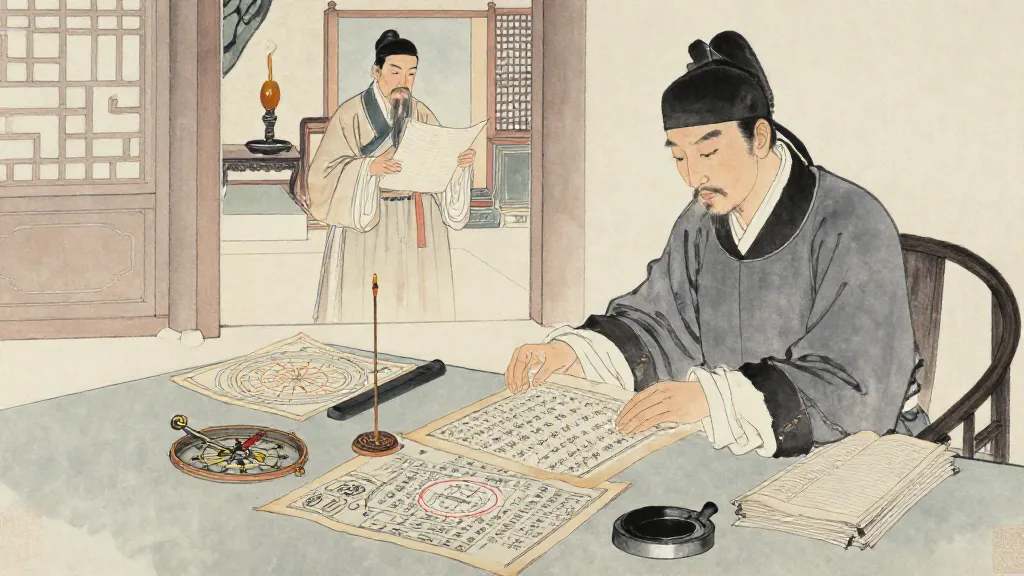
When Rationalists Review the Occult
The Siku scholars were Confucian textual critics trained in evidence-based reasoning. The Emperor practiced divination. The divination section of the imperial catalog is the record of what happened when these two facts collided.
Part 15 of The Emperor's Library — how China reviewed all knowledge.
The Institutional Bind
The Shushu Lei (術數類)—the “Arts of Calculation” section of the Siku Quanshu Zongmu Tiyao (四庫全書總目提要)—occupies juan 108 through 111. It is filed under the Masters division (子部), alongside philosophy, agriculture, medicine, and the military arts. The scholars who compiled it were the same men who elsewhere demolished forged classics, corrected centuries of textual corruption, and applied rigorous bibliography to every text they touched.
Now they had to review astrology, geomancy, physiognomy, fate calculation, and stalking-and-hexagram divination.
The problem was not merely intellectual. Emperor Qianlong himself used these systems. The Qing court maintained an official Astronomical Bureau (欽天監) responsible for calendar computation and celestial prognostication. The emperor's tombs were sited by geomancers. Court rituals were timed by diviners. The very project the scholars were working on—the Siku Quanshu—had its own compilation schedule reviewed for auspicious dates.
You cannot tell the Emperor that the traditions he relies on are nonsense. But you also cannot, as a rigorous textual critic, pretend that a forged divination manual is genuine or that a contradictory system is coherent. The Shushu Lei is the record of how the scholars navigated this bind.
The Preface: Defining the Legitimate Core
The general preface to the section opens with a move that is simultaneously bold and cautious:
術數之興,多在秦漢以後。要其旨,不出乎陰陽五行,生克制化,實皆《易》之支派,傅以雜說耳。
“The rise of the occult arts mostly postdates the Qin and Han. In essence, they do not go beyond yin-yang and the five phases, generation and conquest, control and transformation—all of which are really branch streams of the Yijing, overlaid with miscellaneous theories.”
This is the scholars' foundation. All divination is downstream of the Book of Changes. The Yijing is canonical—it is one of the Five Classics, taught in every school, commented on by Confucius himself. By defining divination as a branch of the Yijing, the scholars give it a legitimate pedigree. They do not have to defend divination on its own terms. They only have to show that a particular text preserves something of the original Yijing-derived principle, or that it has deviated into fabrication.
Then comes the assessment that would have been unprintable without the safety of an imperial commission:
中惟數學一家為《易》外別傳,不切事而猶近理。其餘則皆百偽一真,遞相煽動。
“Among these, only numerology constitutes a genuine alternative transmission of the Yijing—it does not directly engage with practical affairs yet still approaches principle. The rest are ninety-nine parts falsehood to one part truth, each inflaming the next.”
“Ninety-nine parts falsehood to one part truth.” The scholars have just told the Emperor that 99% of the divination tradition is fabricated. They have said this in an official document that bears the imperial imprimatur. This is not the language of men who believe in divination. This is the language of men who are doing their job under constraints.
The Taxonomy: Six Ways to Read the Universe
The compilers organized divination texts into six sub-categories, each representing a recognized method of accessing hidden knowledge. The taxonomy itself is an intellectual statement: by naming six methods and no more, the scholars declared that everything outside these categories is unrecognized.
Numerology (數學). Cosmological number theory—texts that model the structure of the universe through numerical systems. This is the category they considered most intellectually respectable. Yang Xiong's Tai Xuan Jing (太玄經) and Shao Yong's Huangji Jingshi Shu (皇極經世書) both land here. Sixteen texts admitted.
Prognostication (占候). Celestial observation, weather prediction, omen reading. Only two texts admitted to the library—both valued not for their predictions but for preserving quotations from older works. The scholars explicitly stated: “The art can be discarded, but the book has material worth salvaging” (其術可廢,其書則有可采).
Geomancy (相宅相墓). Siting of houses and graves—what later became known as feng shui. Eight texts admitted, eighteen excluded. The scholars authenticated Guo Pu's foundational Zangshu while demolishing most later texts as fabrications.
Divination proper (占卜). Stalking-and-hexagram methods, including the Yijing-derived tradition. Five texts admitted, including Jiao Yanshou's Yi Lin (易林)—which the scholars reclassified from Yijing commentary to divination practice, a significant editorial judgment.
Physiognomy and fate calculation (命書相書). Reading faces, reading birth data. The Li Xuzhong Mingshu (李虛中命書), foundational to the eight-character (八字) tradition, was accepted with extensive caveats about later interpolation.
Yin-yang and Five Phases (陰陽五行). The catch-all category, including the imperial texts: the Kangxi-era Xingli Kaoyuan (星曆考原) and Qianlong's own Xieji Bianfang Shu (欽定協紀辨方書).
The overall numbers tell the story: 45 texts admitted to the imperial library, 122 texts noted but excluded. Three out of four divination books failed imperial review.
Grudging Concessions
The cognitive dissonance is most visible when the scholars encounter texts they cannot dismiss but do not want to endorse. The pattern recurs: acknowledge that the system appears to function, document it carefully, but never say you believe in it.
The Lingqi Jing (靈棋經), a Six Dynasties divination manual using twelve tokens, received praise not for its divinatory accuracy but for the literary quality of Liu Ji's (劉基) commentary—“elegant and refined” (馴雅). The compilers noted that Liu Ji's approach “truly differs from those who use generation and conquest as their entire technique” (誠異乎世之生克制化以為術者矣). The concession is not to divination itself but to a particular practitioner's intelligence.
Jiao Yanshou's Yi Lin (易林)—the Han dynasty text generating 4,096 omen verses from hexagram pairs—forced a different kind of concession. The scholars could not deny its antiquity: the Dong Guan Han Ji records Emperor Ming using it in 62 AD. They accepted its core authenticity while noting that “practitioners of occult arts may have added interpolations over time” (方伎家輾轉附益,竄亂原文). They kept the text but reclassified it: Jiao Yanshou belongs with the diviners, not with the Yijing commentators, because his tradition “does not originate from the classical Yijing lineage” (其源實不出於經師).
This reclassification is a quiet act of intellectual hygiene. By moving the Yi Lin out of the Classics section and into the Arts of Calculation, the scholars preserved its text while quarantining its influence. It would not contaminate the canonical commentary tradition. It would sit among the practitioners, where it belonged.
Scholarly Demolitions
Where the scholars felt free to demolish, they did so with evident relish. The cunmu sections—juan 110 and 111—contain over a hundred reviews that dismantle texts using the same methods the compilers applied to forged military classics and fabricated Confucian commentaries.
The Zhengyi Xinfa (正易心法), attributed to the legendary Mayi Daozhe (麻衣道者) and supposedly transmitted through the Daoist sage Chen Tuan (陳摶), was demolished using Zhu Xi's own detective work. Zhu Xi had tracked down the actual author—a minor official named Dai Shiyu—and found his private notes. The scholars quoted Zhu Xi's verdict: “its language is vulgar and modern, nothing like writing from one or two hundred years ago.”
The Yuchi Jing (玉尺經), a geomancy text attributed to the Yuan polymath Liu Bingzhong with commentary by Liu Ji (Liu Bowen), was exposed through a simple anachronism. Liu Ji's commentary mentions Guizhou province by name—but Guizhou did not exist as a province until the Yongle reign, decades after Liu Ji's death. The forger had not done his historical homework.
These demolitions follow the same toolkit used in the military section: vocabulary dating, citation chain analysis, institutional anachronism, and stylistic comparison. The compilers did not need separate methods for evaluating divination texts. Forgery detection is forgery detection, regardless of the subject matter. A fake feng shui manual and a fake military treatise fail for the same reasons: they contain words, institutions, and geographical names that did not exist when they claim to have been written.
The Line Between Classical and Folk
The deepest intellectual move in the Shushu Lei is the distinction the compilers draw between “classical” divination and folk practice. Classical divination is rooted in the Yijing. It uses the combinatorial logic of hexagrams, the cosmological structure of yin-yang and the five phases, and the mathematical patterns of number theory. It has textual lineage, intellectual coherence, and historical depth.
Folk practice, by contrast, is what accumulated over centuries as itinerant practitioners invented new methods, attributed them to famous names, and sold them to anxious clients. The compilers' preface captures this dynamic:
然眾志所趨,雖聖人有所弗能禁。其可通者存其理,其不可通者姑存其說可也。
“Yet where the multitude's inclinations tend, even a sage cannot wholly prohibit them. Where the reasoning is sound, preserve the principle. Where it is not, preserve the account and leave it at that.”
This is the scholars' final position: curate, don't prohibit. They cannot stop people from consulting fortune-tellers. They can establish which texts in the tradition have genuine intellectual content and which are fabrications. The 27 rationalist critiques in Volume 36 of the Xieji Bianfang Shu take this approach to its logical conclusion: detailed, line-by-line demolition of specific folk practices, conducted from inside the tradition by scholars who understand it thoroughly.
The Emperor in the Room
The unspoken presence throughout the Shushu Lei is the Emperor himself. Qianlong did not merely tolerate divination—he institutionalized it. The Xieji Bianfang Shu was his personal project: a 36-volume standardization of the date-selection tradition, bearing his imprimatur. The Astronomical Bureau reported to him directly. His palaces and tombs were sited by court geomancers according to dragon-vein theory.
The scholars could not write “divination is superstition” without implying that the Emperor's own practices were superstitious. So they did something more sophisticated. They distinguished between the Emperor's divination—grounded in classical systems, administered by trained scholars, subjected to quality control—and the popular divination practiced by itinerant fortune-tellers. The former is legitimate because it preserves the Yijing tradition. The latter is illegitimate because it is fabricated by charlatans.
This is not cynical. The distinction is real. There is a genuine difference between a system rooted in 3,000 years of textual tradition and one invented last Tuesday by someone who wants to charge you for a consultation. The scholars just happened to draw that line exactly where it needed to be drawn to keep the Emperor on the right side of it.
Method Over Belief
What emerges from the Shushu Lei is not a statement about whether divination works. The scholars never engage that question directly. What they do instead is apply bibliographic method to every text and let the results speak. Is the text genuinely ancient or forged? Is its internal logic consistent or contradictory? Does it preserve something of the classical tradition or is it pure invention? Can its lineage be traced through reliable bibliographic records?
These questions are answerable regardless of whether one believes in divination. The compilers applied the same critical standards to a feng shui manual that they applied to a Confucian commentary or a military treatise. Method is neutral. And the method, applied consistently, produced the same result across all categories: most of what passes for traditional knowledge is poorly sourced, internally contradictory, and of recent vintage.
The full account of what survived imperial review shows that the narrow tradition the scholars endorsed—grounded in the Yijing's combinatorial logic, transmitted through documented textual lineages, subjected to internal consistency checks—is a small fraction of the total. The rationalists did not defeat the occult. They curated it.
References
Primary Sources
四庫全書總目提要, 卷一〇八–一一一 (Siku Quanshu Zongmu Tiyao, juan 108–111). Ji Yun et al., compiled 1773–1782. 子部·術數類. Wikisource (juan 108)
Secondary Scholarship
Guy, R. Kent. The Emperor's Four Treasuries: Scholars and the State in the Late Ch'ien-lung Era. Harvard University Press, 1987.
Smith, Richard J. Fortune-tellers and Philosophers: Divination in Traditional Chinese Society. Westview Press, 1991.
Henderson, John B. The Development and Decline of Chinese Cosmology. Columbia University Press, 1984. On the intellectual frameworks underlying Chinese occult traditions.