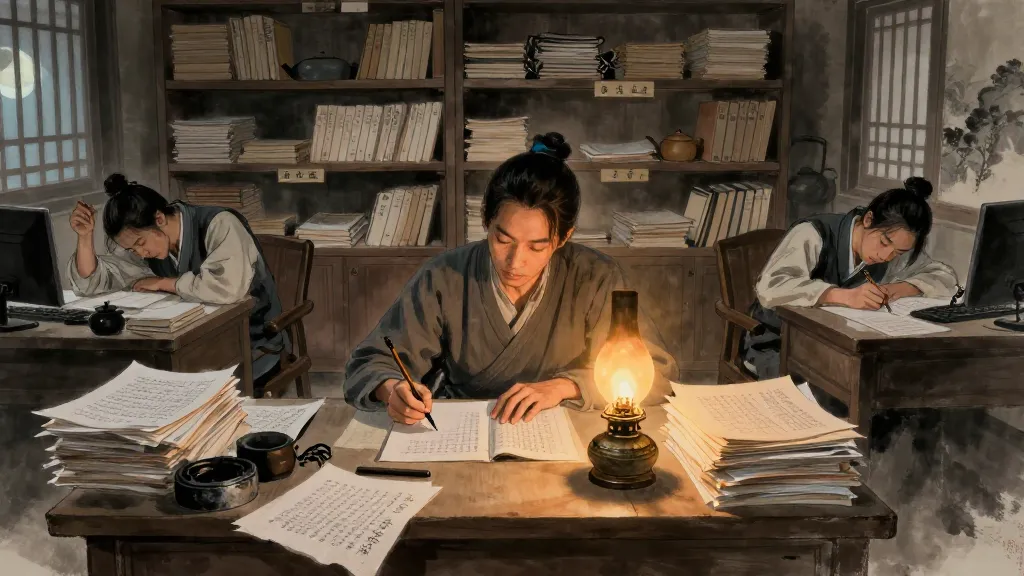
The Scholars Who Wrote the Reviews
Ji Yun led 360 scholars from different traditions, with different biases, through a decade of critical evaluation. The reviews they wrote are learned, precise, and sometimes devastatingly funny.
Part 4 of The Emperor's Library — how China reviewed all knowledge.
The Chief Editor
Ji Yun (紀昀, 1724–1805) came from Xian County (獻縣) in what is now Hebei Province. He earned his jinshi degree in 1754 at the age of thirty, placing high enough to enter the Hanlin Academy— the empire's most elite scholarly institution, which served as a training ground for future grand secretaries and a pool of talent for imperial literary projects. By the time he was appointed chief editor of the Siku Quanshu project in 1773, he had already served in several high-ranking editorial positions, including work on the imperial encyclopedia and the compilation of court records.
But Ji Yun was not just a bureaucratic scholar. He was one of the most distinctive literary voices of the Qing dynasty. His prose style combined deep learning with a lightness of touch that made even technical discussions readable. He had a reputation for sharp wit— anecdotes about his quick retorts and pointed observations circulated widely during his lifetime and became legendary after his death. He was the kind of mind that could hold the entire Chinese literary tradition in view while also noticing that a particular author's prose was pompous, or that a commentary's reasoning was circular, or that a book's claims to antiquity were undermined by anachronistic vocabulary.
This combination of range and precision is visible throughout the Zongmu Tiyao. The catalog's best entries have a voice— authoritative but not ponderous, critical but not cruel, capable of dismissing a bad book in a sentence and praising a good one with genuine enthusiasm. That voice is substantially Ji Yun's, though it was filtered through the contributions of hundreds of collaborators and shaped by the institutional pressures of the project.
The Ghost Story Writer
Ji Yun's other great work—the one he wrote for himself rather than for the emperor—was the Yuewei Caotang Biji (閱微草堂筆記, Notes from the Thatched Hut of Close Observation), completed in 1798, the same year the Zongmu Tiyao was finalized. It is a collection of roughly 1,200 short narratives: ghost stories, fox spirit tales, accounts of strange events, moral anecdotes, philosophical reflections, and sharp social commentary.
The juxtaposition is revealing. The same man who spent his days evaluating the authenticity of ancient texts and writing sober critical assessments of philosophical treatises spent his evenings writing stories about foxes who debated Confucian ethics, ghosts who complained about the quality of funeral offerings, and scholars who were outwitted by supernatural beings. The Yuewei Caotang Biji is not escapist entertainment—it is a serious work that uses the supernatural as a lens for examining human behavior—but it operates in a register completely different from the Zongmu Tiyao.
This range matters because it tells you something about the mind behind the catalog. Ji Yun was not a narrow specialist. He could evaluate a mathematical treatise and a poetry collection and a divination manual with equal competence because his intellect was genuinely comprehensive. The ghost stories show a man who was curious about everything, amused by human folly, and capable of holding multiple frameworks—scholarly rigor, moral seriousness, playful imagination—simultaneously.
The Working Conditions
The Siku project was not a collegial seminar. It was a massive bureaucratic operation housed in the Wenyuan Ge (文淵閣), the imperial library within the Forbidden City, and staffed by scholars who were simultaneously government officials with other duties, career ambitions, and political vulnerabilities.
The organizational structure had several tiers. At the top was the overall director (總裁), a position held by a succession of high-ranking officials. Below the director was Ji Yun as chief editor (總纂官), responsible for the intellectual coherence of the catalog. Below Ji Yun were the compilers (纂修官)—roughly forty senior scholars who drafted the catalog entries and category prefaces. Below the compilers were the collators (校勘官) who checked texts against source editions. And below everyone were the copyists (謄錄官)—more than 3,800 of them over the life of the project—who hand-copied the selected texts into the seven manuscript sets of the Siku Quanshu.
The total number of people who worked on the project in some capacity exceeded 4,000. But the intellectual core—the scholars who actually read the books, assessed their quality, and wrote the reviews—was much smaller: roughly 360 compilers and senior collators, drawn from across the empire and representing different scholarly traditions, different regional intellectual cultures, and different degrees of sympathy toward the various fields they were asked to evaluate.
360 Scholars, 360 Opinions
The diversity of the editorial team was both the project's greatest strength and its most persistent source of internal tension. The Qing intellectual world in the 1770s and 1780s was not monolithic. There were major fault lines between the evidential scholarship (考證學) movement, which emphasized philological precision and textual criticism, and the Song-dynasty-influenced school of moral philosophy (理學), which emphasized the interpretation of classical texts through a Neo-Confucian philosophical framework.
These were not merely academic distinctions. A scholar trained in the evidential tradition would evaluate a classical commentary by asking whether its textual readings were philologically sound. A scholar trained in the moral philosophy tradition would evaluate the same commentary by asking whether its interpretation was philosophically coherent and morally instructive. The same book could receive radically different assessments depending on which scholar reviewed it.
Ji Yun's own sympathies lay firmly with the evidential scholarship movement. He valued philological precision, textual accuracy, and historically grounded interpretation. This bias is visible throughout the catalog: commentaries that demonstrate careful textual work tend to receive more favorable reviews than those that prioritize philosophical speculation, even when the speculative commentary might be more intellectually ambitious.
But Ji Yun could not simply impose his preferences across the entire catalog. The project was too large, the editorial team too diverse, and the political pressures too complex. Some sections of the catalog reflect Ji Yun's voice clearly. Others bear the marks of compilers whose intellectual commitments differed from his. The result is a catalog that is internally consistent in its organizational framework but subtly varied in its evaluative standards—a document with one structure and many voices.
The Review Process
The production of a catalog entry followed a defined workflow. When a book arrived at the project—submitted by a provincial official, donated by a private collector, or sourced from an imperial library—it was assigned to a compiler for review. The compiler read the work (or, for very long works, surveyed it systematically), prepared a draft entry summarizing its contents and evaluating its quality, and submitted the draft for review.
Drafts circulated among senior editors for comment. Ji Yun reviewed and revised entries, sometimes extensively. Disputed assessments were discussed in editorial meetings. For politically sensitive works, drafts might be reviewed by the overall director or even submitted to the emperor himself. The process was iterative— entries went through multiple rounds of revision before reaching their final form.
This process produced a distinctive kind of prose. The catalog entries are not personal essays; they are institutional documents, shaped by committee review and political awareness. But they are not bland either. The best entries convey strong opinions in measured language, using the conventions of scholarly prose to deliver judgments that are precise and sometimes cutting. A book might be described as “not without merit in its individual observations, though the overall framework lacks coherence”—which is a polite way of saying that the author had some good ideas but couldn't organize an argument.
The Art of the Devastating Review
The Zongmu Tiyao's negative reviews are among its greatest literary pleasures. The editors had a gift for the precise observation that deflates pretension without descending into nastiness. They could acknowledge a book's learning while demonstrating that its conclusions did not follow. They could praise an author's diligence while noting that diligence without judgment produces only longer books, not better ones.
Works of dubious authenticity received particularly sharp treatment. The evidential scholarship tradition had developed sophisticated methods for detecting forgeries—anachronistic vocabulary, institutional titles that didn't exist in the claimed period, quotations from texts that postdated the alleged author—and the Siku editors applied these methods with evident relish. A text claiming ancient origins might be systematically dismantled in a few sentences: the vocabulary is post-Han, the institutional references are Tang, and the philosophical framework is suspiciously compatible with Song Neo-Confucianism. Therefore the claimed attribution is untenable.
But the editors were also capable of generous appreciation. Reviews of works they considered genuinely excellent could be warm, detailed, and enthusiastic. A well-crafted commentary might be praised for the elegance of its reasoning. A medical text might be commended for the precision of its clinical observations. A literary collection might be celebrated for the quality of its individual poems. The catalog is not uniformly critical; it is uniformly evaluative, and evaluation includes praise as well as blame.
Scholarly Feuds in Print
Read enough entries and you begin to see the fault lines within the editorial team. Certain categories show signs of internal disagreement—entries that seem to push back against the evaluative criteria established in the category preface, or that assess a work more generously (or more harshly) than the prevailing tone would suggest.
The divination section (術數類) is a case in point. The category preface, likely written or heavily edited by Ji Yun, establishes a measured position: divination has a legitimate intellectual history rooted in the Yijing, but the field has accumulated centuries of superstitious accretions that must be separated from the genuine tradition. Individual entries within the section, however, vary considerably in their sympathy toward divinatory texts. Some reviewers clearly found the material interesting and evaluated it on its own terms. Others were visibly hostile, dismissing works that the category preface's criteria would suggest deserved more nuanced treatment.
Similar variations appear in the Buddhist and Daoist sections, where some reviewers brought genuine understanding of the traditions they were evaluating while others approached them with the suspicion of orthodox Confucian scholars encountering heterodox material. The catalog's assessment of Buddhist philosophy, in particular, varies in tone depending on which compiler wrote the entry—a fact that later scholars have used to identify the authorship of unsigned entries.
These internal variations are not flaws. They are evidence that the catalog was produced by human beings with intellectual commitments, working within an institutional structure that constrained but did not eliminate individual judgment. The Zongmu Tiyao is more interesting—and more honest—for containing multiple voices rather than enforcing a single evaluative standard across 10,000 entries.
The Weight of Individual Bias
The impact of individual reviewers on the catalog's verdicts raises a question that applies to any large-scale evaluative project: how much does the assessment of a work depend on the assessor? The Siku project's answer is: more than the institutional structure would like to admit.
A compiler sympathetic to the occult sciences would evaluate a text on geomancy (堪輿) differently from a compiler who considered the entire field fraudulent. A compiler trained in the philological methods of the Lower Yangzi scholarly tradition would apply different standards to a classical commentary than a compiler from the more philosophically oriented tradition of the north. A compiler who personally disliked an author's literary style could write a technically accurate review that nonetheless conveyed disapproval through the selection and emphasis of details.
Ji Yun's editorial oversight mitigated these biases but could not eliminate them. He reviewed and revised entries, imposed consistency where he could, and wrote or rewrote the category prefaces to establish clear evaluative frameworks. But the sheer volume of the project—10,000 entries across every field of Chinese learning—meant that many individual entries reached their final form without close attention from the chief editor. The catalog is Ji Yun's project, but it is not Ji Yun's monograph. It is the product of 360 minds, coordinated but not unified.
After the Project
Ji Yun served as chief editor of the Siku project for roughly twenty years, from his appointment in 1773 until the catalog was finalized in the 1790s. He continued in government service after the project's completion, eventually rising to the rank of Minister of Rites (禮部尚書) and Grand Secretary of the Xietian Hall (協辦大學士). He died in 1805 at the age of eighty-one, still active and still sharp.
His legacy is double. As chief editor of the Zongmu Tiyao, he produced the single most important reference work in Chinese bibliography—a text that defined the categories of Chinese knowledge for two centuries and that remains the standard starting point for any serious engagement with the pre-modern Chinese literary tradition. As the author of the Yuewei Caotang Biji, he produced one of the most entertaining and intellectually rich collections of short prose in Chinese literature.
The combination is what makes Ji Yun worth remembering. He was not a narrow specialist who happened to receive a large assignment. He was a mind capacious enough to hold the entire tradition—its canonical texts and its ghost stories, its philosophical treatises and its divination manuals, its brilliant achievements and its fraudulent pretensions—and to evaluate each part with precision, wit, and genuine understanding.
The catalog he produced is the subject of this series. It is indispensable, it is compromised by the political pressures under which it was written, and it is the best map we have of the Chinese intellectual tradition as the Qing dynasty understood it. Understanding the scholars who wrote it—their methods, their biases, their feuds, and their brilliance—is essential to reading it well.
References
Primary Sources
四庫全書總目提要 (General Catalog of the Complete Library of the Four Treasuries, with Critical Abstracts). Compiled under Ji Yun (紀昀), completed 1798. The catalog entries themselves are the primary evidence for the reviewers' methods, biases, and intellectual standards. Chinese Text Project
紀昀, 閱微草堂筆記 (Notes from the Thatched Hut of Close Observation). Ji Yun's personal collection of tales and reflections, offering insight into the chief editor's intellectual range and literary sensibility. Completed 1798.
四庫全書纂修檔案 (Siku Quanshu Compilation Archives). Surviving administrative records of the project, including personnel documents, editorial correspondence, and imperial directives.
Secondary Scholarship
Guy, R. Kent. The Emperor's Four Treasuries: Scholars and the State in the Late Ch'ien-lung Era. Harvard University Press, 1987. The definitive study of the project's scholarly culture, including detailed analysis of the editorial team's composition, working methods, and internal dynamics.
Elman, Benjamin A. From Philosophy to Philology: Intellectual and Social Aspects of Change in Late Imperial China. Harvard University Asia Center, 2001. Essential for understanding the evidential scholarship movement that shaped Ji Yun's intellectual standards and the catalog's evaluative criteria.
Nivison, David S. “The Literary and Historical Thought of Chang Hsueh-ch'eng.” In The Life and Thought of Chang Hsueh-ch'eng (1738–1801). Stanford University Press, 1966. Study of a contemporary of Ji Yun whose alternative approach to bibliography and historical thought provides a critical counterpoint to the Siku project's framework.