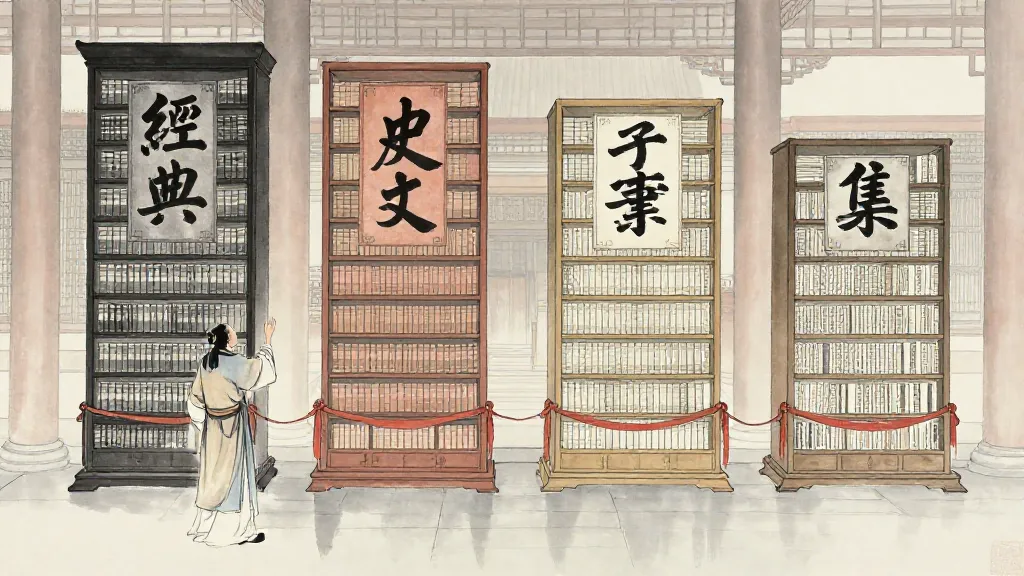
How You Organize All Human Knowledge
The Four Treasuries—Classics, History, Masters, Collections—are not just library shelves. They are a theory of what knowledge is and how its parts relate. The ordering tells you everything.
Part 3 of The Emperor's Library — how China reviewed all knowledge.
The Shape of the System
The name says it all. Siku Quanshu—四庫全書—means “Complete Books of the Four Repositories.” The four repositories, or treasuries (庫), are the four divisions into which the editors classified the entirety of Chinese written knowledge: Classics (經部), History (史部), Masters (子部), and Collections (集部). This four-part scheme was not invented for the Siku project. It had been the standard framework for Chinese bibliography since the early Tang dynasty, when the Sui History's Treatise on Literature (隋書·經籍志) formalized a classification that had been developing for centuries. What the Siku project did was apply it at an unprecedented scale and with unprecedented rigor.
The four divisions are not arranged alphabetically, or by size, or by date of composition. They are arranged by epistemic status— by the kind of knowledge each division contains and the authority that knowledge carries. This ordering is not neutral. It is a philosophical claim about how knowledge works.
經部: The Classics
The Classics division (經部) comes first because it contains the foundational texts of the civilization. These are the works attributed to or associated with the sages—the texts through which, as the Zongmu Tiyao's preface puts it, the sages “embedded instruction within practical affairs.” Everything else in the library is downstream of the Classics in the way that case law is downstream of a constitution.
The division is subdivided into categories that map the classical curriculum. The Yijing (易經, the Book of Changes) and its commentaries form the Yi Lei (易類). The Shangshu (尚書, the Book of Documents) and its commentaries form the Shu Lei (書類). The Shijing (詩經, the Book of Songs) and its commentaries form the Shi Lei (詩類). Then the Three Rites: the Zhouli (周禮), the Yili (儀禮), and the Liji (禮記), each with their own subcategory. The Spring and Autumn Annals (春秋) and its three commentaries get their own section. The Four Books—the Analerta, Mencius, the Great Learning, and the Doctrine of the Mean—receive a category. And then there are sections for music (樂類), philology (小學類), and general classical studies (經解類).
Notice that the Yijing comes first within the Classics. This is not arbitrary. The Zongmu Tiyao's preface to the Yi Lei explains that the Changes is the root of all pattern-knowledge, the text through which the sages first articulated the principles that all other classics elaborate. The Yijing's position at the head of the Classics—and therefore at the head of the entire library—is a claim about the primacy of pattern-recognition as a mode of understanding.
史部: History
The History division (史部) comes second because it records the unfolding of human affairs across time. If the Classics articulate principles, History documents their application and misapplication—the concrete record of what happened when humans governed, fought, negotiated, built, and failed.
The subcategories reveal how the Chinese tradition understood historical knowledge. The Standard Histories (正史類) come first—the official dynastic histories from the Shiji through the Ming History, each one a comprehensive account of a dynasty's political, institutional, and cultural life. Then come Annals and Chronicles (編年類), which organize events by date rather than by topic. Then Narratives of Events (紀事本末類), which organize events by episode. Then Miscellaneous Histories (別史類), Unofficial Histories (雜史類), and Court Diaries (詔令奏議類).
But the History division goes beyond what a modern Western library would classify as history. It includes Geography (地理類)— because geographic knowledge was understood as a branch of administrative knowledge, essential for governance. It includes Government Documents (政書類)—institutional manuals, legal codes, tax records. And it includes Bibliographies (目錄類)— records of books are records of intellectual history, and intellectual history is history.
The placement of bibliographies within the History division is quietly significant. It means the Zongmu Tiyao, as a bibliography, classifies itself as a historical work. The catalog is aware that it is a document of its own moment, a record of what the Qing understood Chinese knowledge to contain. It does not claim to be timeless. It claims to be comprehensive for its time.
子部: The Masters
The Masters division (子部) is where things get interesting. The character 子 (zǐ) means “master” or “sir”— it is the honorific applied to the great thinkers of the pre-imperial period: Kongzi (Confucius), Mengzi (Mencius), Laozi, Zhuangzi, Mozi, Xunzi, Hanfeizi. But by the time of the Siku project, the Masters division had expanded far beyond philosophy to encompass virtually every form of specialized knowledge that did not fit into the other three divisions.
The subcategories read like a map of the Chinese intellectual world. Confucian Masters (儒家類) come first—works of Confucian philosophy and ethics not deemed canonical enough for the Classics division. Then Military Science (兵家類): Sun Tzu, the Six Secret Teachings, the Wuzi. Then Legalism (法家類): Han Feizi, the Book of Lord Shang. Then Agriculture (農家類). Then Medicine (醫家類). Then Astronomy and Mathematics (天文算法類). Then Divination and Numerology (術數類). Then Arts and Crafts (藝術類). Then Catalogues and Encyclopedias (類書類). Then Fiction and Miscellanea (小說家類). And finally Buddhism (釋家類) and Daoism (道家類).
The Masters division is the catch-all, the place where the classification system absorbs everything that is neither canonical (Classics), nor historical record (History), nor literary art (Collections). It is also the division that most clearly reveals the value judgments embedded in the system. Philosophy sits alongside medicine, military strategy alongside agriculture, divination alongside fiction. These fields are grouped not because they are similar in content but because they share a structural position—they are all bodies of specialized knowledge developed by particular masters and their lineages, legitimate but subordinate to the canonical and historical traditions.
The Divination Category: Legitimate Knowledge
The placement of divination (術數類) within the Masters division deserves special attention because it tells you something that modern Western categories would obscure. In a Western library, divination would be shelved under “occult,” “religion,” or “folklore”—categories that signal marginality. In the Siku system, it sits alongside medicine, astronomy, and military strategy as a legitimate branch of specialized knowledge.
The Zongmu Tiyao's preface to the 術數類 is explicit about this. It traces the tradition from the Yijing's system of hexagrams and lines through the Han dynasty masters who developed specific divinatory techniques, notes which approaches the editors consider well-founded and which they regard as superstitious accretions, and establishes criteria for evaluating individual texts. The editors are not uncritical—they dismiss plenty of works as nonsense. But they treat the field itself as real, as a domain of knowledge with a legitimate intellectual history and standards of rigor that can be applied to separate good work from bad.
This matters for understanding the Chinese intellectual tradition on its own terms. The Siku editors were not credulous enthusiasts shelving astrology texts out of politeness. They were the most rigorous bibliographers in Chinese history, working under the direction of Ji Yun, a man whose evidential scholarship standards were among the highest in the Qing. Their decision to treat divination as a legitimate subcategory of the Masters division was a considered intellectual judgment, not a lapse.
集部: Collections
The Collections division (集部) comes last, and its position is significant. It contains literary works: individual authors' collected writings (別集類), literary anthologies (總集類), literary criticism (詩文評類), and, in a late addition, drama (詞曲類). The division begins with the Chu Ci (楚辭), the great anthology of southern poetry from the Warring States period, and proceeds chronologically through individual collections from every dynasty.
Collections come last not because the editors considered literature unimportant but because literary works, in the Siku framework, are expressions rather than foundations. The Classics provide principles. History provides the record. Masters provide specialized knowledge. Collections provide the literary articulation of all three—the poetry, prose, and criticism through which individuals responded to the tradition. Literature is the most personal and therefore the least foundational of the four categories.
This does not mean the editors were dismissive of literary quality. Some of the most detailed and most appreciative entries in the entire Zongmu Tiyao are reviews of literary collections. Ji Yun himself was a formidable prose stylist, and the reviews of poetry and prose in the Collections division are often the entries where the editors write most freely and with the most evident pleasure. But the structural position is clear: literature serves, it does not lead.
What the Ordering Reveals
The sequence—Classics, History, Masters, Collections—is a theory of knowledge expressed as a library catalog. It says: knowledge begins with foundational principles (經), those principles are tested and documented through historical experience (史), specialized fields of practical and theoretical knowledge develop from that foundation (子), and individuals articulate their understanding of all three through literary expression (集).
This is fundamentally different from Western library classification systems. The Dewey Decimal Classification, developed in 1876, organizes by subject matter: 000 for generalities, 100 for philosophy, 200 for religion, and so on. The Library of Congress Classification, developed around 1900, organizes alphabetically by broad discipline: A for general works, B for philosophy and religion, C–D for history. Both systems treat knowledge as a flat landscape of topics, equally accessible from any starting point.
The Chinese four-part system, by contrast, is hierarchical and directional. It has a starting point (the Classics) and a direction (from foundational principles through historical record through specialized knowledge to literary expression). It does not treat all fields as equivalent. It makes an explicit claim about which kinds of knowledge are primary and which are derivative.
This is not necessarily better or worse than the Western approach. It is different in a way that reveals different assumptions about what knowledge is for. The Western systems are designed for retrieval—they help you find the book you are looking for. The Chinese system is designed for orientation—it tells you where any given book stands in relation to the foundational tradition. One answers the question “where is this book?” The other answers the question “what kind of knowledge is this?”
A System That Shapes Thought
Classification systems are not neutral containers. They shape the way people think about the things they classify. The four-part system shaped Chinese intellectual culture for centuries by establishing a default framework within which every text had a place and every place carried evaluative weight.
Consider the consequences. A military treatise classified under the Masters division is, by that act of classification, positioned as specialized practical knowledge subordinate to the Classics. A Buddhist text in the same division is positioned the same way— valuable within its domain but not foundational. A commentary on the Yijing, classified under the Classics, has a different epistemic status entirely: it is working with foundational material, and its quality is judged by different standards.
This explains why debates about classification in the Chinese bibliographic tradition were never merely technical. To move a text from one category to another was to change its intellectual status. When the Siku editors decided that a particular commentary belonged in the Classics division rather than the Masters division, they were making a claim about the commentary's relationship to canonical truth. When they placed a historical text in the Miscellaneous Histories category rather than the Standard Histories category, they were demoting its authority as historical record.
The literary inquisition operated through this same classificatory logic. Banishing a text from the library entirely was the extreme case, but the more subtle and more common form of control was reclassification and demotion—moving a work to a lesser category, assigning it to the cunmu rather than full inclusion, writing a review that acknowledged the work's existence while undermining its authority.
Using the System Today
Modern Chinese libraries no longer use the four-part system for shelving books—most have adopted the Chinese Library Classification (中國圖書館分類法), a subject-based system modeled on Western approaches. But the four-part framework persists as the default conceptual scheme for discussing pre-modern Chinese texts. When a scholar refers to a text as belonging to the 子部, they are invoking the Siku classification even if the physical book sits on a shelf organized by a different system entirely.
For anyone working with classical Chinese texts, understanding the four-part system is not optional. It tells you how the tradition understood the relationship between its own parts. It explains why the Yijing is classified as a Classic and not as divination— and why that classification carries weight. It reveals the logic behind the inclusion and exclusion decisions that shaped what survived and what was lost.
In the next article, we turn from the system to the people who built it—Ji Yun and his team of 360 scholars, their working methods, their intellectual feuds, and the personalities behind 10,000 critical reviews.
References
Primary Sources
四庫全書總目提要 (General Catalog of the Complete Library of the Four Treasuries, with Critical Abstracts). The category prefaces (類序) for each of the four divisions and their subcategories are the primary source for the Siku classification system's intellectual rationale. Chinese Text Project
隋書·經籍志 (Sui History, Treatise on Literature). The earliest formal application of the four-part classification system to a comprehensive bibliography. Chinese Text Project
Secondary Scholarship
Guy, R. Kent. The Emperor's Four Treasuries: Scholars and the State in the Late Ch'ien-lung Era. Harvard University Press, 1987. Chapter 3 analyzes the classification system and its intellectual antecedents.
Wilkinson, Endymion. Chinese History: A New Manual. Harvard University Asia Center, 2018. Part III provides a comprehensive overview of Chinese bibliographic classification from the Han through the Qing, with detailed comparison to Western systems.
Drège, Jean-Pierre. Les bibliothèques en Chine au temps des manuscrits. École française d'Extrême-Orient, 1991. Study of Chinese library organization from the manuscript period through the development of the four-part classification.