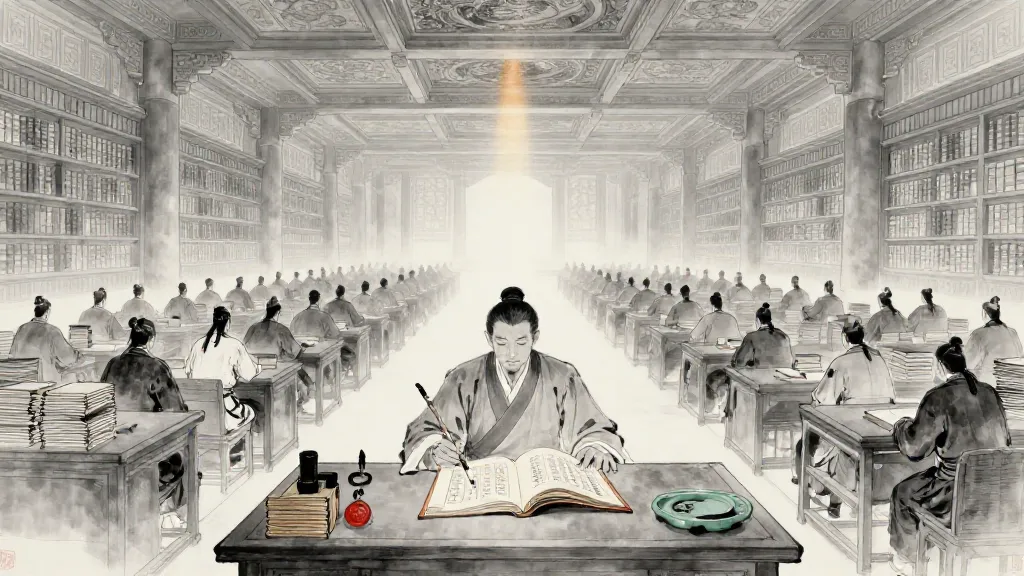
The Biggest Book Review in History
In 1772, the Qianlong Emperor ordered 360 scholars to read every book in China and write a critical review of each one. The result was the largest annotated bibliography ever compiled—and a statement about what knowledge is for.
Part 1 of The Emperor's Library — how China reviewed all knowledge.
An Emperor at His Peak
By 1772, the Qianlong Emperor (乾隆, r. 1735–1796) had been on the throne for thirty-seven years. The Qing dynasty controlled the largest contiguous territory in Chinese history. The treasury was full. The military frontier was secured. And Qianlong—already the most prolific poet in the imperial line, already the patron of enormous painting and porcelain commissions—turned his attention to a project whose ambition dwarfed everything that had come before.
He wanted to collect, copy, and critically evaluate every book worth preserving in China.
This was not without precedent. The Ming dynasty's Yongle Encyclopedia (永樂大典, 1408) had gathered excerpts from thousands of texts into a single reference work. Earlier dynasties had compiled imperial libraries and bibliographies going back to the Han. But Qianlong's project was different in kind, not just scale. He didn't want to compile an encyclopedia. He wanted to assemble the complete text of every significant book in the empire, organize them into a classified library, and produce a critical review—a tiyao (提要)—for each one. The reviews would explain what each book was about, assess its quality, judge its authenticity, and situate it within the larger tradition.
The result was the Siku Quanshu (四庫全書, Complete Library of the Four Treasuries) and its companion catalog, the Siku Quanshu Zongmu Tiyao (四庫全書總目提要, General Catalog with Critical Abstracts). Together they constitute the most comprehensive act of literary evaluation ever undertaken by a single institution.
The Numbers
The scale resists casual comprehension. Over the course of roughly fifteen years, the project processed more than 10,000 titles. Of these, about 3,460 were selected for full transcription into the Siku Quanshu itself. Each selected work was hand-copied by teams of scribes into seven manuscript sets, distributed to imperial libraries across the empire. The transcription alone involved more than 3,800 copyists producing approximately 2.3 million pages.
But the catalog—the Zongmu Tiyao—is in many ways the more remarkable achievement. It contains roughly 10,000 entries spanning 200 juan (卷, fascicles). Each entry is a critical abstract: not just a title and author, but a substantive evaluation of the work's contents, its textual history, its relationship to other works, and its value. For the 3,460 works included in the full library, the abstracts are detailed. For the remaining 6,700+ works that were reviewed but not selected for copying—the so-called cunmu (存目, preserved titles)—the abstracts are briefer but still evaluative.
Ten thousand critical reviews. Written by hand. In classical Chinese. Over fifteen years. There is nothing else like it in the history of bibliography.
Ji Yun: The Editor Who Made It Work
The project needed a chief editor with the literary range to oversee reviews across every field of Chinese learning, the political sensitivity to navigate court politics, and the stamina to sustain the work over more than a decade. The man who got the job was Ji Yun (紀昀, 1724–1805), one of the most brilliant literary minds of the Qing.
Ji Yun was a jinshi (進士) degree holder—the highest level of the imperial examination system—and had served in the Hanlin Academy, the elite scholarly body that staffed the empire's most prestigious intellectual positions. He was known for a prose style that combined erudition with wit, a rare talent for making learned judgments entertaining to read. His appointment as chief editor (總纂官) of the Siku project in 1773 put him in charge of the largest editorial operation in Chinese history.
The role demanded more than scholarship. Ji Yun had to coordinate the work of hundreds of compilers, arbitrate disputes between scholars from different intellectual traditions, maintain consistency of judgment across tens of thousands of entries, and do all of this under the watchful eye of an emperor who considered himself a literary critic of the first rank. Qianlong read drafts. Qianlong had opinions. Ji Yun navigated both the scholarship and the sovereign.
He also, separately, wrote one of the most entertaining books of the Qing period—the Yuewei Caotang Biji (閱微草堂筆記, Notes from the Thatched Hut of Close Observation), a collection of supernatural stories, philosophical reflections, and sharp social commentary. The same mind that reviewed ten thousand books for the emperor also wrote ghost stories for pleasure. The combination tells you something about the range of intellect the project attracted.
More Than Bibliography
What makes the Zongmu Tiyao remarkable is not the cataloging— any sufficiently staffed library can produce a catalog. It is the criticism. Each entry is a review in the full sense: the editors assess the quality of the work's arguments, identify interpolations and forgeries, trace textual transmission histories, compare editions, and render judgment on whether a book is sound, mediocre, or worthless. They are opinionated. They are specific. They are often devastating.
A work might be praised for its philological precision and then criticized for its author's tendency toward speculation. A commentary on a classic might be judged faithful to the original meaning but too derivative to merit inclusion. A medical text might be reviewed positively for its clinical observations and negatively for its theoretical framework. The reviews distinguish between what is useful in a book and what is not, often at the level of individual chapters.
This evaluative rigor is what separates the Zongmu Tiyao from every previous Chinese bibliography. The Han dynasty's Yiwen Zhi (藝文志) classified books. The Sui dynasty's Jingji Zhi (經籍志) classified them more systematically. But neither reviewed them. The Zongmu Tiyao did both: it placed each book in a classification system and then told you what the book was actually worth. It is a bibliography with teeth.
The Framework: What Knowledge Is For
The preface to the Siku Quanshu Zongmu Tiyao sets out a theory of knowledge that explains the entire classification system. It is worth understanding because it reveals assumptions fundamentally different from those underlying Western library classification.
The preface begins with the sages. The ancient sages, it argues, did not teach through abstract doctrine. They embedded instruction within practical affairs—within the systems people actually used. The Yijing (易經) taught through divination. The Shijing (詩經) taught through song. The Liji (禮記) taught through ceremony. The Shangshu (尚書) and Chunqiu (春秋) taught through historical record. In each case, the vehicle was a living practice, and the instruction was inseparable from its practical context.
聖人覺世牖民,大抵因事以寓教。“The sages awakened the world and guided the people largely by embedding instruction within practical affairs.”
This single sentence from the Yi Lei (易類, Divination category) preface encapsulates the entire philosophy of the catalog. Knowledge is not an abstract good. It is a tool for governance, moral cultivation, and the maintenance of civilizational order. Books are evaluated not merely by their intellectual quality but by their relationship to this larger project. A brilliant work of pure speculation that serves no practical purpose ranks lower than a competent handbook that helps officials govern well.
This is why the Classics (經部) come first in the four-part classification. They are not first because they are oldest, though they are. They are first because they are the texts through which the sages' instruction was originally transmitted. Everything else—history, philosophy, literature—is downstream of the Classics in the same way that applications are downstream of principles.
The Catalog as Intellectual Map
To read the Zongmu Tiyao is to see the entire Chinese intellectual tradition laid out as a single, navigable structure. Each of the four main divisions (Classics, History, Masters, Collections) is subdivided into categories, and each category has its own preface explaining what the category contains and why it is organized as it is. These category prefaces are themselves essays in intellectual history—they trace the development of a field from its origins to the Qing, identify the major schools and debates, and explain the criteria used to evaluate works in that field.
The divination category (術數類), for instance, sits within the Masters division (子部). Its preface traces the history of divinatory practice from the Yijing through the Han dynasty numerologists to the Song dynasty image-and-number school, explains which approaches the editors consider legitimate and which they regard as heterodox, and sets out the standards by which individual texts will be judged. Before you even reach the first entry, you have a compressed history of Chinese divination and a statement of evaluative principles.
This means the catalog is not just a list of books. It is a theory of knowledge—a complete account of what the Chinese intellectual tradition contains, how its parts relate to each other, and what standards should govern evaluation. It is the Qing dynasty's answer to the question: if you had to organize everything anyone had ever written in Chinese, how would you do it?
Why This Series Exists
This series—The Emperor's Library—exists because the Siku Quanshu Zongmu Tiyao is the most important reference work most people have never heard of. It is the text that tells you where every other text fits. If you want to understand why the Yijing is classified as a Classic and not as divination, the Zongmu Tiyao explains it. If you want to know why a particular military treatise was considered sound while another was dismissed as derivative, the Zongmu Tiyao tells you. If you want to understand the categories that organized Chinese thought for two centuries, the Zongmu Tiyao is where those categories were defined.
But the catalog is also a product of its moment. It was compiled under an emperor who used the project to suppress books he found politically dangerous. It was written by scholars whose biases shaped their verdicts. It reflects a particular moment in Chinese intellectual history—the high Qing, when evidential scholarship (考證學) was ascendant and speculative philosophy was under suspicion. Reading it requires understanding both its authority and its limitations.
That is what the following articles will do. We will look at the dark side of the project—the literary inquisition that ran alongside it. We will examine the four-part classification system and what it reveals about how China organized knowledge differently from the West. And we will meet the scholars who wrote the reviews—Ji Yun and his team, their methods, their feuds, and the intellectual culture that produced 10,000 critical evaluations in a decade and a half.
The biggest book review in history. Let us see how it was done.
References
Primary Sources
四庫全書總目提要 (General Catalog of the Complete Library of the Four Treasuries, with Critical Abstracts). Compiled under the direction of Ji Yun (紀昀), completed 1798. 200 juan. The catalog and its category prefaces are the primary source for the Siku project's intellectual framework. Chinese Text Project
紀昀, 閱微草堂筆記 (Notes from the Thatched Hut of Close Observation). Ji Yun's personal collection of supernatural tales and philosophical reflections, completed 1798.
Secondary Scholarship
Guy, R. Kent. The Emperor's Four Treasuries: Scholars and the State in the Late Ch'ien-lung Era. Harvard University Press, 1987. The definitive English-language study of the Siku Quanshu project, its political context, and its scholarly culture.
Elman, Benjamin A. From Philosophy to Philology: Intellectual and Social Aspects of Change in Late Imperial China. Harvard University Asia Center, 2001. Essential background on the evidential scholarship movement that shaped the Siku project's intellectual standards.