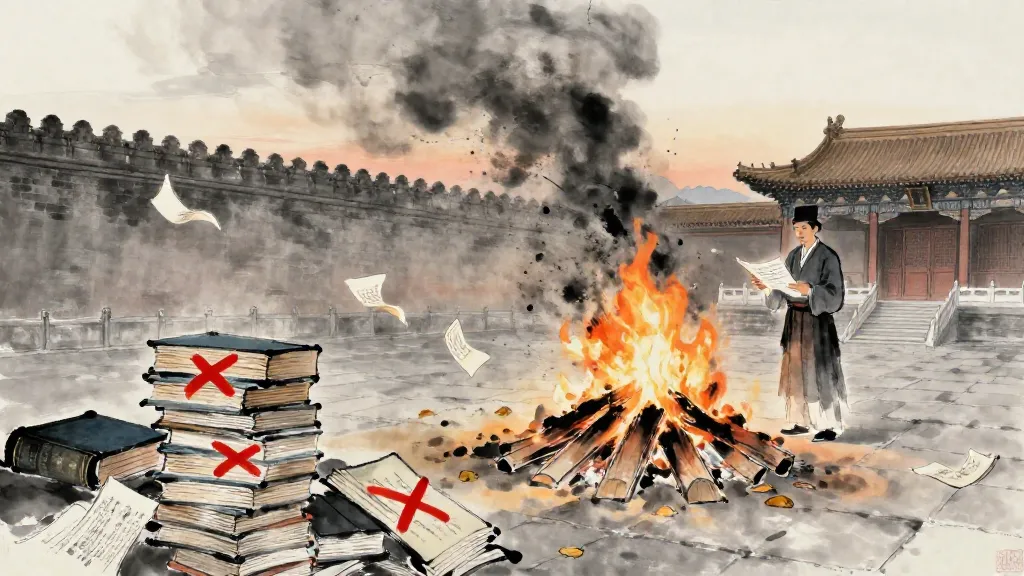
The Literary Inquisition
The Qianlong Emperor's project to catalog every book in China was also a project to destroy the ones he didn't like. The same scholars who reviewed the empire's literature also flagged it for burning.
Part 2 of The Emperor's Library — how China reviewed all knowledge.
The Collection Order
When Qianlong issued the edict in 1772 ordering the collection of books from across the empire, the stated purpose was scholarly: assemble the greatest library ever compiled, preserve rare texts, produce a definitive catalog of Chinese knowledge. Provincial officials, private collectors, and institutional libraries were instructed to submit their holdings for review. The tone was generous—books would be copied and returned, rare editions would be honored, contributors would be recognized.
But a second purpose ran alongside the first, and it was not generous at all. The collection order was also a surveillance operation. As books flowed into the capital from every corner of the empire, the Siku editors were instructed to flag texts containing content hostile to the Qing dynasty, disrespectful of the Manchu ruling house, or sympathetic to the fallen Ming. The same apparatus that was cataloging Chinese literature was simultaneously screening it for political danger.
This was the 文字獄—the “literary inquisition,” or more literally, the “prison of written characters.” The term refers to the Qing practice of prosecuting authors, editors, and even owners of texts deemed politically subversive. Under Qianlong, the literary inquisition reached its peak intensity, and the Siku project became its most powerful instrument.
What Got Destroyed
The numbers are striking. While approximately 3,460 titles were selected for inclusion in the Siku Quanshu, and roughly 6,700 more were reviewed and cataloged in the cunmu (存目, preserved titles) section, an estimated 2,600 titles were ordered wholly or partially destroyed. Some scholars put the count of individual works affected even higher, since a single title could exist in many editions, each of which had to be tracked down and eliminated.
The destruction was systematic. Provincial officials received lists of banned titles and were required to confiscate copies from bookshops, private libraries, and temple collections. Compliance was monitored. Officials who failed to locate and destroy copies faced punishment. The burning of books was documented bureaucratically, with reports filed and quotas tracked, in the same administrative style that governed the cataloging of the books that were kept.
What qualified a book for destruction? The categories were broad but consistent. The most dangerous content was anything that explicitly criticized the Qing dynasty or the Manchu people. This included late-Ming and early-Qing texts by loyalists who had resisted the Manchu conquest, works that used derogatory terms for northern peoples (夷, 虜, 狄—terms that had been standard Chinese vocabulary for centuries but that the Qing court now considered slurs), and historical accounts that portrayed the Ming-Qing transition sympathetically to the losing side.
But the criteria extended beyond explicit anti-Manchu sentiment. Works that discussed border defense in ways that implied the northern frontier was a threat were suspect. Texts that celebrated Ming military victories over northern peoples were dangerous even if they never mentioned the Qing. Poetry that could be read as allegorical criticism of the current dynasty was flagged. The net was cast wide enough to catch not just overt dissent but any text that might, read in the right light, undermine the legitimacy of Manchu rule.
The Paradox of the Catalog
Here is the paradox that makes the Siku project so fascinating to historians: the catalog preserves records of books it ordered destroyed. The Zongmu Tiyao includes entries for works that were banned, confiscated, and burned. The entries are brief— typically just a title, author, and a note explaining why the work was suppressed—but they exist. The catalog that served as an instrument of censorship also served as an inadvertent archive of what was censored.
This was not accidental generosity. The editors needed to maintain records of what had been reviewed and rejected in order to prevent the same texts from being resubmitted or rediscovered and mistakenly cataloged. The bureaucratic requirements of thorough censorship demanded documentation, and documentation is the enemy of forgetting. Scholars in later centuries used these very catalog entries to reconstruct what had been lost, to identify texts that might survive in private collections the Qing apparatus had missed, and to understand the shape of the intellectual tradition that the Siku project had tried to reshape.
The catalog thus occupies a peculiar double position. It is simultaneously the most comprehensive record of Chinese literature and a record of the most comprehensive destruction of Chinese literature. It tells you what was preserved and what was erased, and it tells you both in the same bureaucratic tone, with the same scholarly precision.
The Cunmu: Demotion as Judgment
Between full inclusion and outright destruction lay a middle category that reveals the subtlety of the project's censorship. The cunmu (存目)—literally “preserved titles”—were works that the editors reviewed and cataloged but did not copy into the Siku Quanshu. They were not destroyed, but they were not preserved in the imperial library either. They were noted and set aside.
The reasons for demotion to cunmu status varied. Some works were judged intellectually mediocre—competent but not distinguished enough to merit the expense of copying. Some were considered redundant, covering ground already represented by superior works in the same field. Some were too specialized for a general library. And some were politically sensitive without being dangerous enough to destroy: works that expressed mildly heterodox views, or that came from intellectual traditions the editors considered marginal.
The cunmu category is important because it shows that the Siku project operated on a spectrum of judgment, not a binary of accept/reject. A book could be acknowledged as real, reviewed with scholarly seriousness, and then quietly sidelined. The catalog entry would note its existence and summarize its contents, but the text itself would not be copied or preserved by the state. In a culture where imperial patronage determined which texts survived and which were gradually lost to decay, demotion to cunmu was a soft form of erasure—not destruction, but abandonment.
More than 6,700 titles received this treatment. They outnumber the fully included works by nearly two to one. The Siku Quanshu is remembered as a library of 3,460 books, but it is equally a monument to the 6,700 books that were reviewed, judged, and left outside the gate.
Scholarship and State Power
The relationship between the Siku scholars and the censorship apparatus was not simple. Ji Yun and his editors were not merely instruments of imperial will, mechanically flagging texts on command. They were scholars with their own intellectual commitments, their own sense of what mattered in the tradition, and their own discomfort with the destruction of books. Some scholars on the project are known to have quietly preserved copies of texts they were supposed to flag. Others wrote catalog entries that, while technically compliant with the censorship directives, managed to convey the intellectual value of suppressed works through careful phrasing.
But they also participated. The literary inquisition was not imposed on the Siku project from outside; it was woven into the project's structure. The same editorial meetings that discussed the merits of a Song dynasty commentary also discussed whether a Ming dynasty memoir should be burned. The same scholars who wrote elegant, learned reviews of canonical texts also wrote the terse notes recommending destruction. The tension between scholarship and state power ran through every aspect of the project, and no one involved could fully resolve it.
Qianlong himself made this tension explicit. He read drafts of the catalog entries and issued corrections. He demanded that certain works be evaluated more harshly. He personally ordered the destruction of specific titles. The emperor was not a distant patron funding scholarly work and letting the scholars get on with it. He was an active participant in the editorial process, and his participation was shaped by political concerns that the scholars could not ignore.
Not Without Precedent
It would be a mistake to treat the Qing literary inquisition as uniquely monstrous. The destruction of books by state power is one of the recurring patterns of Chinese history, and the Siku project sits within a long tradition.
The most famous precedent is the First Emperor of Qin (秦始皇), who in 213 BC ordered the burning of all books outside the imperial archives except for works on medicine, divination, and agriculture. The Qin book-burning targeted the Confucian classics and the historical records of the defeated feudal states—texts that might provide intellectual ammunition for resistance to the new imperial order. The parallel with Qianlong's project is uncomfortably close: both emperors sought to control the intellectual landscape by controlling what could be read, and both justified the destruction as a necessary measure for political stability.
The differences are real but less reassuring than they might seem. The Qin book-burning was wholesale and indiscriminate. The Siku censorship was selective and evaluative—books were read before they were burned. But selectivity does not mitigate destruction; it merely makes it more efficient. A censor who reads a book before destroying it understands better than one who burns it unread exactly what is being lost.
Other dynasties practiced their own forms of literary control. The Ming dynasty banned works critical of its founding, particularly those that discussed the irregular circumstances of the Yongle Emperor's seizure of the throne. The Song dynasty suppressed texts associated with Wang Anshi's reform faction after the reforms were reversed. The practice of using state power to shape the textual record is not a Qing invention. What the Qing brought was unprecedented thoroughness.
What Survived and What Didn't
The literary inquisition was not perfectly effective. China was enormous, private libraries were numerous, and the bureaucratic apparatus, however thorough, could not reach every collection in every household in every province. Texts that were ordered destroyed sometimes survived in private hands, hidden in walls, buried in gardens, or smuggled to regions where enforcement was lax. Some banned works survived in Japan or Korea, where they had been exported before the Qing edict reached their Chinese owners.
But the losses were real and substantial. Entire bodies of work by late-Ming intellectuals were reduced to fragments. Accounts of the Ming-Qing transition written by participants and witnesses were destroyed, leaving gaps in the historical record that can never be filled. Poetry collections, personal correspondence, local gazetteers—the granular, particular, irreplaceable record of how people thought and lived during a period of dynastic change—were burned in quantities that modern scholars can estimate but not fully reconstruct.
And beyond the texts that were physically destroyed, there is the larger effect of intimidation. The literary inquisition did not merely eliminate existing works; it discouraged future ones. Writers in the decades after the Siku project learned to avoid certain topics, certain words, certain modes of historical reflection. The chilling effect extended far beyond the specific titles on the banned lists. It reshaped the boundaries of what could safely be written, and those boundaries persisted long after the inquisition itself subsided.
Reading the Catalog Now
For modern readers approaching the Siku Quanshu Zongmu Tiyao, the literary inquisition is not background context. It is part of the text. Every inclusion, every exclusion, every cunmu demotion, every category preface was written within a system where the wrong judgment could end a career or worse. The catalog's evaluations of politically sensitive works cannot be read at face value; they must be read as the products of scholars working under constraints that shaped what they could say and how they could say it.
This does not invalidate the catalog. The vast majority of its entries—reviews of classical commentaries, mathematical treatises, medical texts, literary anthologies—were not politically sensitive and can be read as straightforward scholarly judgments. But the political dimension is always present as a possibility, a pressure that the reader must account for even when it is not visibly operative.
The previous article described the Siku project as the biggest book review in history. It was. But it was also the biggest book burning in Qing history—and the fact that both descriptions are accurate, simultaneously, is what makes the project so important and so difficult to assess. The catalog is indispensable and compromised. The scholarship is brilliant and coerced. The library preserved more than any institution in Chinese history, and it destroyed more than most.
That is the tension you must hold when you read it. And in the next article, we will look at the classification system itself—the four treasuries that gave the project its name—and see what the structure reveals about how China organized all human knowledge.
References
Primary Sources
四庫全書總目提要 (General Catalog of the Complete Library of the Four Treasuries, with Critical Abstracts). Compiled under Ji Yun (紀昀), completed 1798. The catalog entries for banned and demoted works document both the scope of censorship and the criteria applied. Chinese Text Project
清實錄 (Veritable Records of the Qing Dynasty). Imperial records documenting edicts related to book collection, censorship orders, and literary inquisition cases during the Qianlong reign.
Secondary Scholarship
Guy, R. Kent. The Emperor's Four Treasuries: Scholars and the State in the Late Ch'ien-lung Era. Harvard University Press, 1987. Chapters 4–6 cover the censorship operations in detail, including the political dynamics between scholars and the court.
Goodrich, L. Carrington. The Literary Inquisition of Ch'ien-lung. Paragon Book Reprint Corp., 1966. The classic English-language study of the Qianlong-era literary inquisition, documenting specific cases and their outcomes.
Brook, Timothy. The Troubled Empire: China in the Yuan and Ming Dynasties. Harvard University Press, 2010. Provides context for the Ming-loyalist literary tradition that became the primary target of Qing censorship.