What the Emperor's Scholars Said About the Book of Changes
In the 1780s, a team of imperial catalogers reviewed every I-Ching commentary in existence. They had opinions.
Part 1 of From the Imperial Catalog — what Qianlong's scholars thought of the classics.
The Catalog and Its Compilers
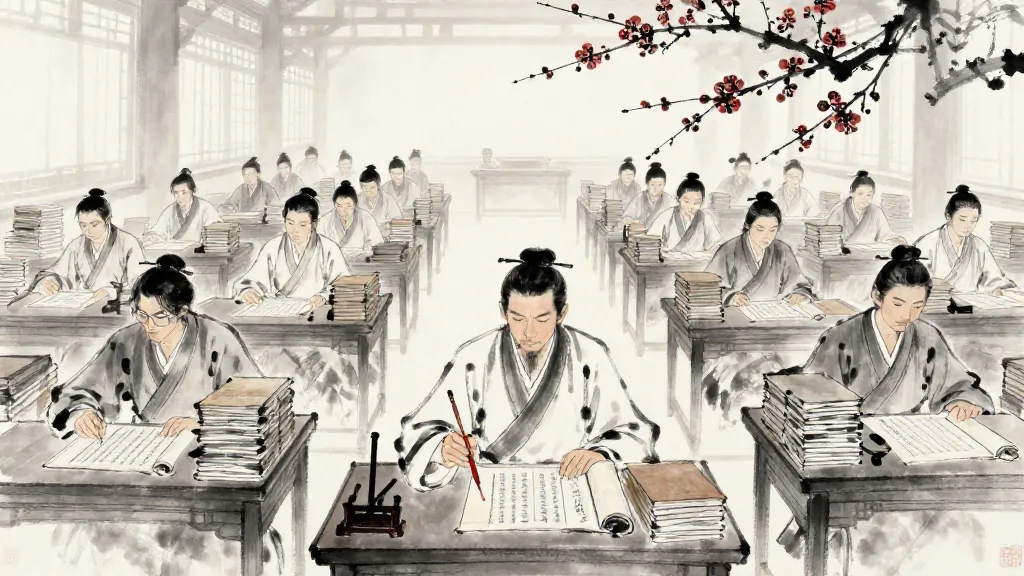
Between 1773 and 1782, Emperor Qianlong ordered the most ambitious bibliographic project in Chinese history: the compilation of the Siku Quanshu (四庫全書), a library intended to contain every significant book in the Chinese tradition. The project employed over 360 scholars and processed more than 10,000 titles. But the real intellectual work was not the copying. It was the catalog.
The Siku Quanshu Zongmu Tiyao (四庫全書總目提要)—the General Catalog with Abstracts—runs to 200 juan (volumes). For every book included in the library, and many that were rejected, the compilers wrote a critical review: who the author was, what sources they used, where they went right, and where they went wrong. The project was led by Ji Yun (紀昀), one of the sharpest literary minds of the Qing dynasty, and the tone of the reviews reflects his temperament: learned, precise, and unafraid to call nonsense by its name.
The catalog opens with the Classics (經部), and the Classics open with the Yi—the Book of Changes. The first six volumes are devoted entirely to I-Ching commentaries. They review over a hundred works, spanning from the Han dynasty to the Qing, and together they constitute the most comprehensive critical survey of I-Ching scholarship ever written by people who actually read all the books.
Six Changes: A History of Getting It Wrong
The catalog's general preface to the Classics section (經部總敍) lays out a framework for understanding two thousand years of scholarship as a series of overcorrections. The compilers identify six phases of classical learning, each arising from the excesses of the one before:
First came the Han scholars, who transmitted their teachers' words with scrupulous fidelity—not just the interpretations, but the exact chapter divisions and sentence breaks. “其學篤實謹嚴”—“their learning was solid and rigorous.” But rigorous became rigid. The flaw: 拘, constriction.
Then Wang Bi and others began to dissent. Scholars through the Tang started arguing independently, no longer bound to any single lineage. The flaw: 雜, confusion—everyone had a theory and no one agreed.
The Cheng-Zhu school of Song Neo-Confucianism swept the field, declaring that only moral philosophy (義理) mattered. Han-era philological work was dismissed as insufficient. The flaw: 悍, aggression. The compilers note drily that scholars of this period “attacked and deleted the classical text whenever they pleased” (攻駁經文,動輒刪改).
Then came intellectual tribalism. Dissent from the Cheng-Zhu orthodoxy was punished socially, and errors in the master's work were covered up rather than corrected. The flaw: 黨, factionalism. The catalog gives a pointed example: when Zhu Xi's commentary on the Analerta misattributed a quote, his follower Zhang Cunzhong simply omitted the passage from his own book rather than acknowledge the mistake.
Overcorrection begat overcorrection. The Wang Yangming school reacted against rigid orthodoxy by throwing out textual study entirely and relying on personal insight. The flaw: 肆, self-indulgence. The compilers compare the late Ming followers to Chan Buddhists interpreting scripture through wild intuition.
Finally, Qing evidential scholars (考證學) reacted against empty speculation by burying themselves in phonetic glosses and textual minutiae. The flaw: 瑣, triviality—arguing for hundreds of words about the pronunciation of a single character.
The catalog's prescription is characteristically balanced: “消融門戶之見而各取所長,則私心祛而公理出”—“dissolve factional views and take the best from each; then private bias is dispelled and public truth emerges.” This is not just politeness. It is the operating principle of the entire catalog.
Two Factions, Six Schools
The preface to the Yi section itself offers an even sharper periodization, this time specific to I-Ching studies. The compilers call it “two factions, six schools” (兩派六宗):
The first faction is image-and-number (象數). Han scholars spoke of hexagram images—that was close to antiquity and legitimate. But then came Jing Fang and Jiao Gan, who turned the system toward omen-reading and prognostication (禨祥). That was the first change. Then came Chen Tuan and Shao Yong, who pushed further into cosmic numerology, trying to map the entire structure of creation. The result: “易遂不切於民用”—“the Changes ceased to have practical relevance for ordinary people.”
The second faction is moral-philosophical (義理). Wang Bi abandoned images entirely and interpreted the Changes through Laozi and Zhuangzi. That was the first change on this side. Then Hu Yuan and Cheng Yi redirected the enterprise toward Confucian ethics. Then Li Guang and Yang Wanli started using the Changes to illustrate lessons from history. The result: “易遂日啓其論端”—“the Changes became an occasion for endless argumentation.”
The compilers then note, almost with a sigh, that because the Way of the Changes is vast and all-encompassing (易道廣大,無所不包), people have dragged in astronomy, geography, music, military strategy, phonology, mathematics, and even Daoist alchemy. “好異者又援以入易”—“lovers of the exotic imported all of it into the Changes.”
Their corrective is elegant. The compilers point to the hexagram images themselves: every single one of the 64 Da Xiang (Great Image) texts contains the phrase “the gentleman thereby” (君子以). This, they say, is the original purpose of the book: moral instruction grounded in concrete images, addressed to real people making real decisions. Everything else—the numerology, the cosmology, the alchemy—is “易之一端,非其本也”: “one facet of the Changes, not its foundation.”
The Reviews: Who Gets Praised, Who Gets Buried
The individual book reviews are where the catalog comes alive. The compilers are dealing with real books by real people, and their judgments are specific and often devastating.
Wang Bi (王弼), the third-century iconoclast who threw out the entire Han tradition of image-and-number interpretation, gets a remarkably balanced assessment. The compilers credit him with saving the Changes from the swamp of omen-reading: “闡明義理,使易不雜於術數者,弼與康伯深爲有功”—“in elucidating moral principle and preventing the Changes from being contaminated by prognostication, Wang Bi and Han Kangbo rendered great service.” But they immediately add: “祖尚虛無,使易竟入於老莊者,弼與康伯亦不能無過”—“in venerating emptiness and nothingness, causing the Changes to fall entirely into Laozi and Zhuangzi, they are also not without fault.” And then the verdict: “瑕瑜不掩,是其定評”—“the flaws do not hide the merits; this is the settled judgment.”
Li Dingzuo's Zhouyi Jijie (周易集解), an eighth-century anthology preserving thirty-five earlier commentators, receives some of the warmest praise in the entire catalog: “千百年後學者得考見畫卦之本旨者,惟賴此書之存耳。是眞可寶之古笈也。”—“That scholars a thousand years later can still examine the original meaning of the hexagram drawings is solely thanks to the survival of this book. It is truly a treasure of the ancient library.”
Cheng Yi's Yizhuan (易傳)—the landmark Northern Song philosophical commentary—is treated with respect but also with a revealing caveat. The compilers note that Cheng Yi “did not believe in Shao Yong's numbers” and deliberately left the Xici Zhuan (系辭傳) and other appendices uncommented. They explain this not as a principled omission but as an unfinished manuscript: “楊時草具未成之說為是”—“Yang Shi's account, that it was drafted but incomplete, is correct.” They want you to know that even the great Cheng Yi did not finish the job.
Su Shi's Dongpo Yizhuan (東坡易傳) draws a more complicated response. Zhu Xi had attacked it in his Zabian, but the compilers point out that Zhu Xi only objected to nineteen passages, of which only fourteen were substantive—not enough to condemn the whole book. Their summary is a masterclass in measured judgment: Su Shi's commentary sometimes falls into Chan Buddhist obscurity on metaphysical passages, but elsewhere “推闡理勢,言簡意明”—“when he expounds on patterns and forces, his words are concise and his meaning is clear.” The verdict: you can learn from him, and anyone who dismisses the book wholesale is being provincial.
The Subtext: What Counts as Legitimate Knowledge
Reading between the reviews, a pattern emerges. The compilers are most severe on two types of scholars: those who abandon the text for mystical speculation, and those who forge lineages to give their innovations false authority.
Yang Jian (楊簡), the Song-dynasty disciple of Lu Jiuyuan who interpreted the Changes entirely through “mind” (心), gets one of the catalog's harshest verdicts. He went so far as to declare that the “take images near at hand from the body” passage in the Xici was a forgery, “not the words of Confucius.” The compilers note that Zhu Xi himself said Yang Jian's writings “could be burned” (楊敬仲文字可毀). But in a characteristic move, they still include the book—precisely so that future readers can see where the tradition went wrong. They compare this to Zhu Xi's own practice of preserving apocryphal texts in his ritual compilations: “存之正所以廢之”—“preserving them is precisely what exposes them.”
The Zixia Yizhuan (子夏易傳), attributed to Confucius's disciple Bu Zixia, takes the prize for most thoroughly debunked text. The compilers trace its genealogy of forgery through multiple layers: the original was already a fake in the Tang dynasty, and the version that circulated in Song times was a forgery of the forgery, “attributed not to Bu Zixia but probably to the Tang-era writer Zhang Hu.” The currently circulating edition does not even match what scholars saw in the Song. “然則今本又出偽託,不但非子夏書,亦並非張弧書矣”—“the current text is yet another forgery; not only is it not Bu Zixia's book, it is not even Zhang Hu's.” They include it anyway, because it has circulated for so long that excluding it would just create a different kind of confusion.
The subtext of all this is a theory of intellectual legitimacy. What makes a commentary valuable is not its antiquity, not the fame of its author, and certainly not its claim to esoteric transmission. It is whether the commentary actually illuminates the text. Sima Guang's fragmentary notes on the Changes—a manuscript so obscure that it had been lost for centuries—earn high praise because his observations on human character are “如布帛菽粟之切於日用”—“as essential as cloth and grain to daily life.” Meanwhile, the elaborate cosmological diagrams of the Chen Tuan lineage are treated as curiosities at best.
The Politics of the Catalog
The Siku catalog is not a neutral document. It is an imperial project, and imperial projects have imperial agendas. The compilers' insistence on balance between Han learning and Song learning was not just scholarly temperament; it was state policy. The Qing dynasty, as a Manchu regime ruling a Han majority, had reason to discourage factional extremism in any form. A catalog that declared one school right and all others wrong would have been a political problem.
You can see the politics most clearly in the treatment of the three imperial-sponsored works that open the Qing section of juan six. The Kangxi emperor's Zhouyi Zhezhong (周易折中)—literally “Balanced Selections on the Changes”—is praised for doing exactly what the catalog says all scholarship should do: reconciling image-number and moral-philosophical approaches, restoring the ancient text order, and refusing to let any single school monopolize the truth. It is described as settling all disputes: “數百年分朋立異之見,至是而盡融”—“centuries of factional disagreement were at last fully reconciled.”
This is, of course, court rhetoric. But it reflects a genuine intellectual accomplishment. The Qing evidential scholars who worked on the Siku project were among the most rigorous philologists China had ever produced. Their judgments on I-Ching commentaries, while framed in the language of imperial harmony, are grounded in actual reading of actual texts. When they say a book is derivative, they can cite the sources. When they say an attribution is false, they supply the evidence. The politics shaped the framing; it did not fabricate the content.
What This Means for Reading the Changes Today
The Siku compilers surveyed the entire landscape and arrived at a simple conclusion: the Changes is a book about human situations. The hexagram images are not mystical symbols; they are structured representations of recurring patterns in human life. The yarrow stalk and coin methods are not magical rituals; they are structured ways of engaging with the system. The commentaries are useful insofar as they help you understand those patterns, and useless insofar as they drift into cosmological speculation or sectarian point-scoring.
This is essentially the approach that Six Lines takes. The app presents the classical text—hexagram images, line texts, the Ten Wings—and lets you read them in the context of your situation. It incorporates the hexagram-calendar system and the Yilin poetic tradition because these are part of the historical record—tools that real scholars used for real purposes. It does not include alchemy, Daoist elixir theory, or diagrams derived from meditation charts, because the best bibliographers in Chinese history looked at those things and concluded they were “易外別傳”—transmissions outside the Changes proper.
The Siku compilers were bureaucrats. They were cataloging a library, not receiving revelations. But after reading every I-Ching commentary that had survived to the eighteenth century, they had earned the right to an opinion. And their opinion was clear: the best way to study the Changes is to read the text carefully, attend to the images, and apply what you find to the decisions in front of you. Two hundred years later, that still seems like sound advice.
References
Primary Sources
四庫全書總目提要 (Siku Quanshu Zongmu Tiyao), juan 1–6: 經部·易類. The critical catalog entries surveyed in this article. Chinese Text Project
周易正義 (Zhouyi Zhengyi). Kong Yingda's Tang-dynasty subcommentary on Wang Bi's annotation, the standard imperial-examination text for centuries. Chinese Text Project
周易集解 (Zhouyi Jijie). Li Dingzuo's eighth-century anthology preserving 35 earlier commentators' interpretations, praised by the Siku compilers as “a treasure of the ancient library.”
Secondary Scholarship
Guy, R. Kent. The Emperor's Four Treasuries: Scholars and the State in the Late Ch'ien-lung Era. Harvard University Press, 1987. The standard study of the Siku Quanshu project and its political context.
Smith, Richard J. Fathoming the Cosmos and Ordering the World. University of Virginia Press, 2008. Comprehensive study of the Yijing in Chinese culture, with substantial treatment of imperial-era commentary traditions.