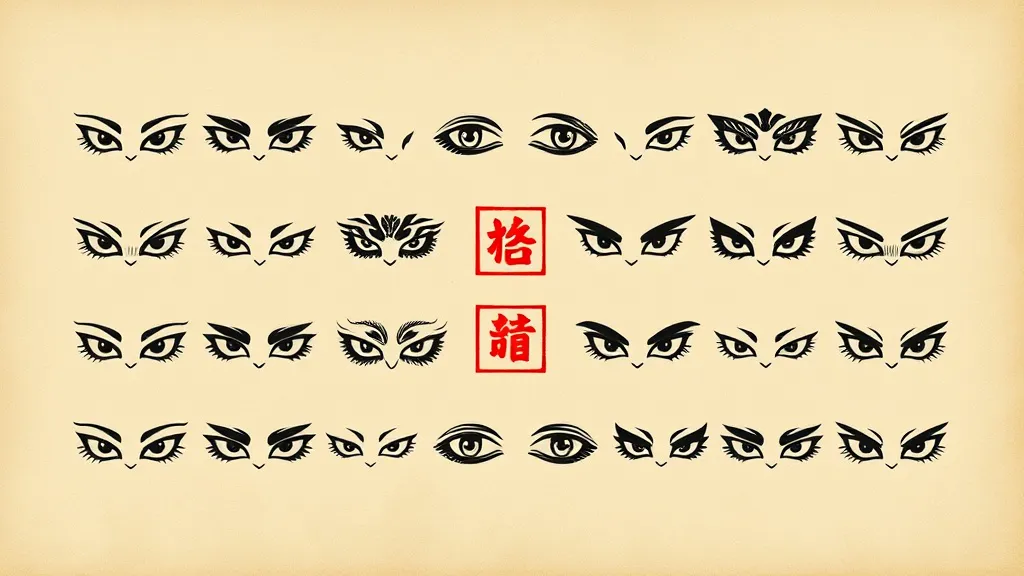
The 25 Eye Types: What the Shenxiang Quanbian Sees in a Glance
The eye chapter is the longest in the Shenxiang Quanbian—four dense pages of woodblock print where every other section gets one or two. The reason is simple: the eyes carry 神, spirit, and spirit is what the entire system is trying to read.
Part 2 of The Emperor's Face Reader — physiognomy from the Shenxiang Quanbian (神相全編).
The Eye as Inspector
In the Five Officers system, the eyes hold the title of 監察官—the Inspector. This is the official whose job is to observe, assess, and report. Not the leader, not the enforcer. The one who sees. In practical terms, the Shenxiang Quanbian treats the eyes as the single most important feature on the face: if the eyes have spirit, even mediocre bone structure can produce a good reading. If the eyes lack spirit, nothing else compensates.
Here's what people miss: the system doesn't just read eye shape. It reads 神—the quality of alertness and clarity behind the eyes. Two people with identical eye shapes can receive opposite readings if one has bright, focused spirit and the other has dull, hazy spirit. Shape is the address. Spirit is the occupant.
What 神 (Spirit) Actually Means
神 is not a mystical concept here. It is closer to what a doctor means when she says a patient “looks well” or “looks unwell”—that immediate, holistic assessment of vitality that precedes any specific measurement. The Shenxiang Quanbian classifies eye spirit into distinct levels:
Bright and clear (神清): alert, focused, alive. The eyes have light in them. This is the best indicator across all 25 types.
Concealed (藏神): spirit is present but not flashy. The person doesn't look intense; they look calm. But when you hold their gaze, there is depth there. The text considers this superior to obvious brightness—because concealment implies control. This is the same principle as 藏 in other Chinese arts: hidden strength outranks displayed strength.
Dull (神不清): hazy, unfocused. The eyes are open but nobody is home. Associated with poor prospects across every category.
Watery (濕淡): excessive moisture, a wet sheen. The text consistently associates this with romantic excess—the person is governed by desire rather than judgment.
Cold (冷): piercing but lifeless. Intensity without warmth. The gaze of someone calculating. Associated with cruelty.
The hierarchy is clear: concealed spirit is best, bright spirit is excellent, and everything below that degrades the reading. This is why the eye chapter matters more than any other—神 is the master variable.
Black-White Distinction (黑白分明)
After spirit, the most frequently cited quality is 黑白分明—the crisp distinction between the dark iris and the white sclera. This appears in the descriptions of nearly every auspicious eye type: Dragon Eyes, Phoenix Eyes, Crane Eyes. The principle is contrast and clarity. Muddied boundaries between black and white indicate muddied character. Excessive white showing around the iris—what the text calls 白露—is one of the strongest negative indicators, appearing in Sheep Eyes, Fish Eyes, and other inauspicious types.
Think of it as a diagnostic shorthand. Clear black-white distinction means the person's internal state is ordered: they see clearly, they think clearly, they present clearly. When the distinction breaks down—when the iris is pale, or the sclera is bloodshot, or the boundary is vague—the reading follows suit.
The Noble Animals: Dragon, Phoenix, Crane
The 25 eye types are named after animals and natural phenomena, and the naming is not arbitrary. Noble animals produce auspicious readings. Base animals produce inauspicious ones. The animal is a compressed character assessment: the eye doesn't just resemble the animal visually; it shares the animal's qualities.
Dragon Eyes (龍眼) are the apex. Large, elegant, slightly upturned, with brilliant black-white distinction and 精神彩 —a radiance of spirit. The classical verse says: 黑白分明精神彩, 波長眼大氣神藏. The key word is 藏—the spirit is vast but contained. The reading: exceptional prosperity, the capacity to assist rulers. This is an emperor's eye.
Phoenix Eyes (鳳眼) are the most celebrated in Chinese aesthetic tradition. Long, elegant, with an upturned slant and refined lines at the corners. The verse emphasizes 秀氣又神清 —elegant energy and clear spirit. The reading: exceptional intelligence, fame, career success. Where Dragon Eyes suggest power, Phoenix Eyes suggest brilliance. The Phoenix Eye is the eye most Chinese face-reading texts will identify as “the most desirable.”
Crane Eyes (鶴形眼) are the longevity type. Long, refined, with clear black-white distinction and a straight noble gaze —正視無偏, looking straight without deviation. The crane in Chinese symbolism lives a thousand years. The reading matches: far-seeing wisdom, a lasting and dignified career. The text adds 人可愛—literally, “people find this person lovable.” A detail worth noting: the system does not only predict fortune. It describes social reception.
The Auspicious Middle: Turtle, Ox, Peacock, Lion
Below the apex types sits a tier of solid, positive readings. These eyes lack the extraordinary spirit of Dragon or Phoenix, but they have specific virtues.
Turtle Eyes (龜眼): small, round, slightly hooded, with multiple fine lines and calm steady brightness. The turtle is the longevity animal. The reading: exceptional lifespan, descendants prosper. Not glamorous. Enduring.
Ox Eyes (牛眼): very large and round, with calm steady brightness and a patient gaze. The reading: great wealth (巨萬), long life, steady and reliable character. The ox does not dazzle. It accumulates.
Peacock Eyes (孔雀眼): beautiful and refined, with bright black iris and minimal white showing (青多白少). The reading: pure nature, the family name prospers. Notice the criterion “minimal white showing”—this is the black-white principle applied positively.
Lion Eyes (獅眼): large and powerful, with a commanding gaze. The reading: late-blooming success. 端莊—dignity in old age. The lion does not peak early.
The Mixed Types: Tiger, Ape, Mandarin Duck, Crow
Five eye types receive qualified readings—positive traits balanced by warnings.
Tiger Eyes (虎眼): large and fierce, with a golden-yellow tint to the iris (睛黃淡金色) and intense brightness. The reading is split: wealth is achievable, but the character is fierce and unyielding (性剛沉重), and there may be setbacks. The tiger is powerful but dangerous to itself.
Ape Eyes (猿眼): round, darting, alert. Clever but restless. The ape cannot sit still. Wealth is possible if other features support it, but the restlessness undermines sustained achievement.
Mandarin Duck Eyes (鴛鴦眼): gentle, curved, slightly watery, associated with peach blossom (桃花). The mandarin duck is the symbol of romantic partnership. The reading: harmonious marriage, strong romantic nature—but a warning of 淫邪, excessive desire. The very quality that makes this eye type attractive is also its risk.
Crow Eyes (鴉眼): sharp, very black (黑漆), with a calculating brightness and a sideways gaze (視人斜). The reading: can achieve official position, but the character is cunning. The sideways gaze is the diagnostic tell—the person does not look at you directly. This is one of the most behaviorally specific readings in the entire chapter.
The Inauspicious Types: A Catalog of Warnings
Nine of the 25 types receive negative readings. What unites them is a pattern: broken spirit, excessive white, asymmetry, or the wrong kind of moisture.
Peach Blossom Eyes (桃花眼) are the most famous warning type. Alluring, curved, watery (濕淡), with a sideways seductive gaze and an expression described as 如醉如癡—as if drunk, as if infatuated. The text is blunt: women with these eyes become promiscuous, men become dissolute, and even monks and priests (僧人道士) are not exempt. This is the eye of uncontrolled desire. It is also, not coincidentally, the eye type most people find attractive—which is exactly the point the text is making.
Yin-Yang Eyes (陰陽眼): one eye noticeably larger than the other. The reading is simple: 無誠—no sincerity. Asymmetry of the eyes implies asymmetry of character.
Drunk Eyes (醉眼): hazy, unfocused, spirit unclear (神不清). The name captures it. The person may have fine features elsewhere, but without clear spirit in the eyes, the potential is wasted.
Sheep Eyes (羊眼): pale, prominent, with excessive white showing (睛露). The reading: no inheritance, poverty in middle and old age. The exposed quality—too much white, not enough concealment—is the diagnostic key.
Fish Eyes (魚眼): bulging, glassy, watery like the surface of a pond (睛若水). The reading: short life, constant sorrow. This is the most severe negative assessment in the chapter.
Snake Eyes (蛇眼): small, piercing, cold, with reddish iris (睛紅). The reading: 大奸大詐—great treachery, great deceit. Dangerous as a wolf or tiger. The text says this person will harm even their own parents. Of all 25 types, this is the most morally damning.
Pig Eyes (猪眼): small, deep-set, with excessive dull white and thick heavy lids. The reading: violent nature (性暴凶), faces legal punishment, “even the law of the ten great wrongs cannot contain them” (十惡法難容).
The pattern across all inauspicious types: spirit is absent, damaged, or misaligned. The eyes are too exposed, too watery, too cold, or too asymmetric. The base animals—sheep, fish, pig, snake—are assigned to eyes that lack the qualities the system prizes: containment, clarity, balanced brightness.
The Five Element Layer
Beneath the animal typology, the Shenxiang Quanbian maps the same Five Element framework that organizes the Liu Yao system and the imperial almanac. Eyes belong to Fire in the Five Officers mapping—the Inspector is brightness, perception, illumination. But individual eye types can express other elements through their qualities: the calm patience of Turtle or Ox Eyes is Water; the commanding force of Tiger or Lion Eyes is Metal; the refined elegance of Phoenix Eyes is Wood; the steady centrality of Dragon Eyes is Earth.
This is how the typology connects back to the broader cosmological system. A face reading does not stop at “you have Phoenix Eyes.” It asks: what element does this eye express, how does that element interact with the elements expressed by the nose, the ears, the mouth? The 25 types are the vocabulary. The Five Elements are the grammar.
The Eagle at the End
The last of the 25 types is 鷲眼—Eagle Eyes. Sharp, piercing, medium-long, with intense focused brightness and a penetrating gaze. The reading: a sharp and incisive mind, serves those in power, attains a great position (身貴近君終大用). The eagle is the final animal in the sequence, and it is auspicious. After a run of negative types —sheep, fish, horse, pig, snake, seagull—the text ends on a note of recovery: not all intensity is cruelty. The eagle's gaze is cold, but it is also clear. Spirit redeems.
What the System Is Actually Doing
Strip away the animal metaphors and the fortune-telling conclusions, and what remains is a systematic observation framework for reading human alertness, emotional regulation, and social presentation through the eyes. The system distinguishes between brightness and dullness, focus and restlessness, concealment and exposure, symmetry and asymmetry, moisture and dryness. These are not mystical categories. They are the same variables a skilled interviewer or portrait painter reads instinctively.
The Shenxiang Quanbian formalized what most people do unconsciously: when you meet someone, you look at their eyes first. You assess whether they seem alert or distracted, warm or cold, direct or evasive. The text gave names to what you already notice. Twenty-five names, twenty-five readings, all built on one principle: the quality of 神 behind the eyes tells you more than the shape of the eyes themselves.
Source
神相全編 (Shenxiang Quanbian), pages 151–154. Ming dynasty compilation. Classical Chinese with woodblock illustrations. The eye chapter covers 25 named types organized across four pages, with classical verse descriptions and character readings for each type.