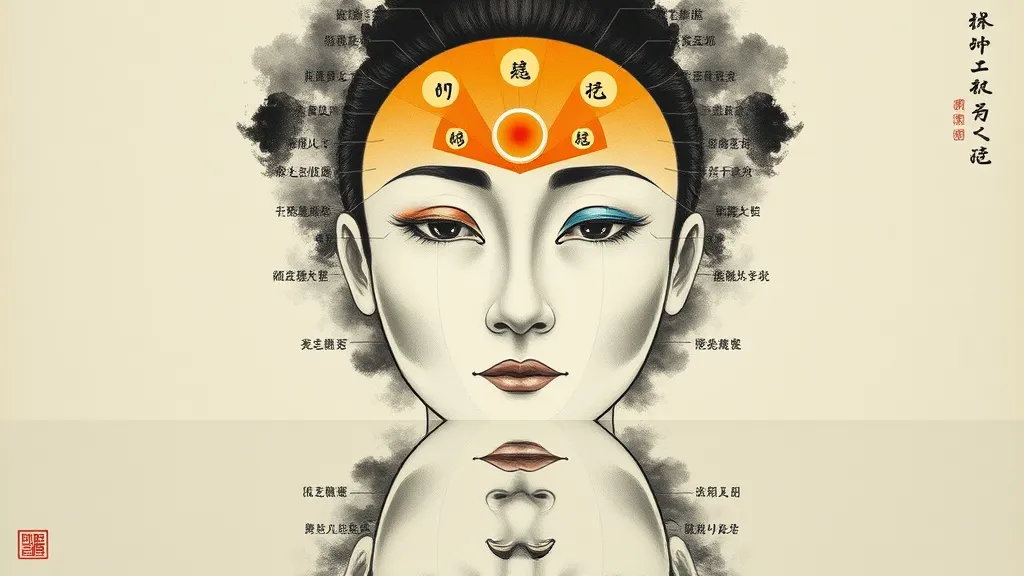
The Twelve Palaces: A Map of Life Written on the Face
Here's what people miss: the Twelve Palaces aren't metaphors. They're a literal coordinate system. Career is here, wealth is there, and the system has been consistent about this for centuries. The same twelve palace names appear in Ziwei Doushu natal charts and in facial physiognomy. That's not coincidence—it's the same classification system applied to two different surfaces.
Part 3 of The Emperor's Face Reader — physiognomy from the Shenxiang Quanbian (神相全編).
Twelve Domains, Twelve Addresses
The introductory article in this series sketched the Twelve Palaces as part of the Shenxiang Quanbian's overall framework. Now we zoom in. Each palace has a precise location, a specific life domain, and a set of indicators the text uses to distinguish prosperity from difficulty. The system is not vague. It is, if anything, uncomfortably specific.
The number twelve is structural, not decorative. Twelve Earthly Branches. Twelve months. The twelve-year Jupiter cycle that drives the Tai Sui system. And twelve palaces in both Ziwei Doushu and facial physiognomy. The face becomes a natal chart you carry with you, readable without consulting any calendar.
The Palaces
1. 命宮 — Life Palace (Between the Eyebrows)
Location: the space between the eyebrows, called 印堂 (Seal Hall) or the glabella. This is the master palace—it governs overall life destiny, general fortune, and the quality of one's vitality.
The text says it should be “bright and luminous as a mirror” (光明如鏡)—wide, open, full, and smooth. When the Seal Hall is bright, the classical text promises fortune and longevity. When it is narrow, dark, pinched, or crossed with lines—when the eyebrows grow together or wrinkles cut across it—the reading turns negative.
Think of the Life Palace as the executive summary. Every other palace contributes detail, but this one sets the baseline. A bright, open 印堂 with dark coloration in the Wealth Palace, for instance, means overall fortune is sound but money will be a specific challenge. The Life Palace contextualizes everything else.
2. 財帛宮 — Wealth Palace (Nose)
Location: the nose, with particular emphasis on the tip (準頭) and wings (蘭臺廷尉). The nose sits at the center of the face, and the Wealth Palace sits at the center of material life. The mapping is deliberate.
Positive indicators: high, straight bridge (豐隆); full, rounded tip (準頭圓); hidden nostrils (不露孔); balanced, fleshy wings (蘭臺廷尉豐). The classical text states: when the nose is full and the Earth Pavilion (地閣, the chin area) is also prominent, with balanced wings on both sides, wealth accumulates.
Negative indicators: exposed nostrils (露孔), which the system reads as wealth leaking out; crooked bridge (歪斜); thin or sharp contours (瘦削); scarring or damage (破損). The text is blunt: “If the nostrils face upward and are exposed, the household has no stores.”
3. 兄弟宮 — Siblings Palace (Eyebrows)
Location: the eyebrows. In the classical context, “siblings” means your support network—brothers, close allies, the people you can rely on when things go wrong.
Positive: clear, elegant (清秀), extending past the outer corner of the eye, well-separated from each other, and symmetrical. The text says: when eyebrows are long past the eyes, three or four siblings prosper without harm to each other.
Negative: eyebrows that cross or meet at the center (交連), sparse or broken (疎散), yellowed or thin (黃薄), uneven between left and right. Crossed eyebrows are a recurring warning sign across multiple palaces—they darken the Life Palace too.
4. 田宅宮 — Property Palace (Between Eyes and Eyebrows)
Location: the area between the eyes and eyebrows, extending in some readings to the lower face (地閣). This palace governs real estate, inherited wealth, and the stability of one's home.
Positive: full, bright eyes with a wide space between the eye and the brow; a full lower face. The text links the upper region (天倉, Heaven's Granary) with the lower region (地庫, Earth's Treasury) in assessing property fortune.
Negative: sunken eyes, narrow eye-brow space, weak chin or jaw. When the Property Palace is deficient, the system reads it as instability in dwelling—frequent moves, inability to hold onto real estate, inherited wealth that dissipates.
5. 子女宮 — Children Palace (Below the Eyes)
Location: the under-eye area (淚堂, the “tear hall”) and the philtrum (人中). This palace governs children, descendants, and fertility.
Positive: full, smooth under-eye area (淚堂豐滿); deep, clear philtrum (人中深); no dark circles or hollows. The text says: when this area is full and luminous, wealth and children both follow.
Negative: hollow under-eye area, shallow or flat philtrum, dark discoloration. The classical reading associates sunken 淚堂 with difficulty having children or troubled relationships with offspring.
6. 奴僕宮 — Servants Palace (Jaw)
Location: the sides of the lower face and jaw. In the imperial context, “servants” means subordinates, employees, anyone who works under your direction. In modern terms: your team.
Positive: full, rounded jaw sides without hollows or depressions. A strong Servants Palace means people will follow you, stay loyal, and support your endeavors.
Negative: sunken, hollow, pointed, or narrow jaw area. The reading is direct—a weak Servants Palace means subordinates cause problems, leave, or cannot be relied upon.
7. 妻妾宮 — Spouse Palace (Outer Eye Corners)
Location: the outer corners of the eyes, called 魚尾 (fish tail). This palace governs marriage, the spouse relationship, and romantic fortune.
Positive: smooth, unwrinkled corners; bright and clear; no dark spots or moles in this area. The ideal Spouse Palace is clean and luminous.
Negative: many wrinkles (魚尾紋多, what we call crow's feet—the text calls them fish tails); dark or clouded; moles at the outer eye corners. The classical text associates heavy wrinkling here with marital discord or multiple marriages.
8. 疾厄宮 — Illness Palace (Nose Bridge)
Location: the bridge of the nose between the eyes, called 山根 (Mountain Root) and extending to the mid-nose (年壽). This palace governs health, illness patterns, and longevity.
Positive: high, unbroken bridge; no horizontal lines crossing it; full and smooth. The Mountain Root connects the upper face to the middle face—when it is strong, the connection between the divisions is solid.
Negative: low or broken bridge; horizontal lines (疾厄紋, literally “illness-disaster lines”); discoloration. This is one of the most referenced positions in age-flow readings—age 41 maps to 山根, making it a critical transition point between early and middle life fortune.
9. 遷移宮 — Travel Palace (Temples)
Location: the forehead corners, near the temples (額角/驛馬). This palace governs travel fortune, relocation, and all forms of movement and change.
Positive: full temples, bright and smooth, no depressions. The term 驛馬 (post horse) appears here—the same astrological marker that indicates travel in Ziwei Doushu natal charts.
Negative: sunken temples, dark discoloration. The reading: travel brings misfortune, relocations fail, attempts to expand beyond one's base backfire.
10. 官祿宮 — Career Palace (Center Forehead)
Location: the center of the forehead, called 中正 (Central Correct). This palace governs career, official position, authority, and social status.
Positive: high, broad forehead; bright and luminous; no blemishes, scars, or marks. The Career Palace sits in the Upper Division (上停)—the region of Heaven—which means career fortune is read as something partly bestowed, not entirely earned.
Negative: low forehead, scars or marks, narrow. The text is particularly concerned with marks and scarring here—any disruption to the smooth surface of the Career Palace is read as disruption to career trajectory.
11. 福德宮 — Fortune Palace (Upper Forehead)
Location: the upper forehead (天庭, Heaven's Court). This palace governs accumulated merit, spiritual fortune, and the blessings that come from sources beyond one's own effort.
Positive: high, full, luminous, well-proportioned. The Fortune Palace is the highest point on the face—closest to Heaven in the Three Divisions framework. Its quality indicates not what you have earned but what you have been given.
The Fortune Palace is the hardest to parse in modern terms. It maps roughly to what we might call luck, except the classical system does not treat luck as random. 福德 is the accumulated result of virtuous action across lifetimes—a Buddhist concept layered into the Confucian-Daoist physiognomic framework.
12. 父母宮 — Parents Palace (Forehead Corners)
Location: the left and right temples, called 日角 (Sun Angle) and 月角 (Moon Angle). This palace governs the relationship with parents, inherited fortune, and early-life circumstances.
Positive: full and balanced on both sides, no depressions. The Sun Angle (left) traditionally corresponds to the father; the Moon Angle (right) to the mother. When both are full, the reading indicates support from both parents.
Negative: one side lower or hollowed, unbalanced. The asymmetry is specifically diagnostic—a sunken left temple with a full right temple might indicate early loss of the father but support from the mother, or vice versa.
The Ziwei Doushu Connection
Here is the fact that makes the Twelve Palaces more than a physiognomic curiosity: the same twelve palace names—命宮, 財帛宮, 兄弟宮, 田宅宮, 子女宮, 奴僕宮, 妻妾宮, 疾厄宮, 遷移宮, 官祿宮, 福德宮, 父母宮—appear in Ziwei Doushu natal astrology. Identical names. Identical domains. Different surface.
In Ziwei Doushu, the twelve palaces are arranged around a circular chart, and stars are placed into them based on your birth date and time. In facial physiognomy, the twelve palaces are arranged on the face, and physical features fill the role that stars play in the chart. The classification system is the same. What varies is the input.
This is characteristic of the Chinese cosmological tradition. A single organizational framework gets applied to multiple domains. The Five Elements organize hexagram lines, calendar days, medical diagnoses, and facial features. The Twelve Palaces organize natal charts and faces. The framework is portable. The surfaces are interchangeable.
How the Palaces Interact
No palace is read in isolation. The Shenxiang Quanbian's reading methodology requires cross-referencing palaces against each other, and the interactions follow predictable patterns.
The Life Palace (命宮) sets the context for all other readings. A bright, open Seal Hall ameliorates difficulties elsewhere. A dark, narrow one amplifies them. It functions like the ascendant in Western astrology or the natal palace in Ziwei Doushu—the lens through which everything else is viewed.
The Wealth Palace (財帛宮, nose) and the Property Palace (田宅宮, eye-brow space) are read together. The nose indicates the capacity to generate wealth; the Property Palace indicates the capacity to hold it. A strong nose with a weak Property Palace means money comes in but does not stay.
The Career Palace (官祿宮, center forehead) and the Servants Palace (奴僕宮, jaw) form another pair. High career fortune with a weak jaw means authority without support—a position achieved but not sustained because the people beneath you cannot be relied upon.
The Siblings Palace (兄弟宮, eyebrows) and the Parents Palace (父母宮, forehead corners) together indicate the quality of one's inherited network. Strong in both: a family that elevates. Weak in both: self-made or unsupported.
The Illness Palace (疾厄宮, nose bridge) occupies a structural position between the Upper and Middle Divisions. When the Mountain Root is low or broken, it literally interrupts the flow between the forehead (early life, career potential) and the nose/mouth area (middle and late life, material outcomes). The physiognomic reading mirrors the structural reality: a break at the bridge is a break in the life trajectory.
The Reading Criteria
The same four criteria apply across all twelve palaces. This is why the system is teachable—you learn the criteria once, then apply them to each location:
Fullness versus hollowness (豐 vs. 陷). Full features indicate abundance in that domain. Sunken or hollow features indicate deficiency. This is the most basic assessment.
Brightness versus darkness (明 vs. 暗). Bright, luminous skin indicates active, positive fortune. Dark, clouded, or dull skin indicates stagnation or difficulty. The text frequently uses the word 光明—luminosity—as the gold standard.
Marks, moles, and scars (痣紋疤). Any disruption to the skin surface in a palace area modifies the reading. Moles have their own sub-system of interpretation. Scars indicate past events that have altered the fortune of that domain.
Relative position in the age flow (流年運氣). Each face position corresponds to a specific life age. The Illness Palace at 山根 corresponds to age 41. The nose tip corresponds to ages 48–50. When you reach the age mapped to a particular palace, that palace's condition becomes especially significant.
Source
神相全編 (Shenxiang Quanbian), pages 69–71. Ming dynasty compilation. The Twelve Palaces section establishes the primary coordinate system for all subsequent face readings. The palace map, detailed descriptions, and classical poetry are from these pages. Cross-references to Ziwei Doushu palace names reflect the shared cosmological vocabulary across Chinese metaphysical systems.