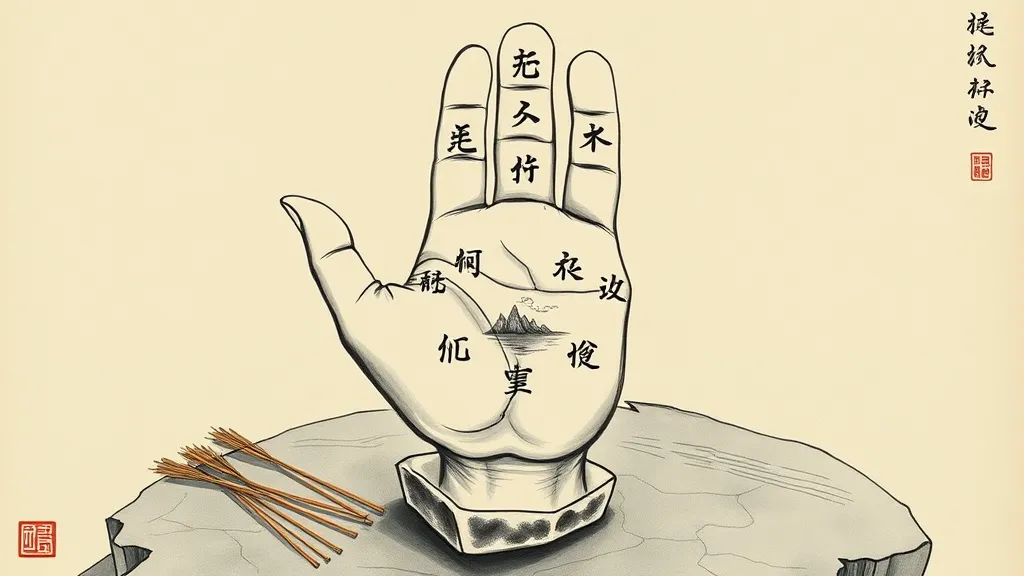
The Eight Trigrams on Your Palm: Classical Chinese Hand Reading
Here's what people miss: classical Chinese palm reading isn't about “life lines” and “love lines.” It's the Eight Trigrams laid on your hand—the same trigrams that build the 64 hexagrams. The palm is a miniature I-Ching board.
Part 4 of The Emperor's Face Reader — physiognomy from the Shenxiang Quanbian (神相全編).
Where the I-Ching Touches Your Hand
The Shenxiang Quanbian devotes pages 362–372 to palm reading, and the first thing it does—before lines, before mounts, before any individual pattern—is map the Eight Trigrams onto the hand. This is not a metaphor. The text provides an explicit diagram called the 八卦十二宮之圖—the Chart of Eight Trigrams and Twelve Palaces—showing exactly where each trigram sits on the palm. Qian below the little finger. Kun at the thumb base. Li under the middle finger. Kan at the wrist. Zhen on the thumb side. Xun at the index finger base. Dui below the ring finger. Gen at the heel of the palm.
If you have read the Shuogua Zhuan—the Discussion of the Trigrams, one of the Ten Wings of the I-Ching—you already know these eight symbols as a classification system for the entire natural world. Heaven, Earth, Thunder, Wind, Water, Fire, Mountain, Lake. Each trigram governs a direction, a family member, an element, an animal, a body part, a season. The Shenxiang Quanbian takes the same taxonomy and says: it also governs a region of your hand.
This is the connection that most modern palmistry discussions miss entirely. When a classical Chinese palm reader looks at the area below your little finger, they are not seeing “the Mercury mount” in some vaguely astrological sense. They are seeing the Qian trigram—Heaven, Metal, the father, authority, career. The same Qian that appears as the first hexagram, the same Qian whose palace contains eight hexagrams in the Eight Palaces system. The conceptual framework is identical. The surface has changed from hexagram lines to the lines of the hand.
The Eight Trigrams on the Palm
The trigram positions follow the Later Heaven sequence—the same arrangement used in feng shui and practical divination, not the Earlier Heaven arrangement of pure cosmic symmetry. This is significant. The Later Heaven sequence represents the world as it actually operates—the dynamic, temporal, working cosmos. The palm, like the luopan compass, maps practical reality.
Qian (乾)—Heaven, Metal—sits below the little finger. It governs the father, authority, and career. In the trigram system, Qian is pure yang, the creative force. On the palm, a well-developed Qian area indicates leadership capacity and the favor of authority figures.
Kun (坤)—Earth, Earth element—occupies the thumb base, the fleshy mount that Western palmistry calls Venus. It governs the mother, nurturing, and stability. Kun is pure yin, the receptive. A full, firm Kun area indicates strong foundations and reliable material support.
Li (離)—Fire—sits at the middle finger base. Intelligence, fame, recognition. Li is the trigram of clarity and illumination, the one whose hexagram palace contains hexagrams of vision and civilization. On the palm, it governs the mind's brightness.
Kan (坎)—Water—is at the wrist, the lower center of the palm. Danger, career obstacles, the kidneys. Kan is the abyss, the trigram of depth and difficulty. Its position at the base of the palm mirrors its position in the Later Heaven arrangement: the North, the midnight, the lowest point from which things can only rise.
Zhen (震)—Thunder, Wood—occupies the thumb side of the inner palm. Movement, action, the eldest son. Zhen is initiative, the first stirring of yang. A strong Zhen area indicates decisiveness and the capacity to start things.
Xun (巽)—Wind, Wood—sits at the index finger base. The eldest daughter, wealth, travel. Xun is gentle penetration, influence that works gradually. On the palm, it governs the capacity to accumulate through patience rather than force.
Dui (兌)—Lake, Metal—is below the ring finger. The youngest daughter, joy, speech. Dui is the open mouth, the trigram of expression and exchange. On the palm, it governs social ability and creative output.
Gen (艮)—Mountain, Earth element—occupies the lower palm, the heel. The youngest son, stillness, property. Gen is the stopping point, the trigram of knowing when to hold. On the palm, it governs real estate, savings, and the capacity to accumulate without squandering.
And at the center of the palm: the 明堂—the Bright Hall. This is the convergence point, the place where all eight trigram zones meet. In the face reading system from Part 1, the equivalent is the nose, the Central Peak of the Five Mountains. Every classical Chinese topographic system has a center, and the center tells you the overall fortune.
The Three Main Lines: Heaven, Human, Earth
The three principal palm lines are not called “heart line,” “head line,” and “life line.” Those are Western names that entered popular culture through 19th-century European chiromancy. The classical Chinese names are 天紋 (Heaven Line), 人紋 (Human Line), and 地紋 (Earth Line)—the Three Powers, the same tripartite structure that divides every hexagram into three pairs of lines, the same structure that divides the face into three horizontal bands in the Three Divisions system.
The Heaven Line (天紋) is the uppermost horizontal line, running across the top of the palm below the fingers. It governs emotions, relationships, and heart health. The Western tradition calls this the heart line and reads it for love. The Chinese tradition reads it for Heaven's will—the fate dimension that arrives from above, not from personal effort. A clear, deep Heaven Line extending across the full palm indicates that the person's emotional constitution and relational fortune are fundamentally sound.
The Human Line (人紋) is the middle line. It governs intelligence, thinking style, and mental health. The Western tradition calls this the head line. The Chinese tradition calls it the Human Line because it represents the person's own agency—the middle term between Heaven above and Earth below. What you do with what you are given. A clear line of moderate length, without breaks, indicates steady judgment and analytical clarity.
The Earth Line (地紋) curves around the thumb base. It governs vitality, life force, and the major events of a life. The Western tradition calls this the life line and panics people by reading its length as lifespan. The classical Chinese reading is more nuanced: a deep, unbroken Earth Line with a wide arc indicates strong vitality and a life with firm material foundations. The length matters less than the depth, the color, and whether the line is interrupted.
The naming convention is not decorative. Heaven, Human, Earth is the foundational triad of Chinese cosmology. The Great Treatise says the hexagram's six lines are divided into three pairs: the bottom two are Earth, the middle two are Human, the top two are Heaven. The palm reproduces this structure. The Earth Line at the base. The Human Line in the middle. The Heaven Line at the top. The hand is a hexagram you were born with.
The Nine Mounts and Their Elements
Below each finger and at several other positions on the palm, the flesh rises into mounts—丘 (qiu). These mounts correspond to both the trigram zones and to the planetary bodies. This is where the system reveals its deepest layer: the same Five Elements that organize the hexagram lines and the spirit star system also organize the topography of the hand.
The Jupiter Mount (木星丘) at the index finger base corresponds to the Xun trigram. Wood element. Ambition and leadership. The Saturn Mount (土星丘) at the middle finger base corresponds to Li. Earth in its planetary association, Fire in its trigram. Responsibility and fate. The Sun Mount(太陽丘) at the ring finger base corresponds to Dui. Fame and creativity. The Mercury Mount (水星丘) at the little finger base corresponds to Qian. Communication and commerce.
The Venus Mount (金星丘) at the thumb base corresponds to Kun. Love and vitality—the great reservoir of yin energy. The Moon Mount (月丘) at the outer palm edge corresponds to Kan. Imagination and travel—the Water trigram's realm of depth and the unknown. Two Mars Mounts (火星丘) correspond to Zhen and Gen respectively: active courage on the thumb side, passive endurance on the percussion side.
A well-developed mount—firm, slightly raised, with healthy color—indicates strength in its corresponding domain. A flat mount indicates weakness. An overdeveloped mount indicates excess, which in Five Element logic is just as problematic as deficiency. The reading principle is the same one that governs hexagram analysis: balance. Not too strong, not too weak. The prosperity-and-decline system that determines whether a hexagram line is timely or untimely is the same logic that determines whether a palm mount is properly developed.
The Special Patterns (奇紋)
Pages 362–372 of the Shenxiang Quanbian catalog over forty special line patterns—奇紋—that can appear on the palm. Each has a name, a shape, a specific location, and a specific meaning. This is where the text gets granular, and it is where the distance from Western palmistry becomes most visible.
The Well Pattern (井紋) is a grid of crossed lines resembling the character 井. It indicates hidden wealth or trapped fortune, depending on where it appears. The Jade Pillar(玉柱紋) is a vertical line running up the center of the palm— career stability, a strong backbone. The Canopy(華蓋紋) is an inverted V at the upper palm, indicating spiritual inclination or divine protection. The Northern Dipper(北斗紋) is a pattern of dots resembling the Big Dipper constellation—guidance, finding one's way.
Some patterns are frankly bureaucratic in their ambition. The Minister Appointment Pattern (拜相紋) indicates potential for the highest government positions. The Seal Bearing Pattern (帶印紋) indicates official authority—the pattern literally looks like an imperial seal impressed on the palm. The Military Tally Pattern (兵符紋) in the palm center indicates strategic and military capability. These are not vague character assessments. They are specific career predictions, and they reflect a society where government service was the apex of achievement.
The text also catalogs warning patterns. The Flying Snake(螣蛇) is a curving, serpentine line indicating hidden dangers and transformation. The Knot Pattern (結紋) at line intersections indicates obstacles and turning points. Several patterns relate to romantic excess—the Peach Blossom Pattern(桃花紋) indicates powerful romantic attraction that can destabilize a life, and the Disordered Flower Pattern (亂花紋) indicates scattered affections and a love of luxury that undermines domestic stability.
The patterns also include special markings: stars (*), crosses (+), islands (O), squares, triangles, and nets. Each shape modifies the meaning of the line it appears on. A star on the Sun Mount is good fortune in fame. An island on the Heaven Line is an interruption in relational fortune. The system is combinatorial: line + location + marking + color + mount development all factor into the reading.
Yin Lines and Yang Lines
The Shenxiang Quanbian makes an explicit distinction between yang lines (陽紋) and yin lines (陰紋) on the palm. Yang lines are visible, clear, deep, and strong—they indicate active, manifest fortune. Yin lines are subtle, fine, barely visible—they indicate hidden or latent fortune, potential that has not yet surfaced. This is the yin-yang distinction applied at the smallest scale: even individual palm lines carry the fundamental polarity.
The text also maps seasonal colors onto the palm. In spring, the palm lines should show blue-green or dark tones (青/黑). In summer, red (赤). In autumn, white (白). In winter, yellow (黃). A palm reading is not just spatial—it is temporal. The same lines read differently at different times of year, exactly as the same hexagram reads differently in different months under the prosperity-and-decline system.
Classical Chinese vs. Western Palmistry
Western palmistry, as codified in the 19th and early 20th centuries by practitioners like Cheiro, operates on a fundamentally different framework. It borrows planetary names—Jupiter, Saturn, Apollo, Mercury, Venus, Mars, Moon—but these function largely as labels. The underlying system is character typology: the shape of the hand tells you what kind of person you are, and the lines tell you what will happen to you.
The classical Chinese system operates on cosmological classification. The hand is not read in isolation—it is read as one surface in a universe where every surface maps to the same set of organizing principles. The same Five Elements that determine the interaction between hexagram lines in Liu Yao analysis also determine the interaction between palm regions. The same trigrams that form hexagrams form the topographic grid of the palm. The same Three Powers—Heaven, Human, Earth—that structure the hexagram structure the three main lines. It is not a different system applied to the hand. It is the same system, applied to another surface.
There is also a diagnostic difference. The Shenxiang Quanbian states explicitly that face reading reveals 先天—innate destiny and character—while palm reading reveals 後天—acquired fortune and timing. The face is what you were born with. The palm is what you do with it. This is why the classical tradition reads both together: the face gives the baseline, and the palm gives the trajectory.
The Reading Order
The Shenxiang Quanbian prescribes a specific sequence for palm analysis, and the sequence itself reveals the system's logic:
First, overall palm shape—square, long, or round—which maps to the Five Element classification of hand types. A square palm with short fingers is Earth. A long palm with long fingers is Wood. A pointed palm is Fire. A round, soft palm is Water. A square palm with proportional fingers is Metal. The element of the hand sets the baseline, just as the palace element sets the baseline in hexagram analysis.
Second, flesh quality: thick or thin, hard or soft. This is the equivalent of assessing the overall qi before examining specific features—exactly what a Chinese medical practitioner does before looking at individual symptoms.
Third, the three main lines—Heaven, Human, Earth. The structural framework.
Fourth, mount development. The trigram zones, assessed for strength and balance.
Fifth, special patterns (奇紋). The detailed overlay.
Sixth, finger proportions. The refinement.
The sequence goes from general to specific, from the whole to the part, from the element to the line. This is the same analytical direction prescribed for hexagram reading: identify the palace, then the six relatives, then the useful spirit, then the line strength. Context first, detail second. The method is consistent because the epistemology is consistent.
Source
神相全編 (Shenxiang Quanbian), pages 362–372. Ming dynasty compilation. Classical Chinese with woodblock diagrams. The passages on the Eight Trigrams palm map (八卦十二宮之圖), the Three Dukes' Strange Lines (三公奇紋之圖), the Wealth and Nobility patterns (富貴奇紋之圖), illness and ancestral lines (疾厄祖業紋), seasonal patterns (四季紋), and the complete catalog of over forty special line patterns spanning career, romance, spiritual inclination, and warning signs.