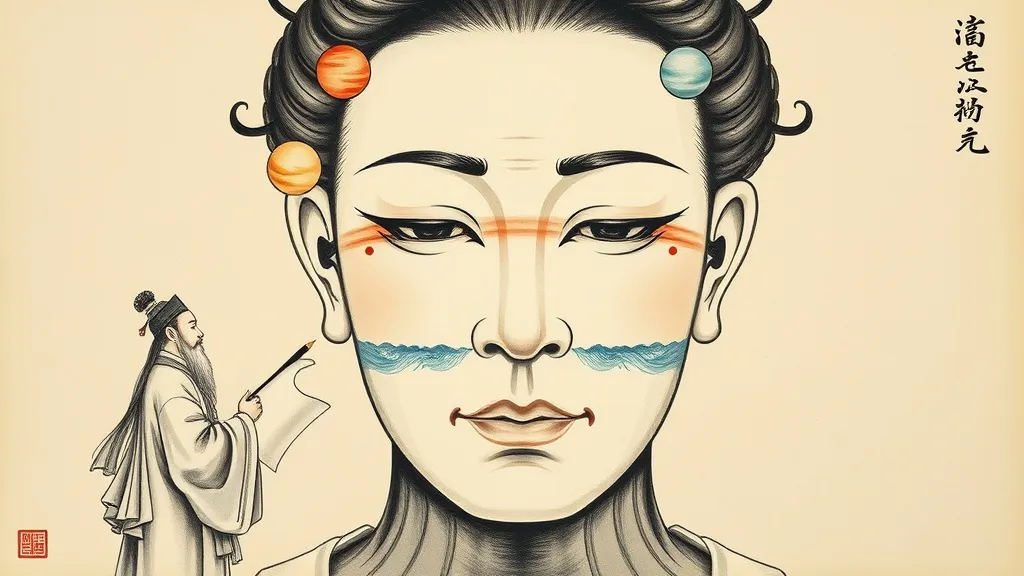
Reading the Face: Five Elements, Three Divisions, and the Map of a Life
Physiognomy sounds like pseudoscience to modern ears. But the Shenxiang Quanbian isn't claiming to read your future from your nose—it's applying the same Five Element classification system that drives the entire Chinese cosmological tradition. Your face is a landscape with zones, and each zone maps to an element.
Part 1 of The Emperor's Face Reader — physiognomy from the Shenxiang Quanbian (神相全編).
The Text
The Shenxiang Quanbian—Complete Compendium of Spirit Physiognomy—is a Ming dynasty compilation, 573 pages of woodblock-printed classical Chinese. It is not a single author's work. It is an anthology: face-reading techniques, palm-reading methods, body-marking interpretations, all gathered into one volume by editors whose names are mostly lost. What survived is the system.
Here's what people miss about Chinese physiognomy: this isn't fortune-telling from facial features. It's the same classification system as the almanac and the hexagrams, applied to anatomy. The Five Elements—Wood, Fire, Earth, Metal, Water—organize everything in the Chinese intellectual tradition: time, space, direction, season, organ, emotion, planet. The Shenxiang Quanbian takes the same framework and maps it onto the face. If you understand Liu Yao or the imperial almanac, you already understand the operating logic. The only thing that changes is the surface.
The text integrates multiple systems that readers of this site will recognize: the Five Elements (五行), the Eight Trigrams (八卦) from the I Ching, the Twelve Palaces (十二宮) mapped to face regions, the Five Stars (五星) mapped to facial features. The face becomes a microcosm of the same cosmos that the hexagrams describe.
The Three Divisions (三停)
The most basic framework. The face is divided into three horizontal bands, and each band corresponds to one of the Three Powers: Heaven, Human, Earth. This is the same tripartite structure that appears in hexagram analysis—the top two lines, middle two lines, and bottom two lines of any hexagram map to the same three domains.
The Upper Division (上停) runs from the hairline to the eyebrows. It corresponds to Heaven (天) and governs the ages 15–30—early life, intelligence, parental fortune. The ideal: round, full, bright and luminous. When this region is well developed, the text says, it indicates 貴—nobility, status, the kind of fortune that comes from being recognized.
The Middle Division (中停) runs from the eyebrows to the nose tip. It corresponds to Human (人) and governs ages 31–50—career, social standing, the self in relation to the world. The ideal: balanced features, a strong nose. It indicates 壽—longevity, which in this system means sustained vitality through the productive years.
The Lower Division (下停) runs from the nose tip to the chin. It corresponds to Earth (地) and governs ages 51–75+—wealth, servants and subordinates, the fortune of later life. The ideal: full and square, no recession. It indicates 富—wealth, the material accumulation that supports old age.
The governing principle is balance. The text states it plainly: 「三停平等,一生衣食無虧」—if the three divisions are equal, lifelong prosperity. If they are unequal, setbacks. This is not a mystical claim. It is a proportional assessment: the face as a proxy for the balance of a life across its phases.
The Five Officers (五官)
The five sensory organs, each assigned a bureaucratic title. This is characteristic of the Chinese cosmological imagination: everything is a government. The sky is a bureaucracy (see the Tianguan Shu). The hexagram lines are officials. And the face is a court with five officers, each responsible for a domain.
The Longevity Protector (保壽官) is the eyebrows. Clear and elegant eyebrows indicate longevity and sibling harmony. The key quality the text looks for: 清秀—refined clarity.
The Inspector (監察官) is the eyes. Bright spirit with clear distinction between black and white indicates intelligence and perception. The key quality: 神采—spiritual radiance.
The Judge (審辨官) is the nose. High, straight, and full indicates wealth and career success. The key quality: 豐隆—abundant and prominent.
The Receiver/Giver (出納官) is the mouth. Well-formed and balanced indicates good fortune in speech and social dealings. The key quality: 方正—square and upright.
The Listener (採聽官) is the ears. Full and well-positioned indicates wisdom and early-life fortune. The key quality: 輪廓分明—clearly defined contours.
Notice what's happening here. Each officer is assessed not by a single measurement but by a qualitative judgment: shape, clarity, spirit, color. The system is closer to traditional Chinese medicine's diagnostic method—look at the whole, assess the quality of qi—than to any modern biometric analysis. Which is exactly what you'd expect, because the same Five Element framework underlies both.
The Twelve Palaces (十二宮)
This is where the system gets specific. Twelve regions of the face, each governing a distinct life domain. The number twelve is not accidental—it mirrors the twelve Earthly Branches, the twelve months, the twelve-year Jupiter cycle that drives the Tai Sui system. The face becomes a clock.
The Life Palace (命宮) sits between the eyebrows, at the point called 印堂—the Seal Hall. It governs overall destiny. The text says it should be “bright and luminous as a mirror” (光明如鏡), wide and open, full and smooth. When the space between the eyebrows is narrow, dark, or crossed with lines—the reading turns negative.
The Wealth Palace (財帛宮) is the nose, especially the tip (準頭) and wings (蘭臺廷尉). High and straight bridge, full tip, hidden nostrils, balanced wings—wealth accumulation. Exposed nostrils, crooked bridge, thin or scarred—financial difficulty. The nose as the center of the face, wealth as the center of material life.
The Siblings Palace (兄弟宮) is the eyebrows. The Spouse Palace (妻妾宮) is the outer corners of the eyes. The Children Palace (子女宮) is the under-eye area and philtrum. The Health Palace(疾厄宮) is the bridge of the nose between the eyes—山根, the Mountain Root. The Career Palace (官祿宮) is the center of the forehead. The Travel Palace (遷移宮) is the temple area. The Fortune Palace (福德宮) is the upper forehead. The Parents Palace (父母宮) is the left and right temples. The Property Palace(田宅宮) is the area between the eyes and eyebrows, extending to the lower face. The Servants Palace (奴僕宮) is the sides of the lower jaw.
Twelve life domains. Twelve face zones. Each assessed on the same criteria: fullness versus hollowness, brightness versus darkness, marks and moles and scars. The reading method is consistent across all twelve palaces because the underlying logic is consistent: the face is a landscape, and the quality of the terrain tells you about the quality of what it governs.
The Cosmological Layer
Beneath the Twelve Palaces, the Shenxiang Quanbian maps an additional layer: the Five Stars and Six Luminaries (五星六曜). Jupiter, Mars, Saturn, Venus, Mercury—the same five planets that correspond to Wood, Fire, Earth, Metal, Water—are each assigned a facial feature. Jupiter governs the left ear. Mars governs the forehead. Saturn governs the nose. Venus governs the right ear. Mercury governs the mouth.
The Six Luminaries—Sun, Moon, Rahu, Ketu, Moon's Apogee, and Purple Energy—map onto the eye areas, eyebrows, mountain root, and seal hall. This is the astronomical substrate. The same planets that the Grand Historian tracked across the sky are now tracked across the face.
And then there is the geographic metaphor: the Five Mountains and Four Rivers (五嶽四瀆). The forehead is the Southern Peak. The chin is the Northern Peak. The nose is the Central Peak. The cheekbones are East and West. The eyes are the Yangtze and Yellow River. The mouth is the Huai. The ears are the Ji. The face is not just a clock or a court—it is a map of China itself.
Why This Matters for the I-Ching Tradition
The Shenxiang Quanbian is not an I-Ching text. Nobody casts hexagrams to read a face. But it shares the same intellectual infrastructure. The Five Elements that determine the relationships between hexagram lines in Liu Yao analysis are the same Five Elements that organize the face. The Twelve Palaces mirror the twelve Earthly Branches. The Three Divisions mirror the Three Powers of Heaven, Human, and Earth that structure every hexagram.
This is not a coincidence. It is a classification system. The Chinese cosmological tradition does not draw hard boundaries between disciplines. Astronomy, calendar-making, medicine, divination, and physiognomy all operate on the same underlying framework. The Xieji Bianfang Shu applies it to days. The Bushi Zhengzong applies it to hexagram lines. The Shenxiang Quanbian applies it to the face.
Understanding this framework—the Three Divisions, the Five Officers, the Twelve Palaces—is the prerequisite for everything that follows in this series. The eye types, the nose types, the eyebrow types: they are all refinements within this grid. You cannot read a specific feature without first understanding where it sits in the map.
Source
神相全編 (Shenxiang Quanbian), pages 63–71, 81, 110, 115. Ming dynasty compilation. Classical Chinese with woodblock illustrations. The passages on Three Divisions, Five Officers, Twelve Palaces, Five Stars and Six Luminaries, Five Mountains and Four Rivers, and Six Storehouses form the foundational framework for all subsequent chapters on specific facial features.