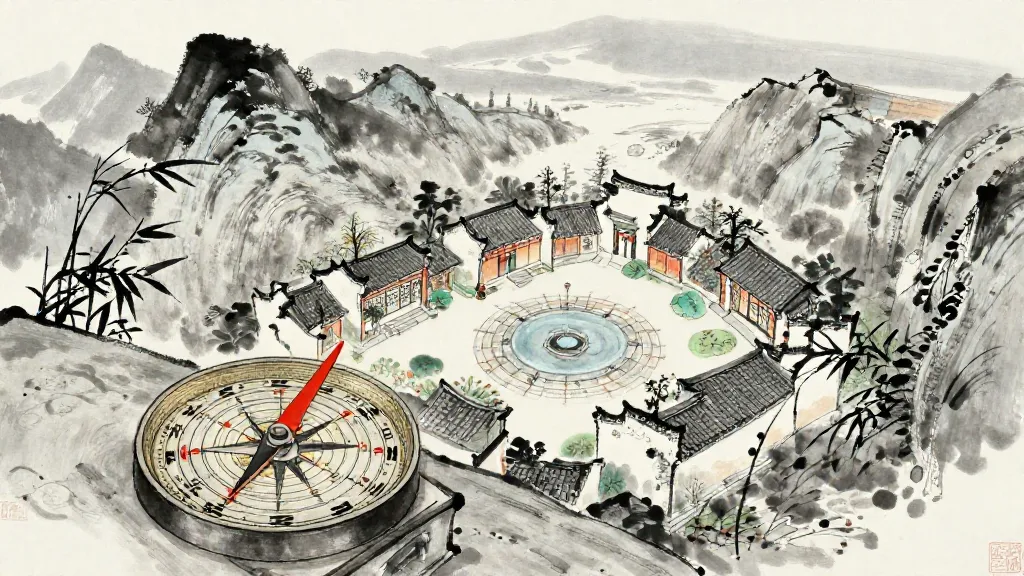
The I-Ching Through Feng Shui
You already know the trigrams. You just call them something else.
The Bridge You've Already Crossed
If you've ever rearranged a room according to feng shui principles — placed a water feature in the north corner, avoided a mirror facing the bed, oriented your desk toward the southeast — you've been working with the I-Ching's building blocks without knowing it.
Feng shui and the I-Ching share the same cosmological root. The eight trigrams (八卦, bagua) that organize the feng shui compass are the same eight trigrams that combine to form the I-Ching's 64 hexagrams. The Five Elements that govern which materials you place where are the same Five Elements that animate every I-Ching reading. The yin-yang polarity that tells you a room is too dark or too bright is the same polarity that runs through every hexagram line.
Most Westerners encounter feng shui first and the I-Ching second — or never. That's a shame, because feng shui is one branch of a much larger tree, and the I-Ching is the trunk. Understanding the trunk makes every branch make more sense. If you already have an intuition for feng shui, you're closer to understanding the I-Ching than you think.
For a broader introduction to the I-Ching itself, see What is the I-Ching?
The Eight Trigrams: Same Symbols, Two Arrangements
The bagua you see in feng shui shops — that octagonal chart with trigram symbols around the edges — is one of two classical arrangements of the eight trigrams. Both arrangements use the same eight figures. They differ in how those figures map to compass directions, and that difference matters.
The Earlier Heaven (先天, Xiantian) arrangement is attributed to the legendary sage Fu Xi, around 3000 BC. It represents an ideal, primordial order — the cosmos before change. Heaven sits at the top (south, in the Chinese convention of south-up maps), Earth at the bottom. Pairs of opposites face each other: Fire and Water, Thunder and Wind, Mountain and Lake. This arrangement appears in I-Ching philosophy and on protective talismans.
The Later Heaven (後天, Houtian) arrangement is attributed to King Wen of Zhou, around 1000 BC. It represents the world in motion — the cosmos as it actually operates, with seasons turning and energy flowing. This is the arrangement used in feng shui practice, because feng shui deals with the real, dynamic world of rooms, buildings, and landscapes.
Here is how the eight trigrams map across both systems:
| Trigram | Name | Nature | Earlier Heaven | Later Heaven (Feng Shui) |
|---|---|---|---|---|
| ☰ | Qian | Heaven | South | Northwest |
| ☷ | Kun | Earth | North | Southwest |
| ☳ | Zhen | Thunder | Northeast | East |
| ☴ | Xun | Wind | Southwest | Southeast |
| ☵ | Kan | Water | West | North |
| ☲ | Li | Fire | East | South |
| ☶ | Gen | Mountain | Northwest | Northeast |
| ☱ | Dui | Lake | Southeast | West |
Notice that the same trigram occupies different positions depending on which arrangement you use. Qian (Heaven) sits in the south in Fu Xi's primordial scheme but moves to the northwest in King Wen's practical one. Both are valid. They describe different things — the ideal versus the actual.
For a deeper look at how these eight trigrams organize the I-Ching's hexagrams into eight “palaces,” see Hexagram Palace: Qian.
The Five Elements: One Cycle, Two Applications
Wood, Fire, Earth, Metal, Water. If you know feng shui at all, you know these five. You know that Wood feeds Fire, Fire creates Earth (ash), Earth yields Metal, Metal collects Water (condensation), and Water nourishes Wood. This is the generative cycle (生, sheng). You probably also know the controlling cycle (剋, ke): Water quenches Fire, Fire melts Metal, Metal cuts Wood, Wood penetrates Earth, Earth dams Water.
In feng shui, you use these cycles to balance a physical space. Too much Fire energy in a room? Introduce Water elements — a dark color palette, a flowing shape, an actual water feature. The south corner of your home corresponds to Fire (via the trigram Li); if that corner is already hot and bright, you might soften it with Earth tones to drain some of that intensity through the generative cycle.
In the I-Ching, the same Five Element relationships operate — but across time rather than space. Each trigram carries an elemental association. When you cast a hexagram, you can read which elements are active, which are dominant, and which are absent. A hexagram heavy in Wood and Fire but lacking Water suggests a situation with abundant growth energy but insufficient cooling reflection. The reading doesn't tell you to “add Water” the way a feng shui consultant might tell you to place a fountain. It tells you the elemental character of the moment, and you reflect on what that means.
The principle is identical. The axis is different. Feng shui balances elements in space. The I-Ching reads elements in time. Same grammar, different sentences.
Yin-Yang: Space and Time
Every feng shui assessment begins with yin-yang balance. Is this room too yang — too bright, too loud, too exposed? Or too yin — too dark, too still, too enclosed? The art is finding the right mix for the right purpose. A bedroom should lean yin. A home office should lean yang. A living room needs both.
The I-Ching does the same thing, but it reads balance across time. Each hexagram is a snapshot of yin-yang distribution in a situation. Hexagram 1, The Creative (six yang lines), represents pure active energy — a moment of total initiative. Hexagram 2, The Receptive (six yin lines), represents pure receptive energy — a moment that calls for following rather than leading. Most hexagrams fall somewhere between these extremes, with a specific mix of yin and yang lines that describes the texture of the moment.
A feng shui practitioner looks at a building and says: “The yin-yang balance here is off. The entrance is too narrow (yin) for the bright, open courtyard behind it (yang). Energy can't flow smoothly.” An I-Ching reader looks at a hexagram and says: “The yin-yang balance here suggests restraint. The lower trigram is all yang — you have energy and will. But the upper trigram is all yin — the environment isn't ready to receive your push.”
Same system. Same logic. Feng shui optimizes yin-yang in space. The I-Ching reads yin-yang in time.
The Trunk and the Branches
Feng shui is one branch of Chinese metaphysics. It is not the whole tree. The tradition recognizes five major arts (五術, wu shu): Mountain (spiritual cultivation), Medicine (Chinese medicine), Divination (including the I-Ching), Appearance (face reading, feng shui), and Fate (astrology, numerology). Feng shui falls under Appearance. The I-Ching falls under Divination. But the I-Ching's trigrams, elements, and yin-yang framework run through all five.
Consider the branches that share the I-Ching's root system:
- Chinese astrology (BaZi / Four Pillars) — Your birth chart is constructed from Heavenly Stems and Earthly Branches, which map directly to the Five Elements and yin-yang polarities. The same generative and controlling cycles that govern feng shui placement govern the interactions between elements in your chart.
- Face reading (Mianxiang) — The twelve palaces of the face correspond to areas of life (wealth, career, relationships), each associated with specific elemental qualities. A face reader evaluates the balance of the five elements in your features.
- Date selection (Jianchu system) — Choosing an auspicious date for a wedding, a business opening, or a burial involves reading the elemental and yin-yang qualities of specific days. The twelve-officer cycle that governs date selection derives from the same cosmological framework.
- Qimen Dunjia — This advanced divination system overlays the eight trigrams, nine palaces, Heavenly Stems, and Earthly Branches onto a single chart. It was historically used for military strategy and statecraft.
All of these systems draw from the same pool: trigrams, Five Elements, yin-yang, Heavenly Stems, Earthly Branches. The I-Ching is the oldest and most fundamental expression of this shared framework. If you understand the I-Ching, you hold the key that unlocks every other branch.
Where to Go from Here
If feng shui brought you this far, the I-Ching is the natural next step. You already understand that the universe has a grammar — that yin and yang, the five elements, and the eight trigrams are not decorative metaphors but a working vocabulary for describing how energy moves and changes.
Feng shui applies that vocabulary to the spaces you inhabit. The I-Ching applies it to the moments you inhabit. Learning to read hexagrams doesn't replace your feng shui practice. It deepens it. When you can read a trigram not just as a compass direction but as a dynamic pattern of change, your understanding of both systems becomes richer and more precise.
Start with the basics — What is the I-Ching? covers the structure and history. For key terms, the Glossary is a useful companion. And when you're ready to see how trigrams organize into larger families, the Eight Palaces series is waiting.