Perseverance Was Never Perseverance
The verdict that was once a question.
Part 3 of The Coded Language of the Changes — how inherited terms in the I-Ching function as compressed philosophical language.
A Word With Three Layers
Of all the recurring verdicts in the I-Ching, 貞 (zhēn) is the one with the longest semantic history. Not the most common — it appears one hundred and nine times across the judgment, image, and line statements, fewer than 吉 (jí) or 利 (lì) — but by a wide margin the most moralized. It begins, three thousand years ago, as a verb. It ends, in Wilhelm's translation, as a character trait. Between those two endpoints is a story about how a ritual word became an ethical word, and what the modern English reader inherits without noticing.
The English you have almost certainly encountered is perseverance. “Perseverance furthers.” “It is favorable to persevere.” “Perseverance in the right brings reward.” Wilhelm uses perseverance consistently, Lynn varies (constancy, steadfastness, being upright), and the translation tradition as a whole has settled into a vocabulary of moral continuity — the virtue of holding to one's course through difficulty. When the line tells you 貞吉 (zhēn jí), you read it as perseverance leads to good fortune, and you file it next to patience is a virtue and steady does it.
This is the end of a very long road. The word did not start here.
What 貞 Was: To Divine
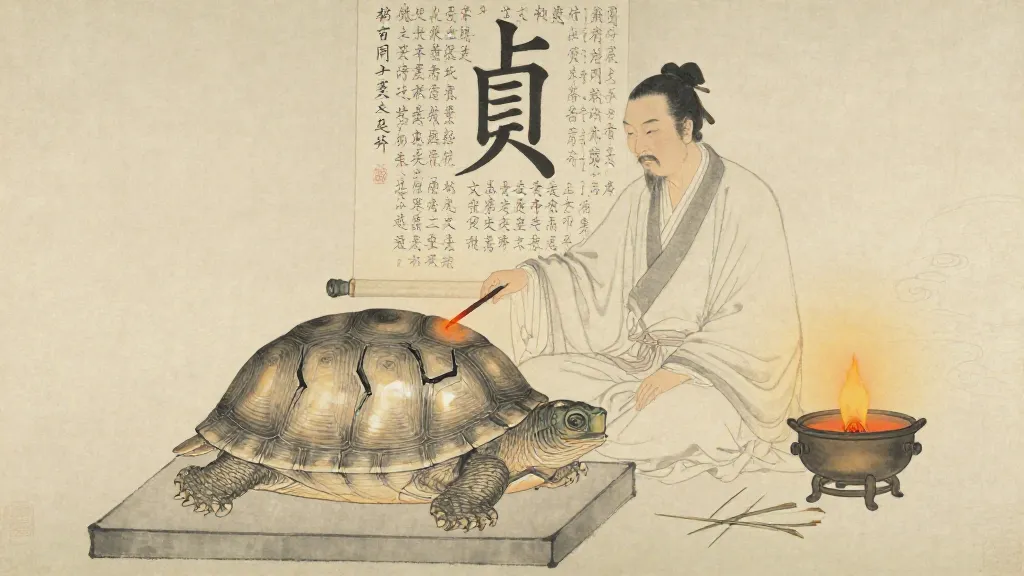
In the earliest stratum of Chinese writing — the oracle bone inscriptions of the Shang court, from roughly 1250 BC — 貞 is a verb. It does not mean to persevere. It does not mean to be steadfast. It does not mean to hold to one's course. It means, simply, to divine — to put a question to the oracle, to crack the bone, to read the answer.
The oracle bones begin, almost invariably, with a formula: on such-and-such a day, so-and-so 貞. The so-and-so is a named diviner; the 貞 is his act. These named figures — the 貞人 (zhēn rén), the “divination-persons” — were specialists at the Shang court whose job was to interrogate the oracle on the king's behalf. They asked about hunts, harvests, sacrifices, military campaigns, the weather. The act of asking was 貞.
Modern oracle-bone scholarship, across the last century, has made this reading stable. David Keightley's work on Shang divination established it for English readers; the pattern is attested in thousands of inscribed bones. Before 貞 was a virtue, it was a transitive verb with the oracle as its implicit object.
This matters because the I-Ching's line statements sit much closer in time to that oracular stratum than to the moralized Wenyan reading layered over it. When the judgment of Hexagram 1 (乾 qián, The Creative) says 元亨利貞 (yuán hēng lì zhēn) — the famous four-word formula that opens the whole book — it is speaking in a register where 貞 is still, at least partially, the verb. The bare sense is beginning, fulfillment, advantage, divination. Four ritual words. Four states of the oracle in use.
What the Wenyan Did
The moralization happened later, in the commentarial layer known as the Ten Wings. The most famous act of moralization is in the Wenyan (文言 wén yán), which we have discussed at length elsewhere, and which takes the four words of 元亨利貞 and, quite deliberately, re-reads them as virtues:
元者,善之長也。
亨者,嘉之會也。
利者,義之和也。
貞者,事之幹也。
“Yuan is the head of goodness.
Heng is the gathering of excellence.
Li is the harmony of rightness.
Zhen is the stem of affairs.”
事之幹 (shì zhī gàn) — “the stem of affairs.” The word gàn means trunk, framework, the load-bearing beam of a structure. The Wenyan is saying: 貞 is what holds action together, what gives a course its spine, what makes conduct coherent over time. It is no longer the act of asking the oracle. It is the quality that makes sustained right action possible.
The move is subtle and enormous. The ritual verb has become the moral trunk. The oracle has been rendered invisible — what was once the asking is now the standing-firm. By the time the text is translated into English, this moralization is so thoroughly complete that translators reach, almost reflexively, for words like perseverance, constancy, steadfastness — words that describe the actor, not the act.
The Wenyan is honest about what it is doing. As the Six Lines article on the Wenyan notes, its reading “refuses” the flat great-success-favorable-perseverance rendering and insists on four separate virtues. This is exactly right: the Wenyan is a philosophical commentary, and the commentary is doing what commentaries do. The problem is not the Wenyan. The problem is that the modern English reader inherits the Wenyan's moralization without inheriting the Wenyan's acknowledgment that it is moralization. The reader sees perseverance, and the oracular stratum beneath it is silent.
The Corpus Tells a Different Story
If 貞 simply meant perseverance — a moral virtue, a character trait — we would expect it to appear with positive verdicts most of the time. Perseverance is good. Perseverance furthers. Perseverance in the right should be auspicious.
The data does not support this. Here is what the canonical text actually does with 貞:
- Of the 109 occurrences, the vast majority are compound — 貞 attached as a modifier to another term.
- 貞 appears compounded with 吉 (auspicious) 36 times.
- 貞 appears compounded with 凶 (xiōng, inauspicious) 10 times.
- 貞 appears compounded with 厲 (lì, dangerous) 8 times.
- 貞 appears compounded with 吝 (lìn, chagrin) 3 times.
- 貞 appears with scope and duration qualifiers: 艱貞 (jiān zhēn, “difficult constancy”) 4 times; 永貞 (yǒng zhēn, “prolonged constancy”) 6 times; 居貞 (jū zhēn, “abiding constancy”) 4 times; 可貞 (kě zhēn, “can be constant”) 5 times; 不可貞 (bù kě zhēn, “cannot be constant”) 2 times.
The picture that emerges is not a moral verdict but a structural qualifier. 貞 does not deliver a valuation; it modifies something else. Most strikingly, the same element — 貞 — attaches to both 吉 and 凶. Constancy is sometimes auspicious. Constancy is sometimes inauspicious. The book is not shy about saying so.
If 貞 were a virtue in any ordinary English sense, 貞凶 would be a contradiction. Perseverance leads to misfortune? It would mean the translation has produced a sentence the original can't have intended. But 貞凶 appears in the book ten times. It is not a mistake. It is the operative grammar of a term that qualifies a move by the presence or absence of a particular relation — whether the move is held-to, whether the inquiry is sustained, whether the standing-firm is appropriate to the moment — and then tells you what the verdict is given that.
When Constancy Becomes Inauspicious
Two lines make this vivid.
The fifth line of Hexagram 3 (屯 tún, Difficulty at the Beginning):
屯其膏,小貞吉,大貞凶。
“Hoarding one's bounty. Small constancy: auspicious. Great constancy: inauspicious.”
Small 貞 auspicious. Great 貞 inauspicious. The exact same element — the persisting, the holding-to, the inquiry — changes valence depending on scale. A small-scope holding-fast is right for the configuration; a large-scope holding-fast is wrong for it. The moral reading has to break here. Perseverance is not a thing that's good at one scale and bad at another. A virtue doesn't flip on size. But 貞 in the structural reading does exactly this: at small scope the holding-fast fits the configuration; at large scope it violates it.
The first line of Hexagram 32 (恆 héng, Duration):
浚恆,貞凶,無攸利。
“Deep persistence. Constancy: inauspicious. Nothing advantageous.”
The hexagram is literally called Duration. Its governing image is continuity. And yet the opening line says: in this position, being constant is inauspicious. The commentary traces why — the first line is the lowest place in the configuration, where continuity has not yet been earned, and insisting on it too early reaches for a depth the position cannot support. But the translation-level point is even sharper: the canonical text of the hexagram of duration opens by telling you that perseverance here is wrong. If 貞 means perseverance in the English ethical sense, this sentence is incoherent. If 貞 means holding to this move in this configuration, the sentence is a precise description of positional misfit.
The Changes is not saying that persistence is bad. It is saying that the holding-to of a particular action in a particular configuration either fits or doesn't — and when it doesn't, the verdict is the one most English readers do not expect from perseverance: inauspicious.
The Qualifier, Not the Verdict
Once you see the pattern, the argument collapses into something simple: 貞 is not a verdict. It is a qualifier.
The bare verdicts of the line vocabulary — 吉, 凶, 悔 (huǐ), 吝, 无咎 (wú jiù) — describe the relationship of a move to a configuration. (We traced this for 无咎 in Part 1 and for 吉 in Part 2.) 貞 does not describe that relationship. It describes a property of the move itself — its duration, its firmness, its standing-to — and then the verdict attaches to the compound.
貞吉 is not perseverance leads to good fortune. It is holding-to-this-move-in-this-configuration is auspicious — the verdict is 吉, and 貞 tells you the specific shape of the move that gets that verdict.
貞凶 is not perseverance leads to misfortune. It is holding-to-this-move-in-this-configuration is inauspicious — the verdict is 凶, and 貞 tells you that the mistake is, specifically, the holding-on.
利貞 (lì zhēn) is not perseverance is advantageous. It is advantageous with respect to holding-fast — a line telling you the configuration supports sustained action of a particular kind.
艱貞 is not difficult perseverance. It is difficult holding-to — a compound that appears four times in the book, always describing configurations where the right move is to hold firm through adversity, with the adversity explicitly named as part of the advice.
The English word perseverance carries too much moral weight to do this work. It collapses a structural qualifier into a personal virtue, and then it attaches that virtue to the actor rather than to the action. The reader ends up reading perseverance furthers as be the kind of person who perseveres, when the line is actually saying in this configuration, a move of this structural type is the right move.
The Historical Depth the Oracle Has
There is a deeper thing to say about 貞, beyond the corpus data and the Wenyan moralization.
No other term in the line vocabulary carries this much historical distance. 无咎 and 吉 were structural from early on; the Wenyan sharpens and systematizes them but doesn't fundamentally reinvent them. 貞 is different. Between the oracle-bone meaning (to divine) and the Wenyan meaning (the stem of affairs) is a gap of roughly a thousand years, across which the word was hollowed out and refilled. The ritual verb became the moral noun. The act of questioning became the virtue of answering well.
The English word perseverance is not wrong; it is the last rung of a very long descent. It preserves, faintly, the sense of holding-to that 貞 carried when the shift was already underway in the late Zhou. What it does not preserve is the original object — the oracle. The act of asking, of submitting a question to the configuration, of letting the bone crack and the lines fall and the answer come back, has been written out. What was once a verb directed at the cosmos is now a property of the person.
This is, if you think about it, exactly the move the whole “Coded Language” series has been tracing in smaller form. Each of these terms — 无咎, 吉, 貞 — carries a structural meaning that the commentarial tradition moralized and that the English translation tradition then moralized again. With 貞 the distance traveled is farthest, the layers thickest, and the loss most complete.
It is worth noticing, when you read perseverance in a hexagram line, that the word is a thousand years old in its current moral sense and three thousand years old in its oracular sense. You are standing at the surface of an archaeological site. The bottom layer is a question.
What to Carry Away
Three things, if you take nothing else from this:
- 貞 is a qualifier, not a verdict. It does not deliver a valuation. It modifies a move — naming the move as held-to, sustained, inquired-of — and the adjacent verdict (吉, 凶, 厲) delivers the valuation. 貞吉 means this holding-fast is auspicious in this configuration. 貞凶 means this holding-fast is inauspicious. Same element. Different configuration. Different verdict.
- The moral reading is a later layer. The Wenyan (文言) re-reads 貞 as 事之幹 — the stem of affairs, the ethical trunk of action. This is the reading most English translations inherit. Beneath it, in the oracle-bone stratum, 貞 was simply the verb to divine, the act of asking the oracle. The distance between the two readings is about a thousand years and a whole shift in how Chinese thought related to the cosmos.
- Perseverance was never perseverance. The English word is the last rung on a translation ladder that has quietly moralized, personalized, and internalized a term whose original work was ritual and external. Knowing this does not mean throwing the English away — there is no better word to hand. It means reading perseverance in a hexagram line with one eye on the archaeology: this word has layers, and the bottom layer is a question, not an answer.
Read this way, perseverance stops being a character trait you are supposed to cultivate and starts being a pointer — to a configuration, to a move-type, to an act of holding-to that either fits the moment or does not.
That is what 貞 meant. That is what perseverance is still trying, faintly, to carry.