Reversal Is the Movement of the Dao
Laozi's law of return, written line by line into the hexagrams.
Part 2 of The Daoist's I-Ching — reading the I-Ching through the Daoism you already know.
The Law in One Line
Of everything Laozi says about how the world moves, one line does the most work:
反者道之動,弱者道之用
“Reversal is the movement of the Dao; yielding is the use of the Dao.” (Daodejing 40)
The Dao does not move in straight lines. It moves in returns. Push anything far enough and it turns into its opposite: the day reaches noon and begins to darken; the moon fills and starts to wane; the empire at its height has already begun to fall. Laozi states the law. What he doesn't give you — because it isn't his medium — is a way to locate yourself on the curve. The I-Ching is.
The Changing Line: Reversal You Can Read
When you cast a hexagram, some of its lines are stable and some are changing — already in the act of turning into their opposite. A changing yang line is yang at its extreme, about to become yin; a changing yin line is yin at its extreme, about to become yang. The changing line is not a footnote. It is 反者道之動 made operational — the single place in the reading where you can see the return beginning.
This is why a hexagram so often comes paired with a second one. The changing lines flip, and the figure you cast transforms into the figure it is becoming. The reading shows you not just where you stand but which way the Dao is already bending the situation. Laozi tells you reversal happens; the I-Ching tells you this line, now, is where it's happening to you.
The Arrogant Dragon
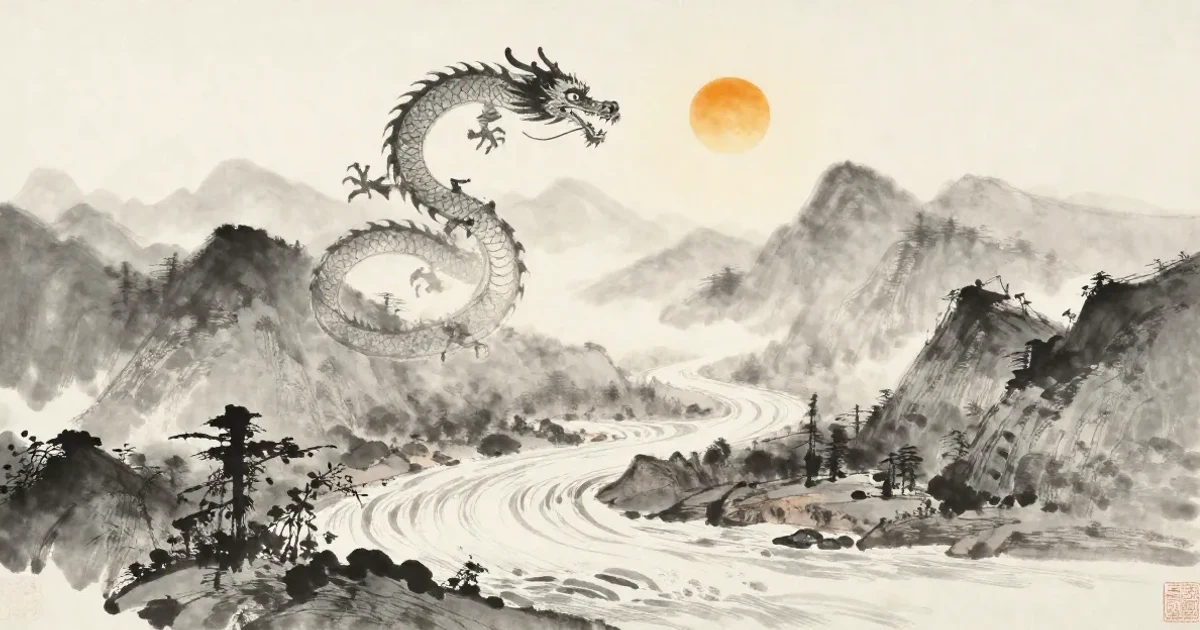
The clearest portrait of the law sits at the top of the very first hexagram. Qian, The Creative, is six unbroken yang lines — pure ascending force. Read from bottom to top, it is a story of rising: the dragon hidden, the dragon in the field, the dragon leaping. And then the sixth line, the top, the extreme:
亢龍有悔
“The arrogant dragon will have cause to repent.”
Pure yang, carried to its summit, has nowhere to go but down. The dragon that climbs too high meets the law Laozi named. The Chinese folk distillation puts it plainly: 物極必反 — things at their extreme reverse. The I-Ching builds that sentence into its architecture, line by line, hexagram by hexagram.
After Completion Is Not the End
The most Daoist joke in the whole book is the order of its last two hexagrams. Hexagram 63 is After Completion (既濟) — every line in its correct place, perfect order, the situation fully resolved. You might expect the book to end there, on completion. It doesn't. It ends on hexagram 64, Before Completion (未濟) — disorder, the wheel turning over, everything to be done again.
That is reversal as the final word. Perfect order is not a resting place; it is the top of the arc, the moment the descent begins. The book closes by refusing to close — 反者道之動, one last time, as structure. If you have ever felt the unease that arrives precisely when everything is finally going right, the I-Ching has a hexagram for it, and Laozi has a law.
Next in the series: where the Dao counsels not pushing — wu wei, and the hexagrams that tell you exactly when to yield.