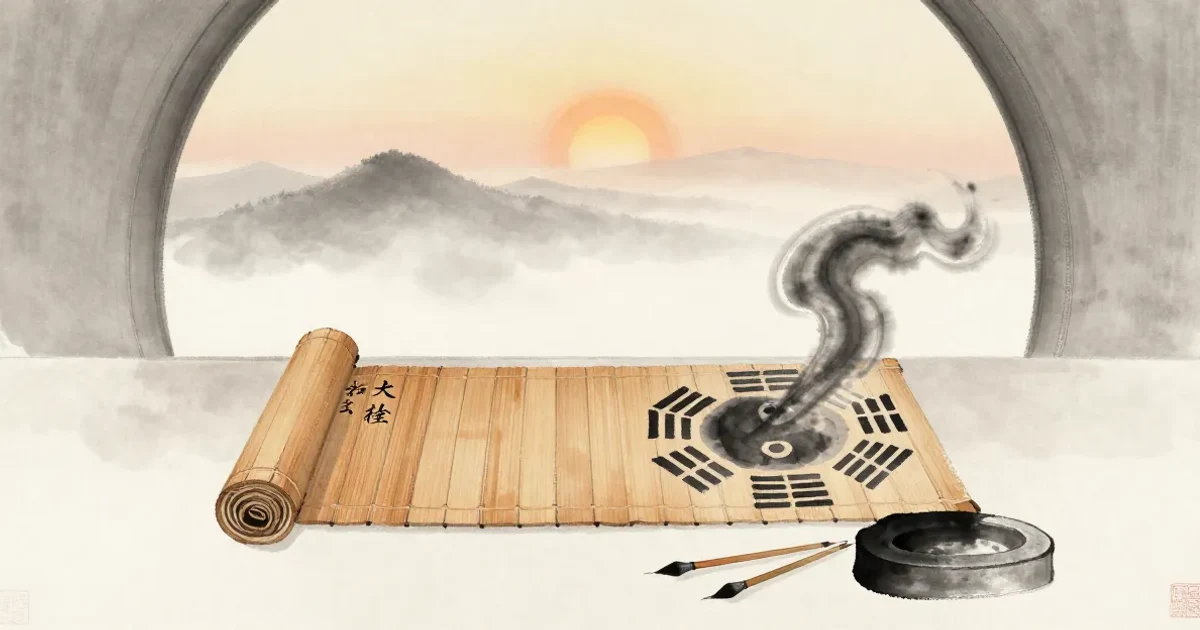
Daoism and the I-Ching
You already know the Dao. The I-Ching is the Dao made consultable.
Part 1 of The Daoist's I-Ching — reading the I-Ching through the Daoism you already know.
You've Read the Philosophy. Meet Its Grammar.
The Tao Te Ching is one of the most translated books in the world. Far more people have read Laozi than have ever cast a hexagram. If you're one of them — if you already nod along to the watercourse way, to wu wei, to the idea that things turn into their opposites — then you are much closer to the I-Ching than you think. You have the philosophy. What you don't yet have is its grammar.
That's the whole relationship in a sentence. Daoism gives you the why; the I-Ching gives you the how. The Daodejing describes the Dao — the way things move, change, and return. The I-Ching takes that same movement and renders it as a structure you can actually consult: sixty-four configurations of how yin and yang meet in a given moment.
The I-Ching's Own Claim
You don't have to take our word that the two are connected. The I-Ching says so itself. In the Xici (繫辭, the “Great Treatise” appended to the text), one line states the entire bridge:
一陰一陽之謂道
“One yin, one yang — that is called the Dao.”
This is the same Dao Laozi writes about, defined in the I-Ching's own vocabulary. The Dao is not a thing or a force; it is the alternation itself — the ceaseless trading of yin and yang. And the broken and unbroken lines of a hexagram are nothing but yin and yang, stacked six high. A hexagram, in other words, is a small picture of the Dao caught in one of its configurations.
A Word on Which Came First
It's natural to ask whether the I-Ching is “Daoist” or whether Daoism is “built on” the I-Ching. The honest answer is more interesting than either, and most popular accounts get it wrong.
The oldest layer of the I-Ching — the bare hexagrams and their terse divination texts (the Zhouyi) — is older than philosophical Daoism, reaching back to the Western Zhou, centuries before Laozi. But the philosophical layer of the I-Ching — the Ten Wings, including the Xici quoted above — was composed during the Warring States and Han periods, the same intellectual moment that produced the Daodejing and the Zhuangzi.
So neither text copied the other. They are two expressions of one shared root: the yin-yang cosmology that runs through all of classical Chinese thought. Daoism articulated that root as prose — a philosophy of the way. The I-Ching had already encoded it as structure — a system you could throw stalks or coins at and read. This series treats the I-Ching as exactly that: the operating system beneath the philosophy you already love.
From One, the Many
Laozi gives the cosmos a famous genealogy:
道生一,一生二,二生三,三生萬物
“The Dao gives birth to one; one to two; two to three; three to the ten thousand things.” (Daodejing 42)
The I-Ching tells the same story as a diagram. The undivided whole (太極, taiji) splits into two modes — yin and yang. The two become four images, the four become the eight trigrams, and the eight trigrams pair into the sixty-four hexagrams: the ten thousand things, laid out as a grid you can navigate. Where Laozi narrates the unfolding, the I-Ching charts it. Same cosmogony, two media.
What This Series Does
Each piece in this series takes one idea you already carry from Daoism and shows you its structural home in the I-Ching — with the primary text in hand, not vague analogy. A few of the pairings ahead:
- Reversal is the movement of the Dao (反者道之動, Daodejing 40) — and the I-Ching's law that everything reverses at its extreme, written into the changing lines.
- Wu wei, non-forcing — and the Receptive (Kun) and Waiting (hexagram 5), where the text tells you precisely when not to push.
- The highest good is like water (上善若水, Daodejing 8) — and Kan, the water trigram, with its strange habit of attaching good fortune to going low.
The promise is simple. You arrived with the philosophy. By the end you will be able to read it — to look at six stacked lines and see the Dao doing exactly what Laozi said it does, in this particular situation, right now.
Where to Start
If you want the I-Ching's own ground first, What is the I-Ching? covers the structure and history. If you came from another door, The I-Ching Through Feng Shui and The Other Oracle (for tarot readers) make the same kind of bridge from other systems. Otherwise, read on — the next piece takes Laozi's law of reversal and finds it line by line in the hexagrams.