Shao Yong's Cosmic Clock: When Hexagrams Measured Centuries
A Song dynasty systems thinker mapped hexagrams not to days but to years, centuries, and epochs—then built a practical 60-year cycle that still tells you which hexagram governs 2026.
Part 6 of The Court Historian's Art — a series on how astronomy, record-keeping, and divination became one tradition.
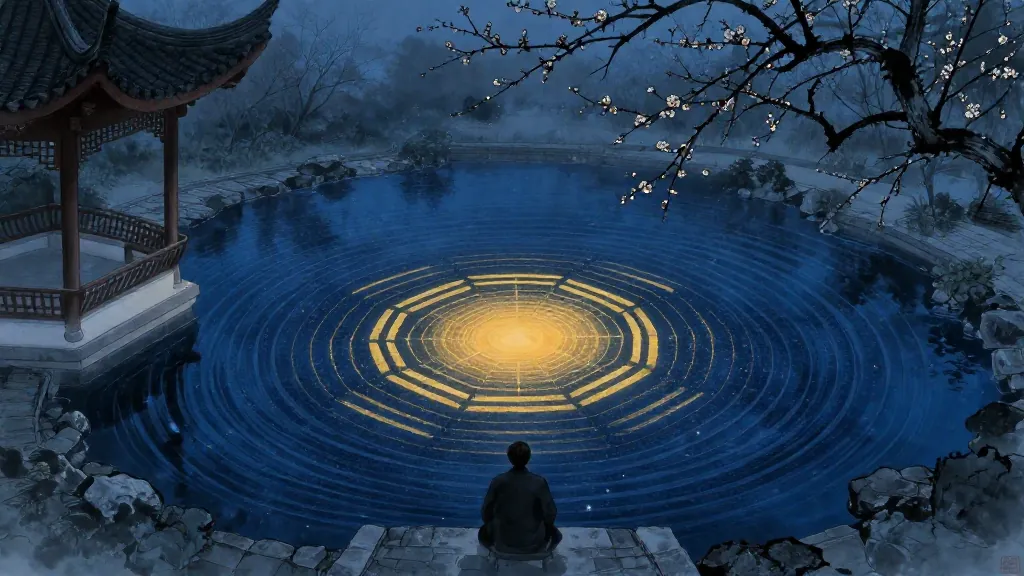
The Systems Thinker of Luoyang
Shao Yong (邵雍, 1011–1077) is one of those figures who gets flattened by his own reputation. In popular culture he's the mystic sage of the Song dynasty, the hermit who could read the future in falling petals. In academic sinology he's a "numerologist"—a word that, in English at least, does him no favors. Here's what he actually was: a systems thinker. Maybe the most ambitious one in the Chinese intellectual tradition.
He lived in Luoyang, the western capital, and declined every official appointment offered to him—not out of some romantic world-rejection but because he wanted to finish his work. He corresponded regularly with the leading Neo-Confucian scholars of his generation: Cheng Hao and Cheng Yi (the Cheng brothers), Sima Guang (the great historian and statesman), and others who would shape Song intellectual life for centuries. The official History of Song (宋史·邵雍傳) records that he was deeply respected by this circle, consulted on philosophical questions, and regarded as a thinker of the first rank. Not a recluse. Not a fortune-teller. A colleague.
What Shao Yong wanted to do was unify number, image, and time into a single coherent system. If that sounds like an absurdly large ambition, it is. But he got remarkably far.
The Book of Supreme World-Ordering Principles
His magnum opus is the 皇極經世書 (Huangji Jingshi Shu, "Book of Supreme World-Ordering Principles")—a twelve-volume work that maps all of human history onto a hexagram-based temporal framework. The companion text, the 觀物篇 (Guanwu Pian, "Observing Things"), lays out the philosophical reasoning behind the system. Together they represent one of the most sustained attempts in any tradition to build a unified theory of historical time.
Here's the key insight, and it's worth pausing on: Shao Yong didn't invent the idea of mapping hexagrams to time. Meng Xi and Jing Fang had already done that in the Han dynasty, assigning hexagrams to individual days in the 卦氣六日七分 system. What Shao Yong did was change the scale. Where the Han scholars mapped hexagrams to days, Shao Yong mapped them to years, decades, centuries, and epochs. The method is recognizable. The ambition is entirely different.
The Yuan Cycle: 129,600 Years
The cosmic framework—the part everyone talks about—is the Yuan cycle (元會運世). One Yuan (元) equals 129,600 years. That Yuan divides into 12 Hui (會), each of 10,800 years. Each Hui divides into 30 Yun (運) of 360 years. Each Yun divides into 12 Shi (世) of 30 years. So: 1 Yuan = 12 Hui = 360 Yun = 4,320 Shi.
These numbers are not arbitrary. They derive from the hexagram system itself. The 64 hexagrams, arranged and multiplied through their own internal relationships (64 × 64 = 4,096 primary combinations, extended through line-level transformations), generate the numerical framework. As Anne Birdwhistell demonstrates in her study of Shao Yong's epistemology, this is a deductive system: the temporal structure is derived from hexagram mathematics, not imposed onto it. The hexagrams don't illustrate time—they generate the temporal framework.
Now, I'll be honest: the cosmic-scale stuff is dramatic, and it's the part of Shao Yong's system that gets the most attention. Mapping all of human civilization onto a 129,600-year arc makes for a compelling intellectual spectacle. But here's what people miss—the practical contributions are what actually matter for anyone building applications or working with the I-Ching as a living system.
The 60-Year Hexagram Cycle
At the usable scale, Shao Yong mapped hexagrams to individual years using the Fu Xi (先天) binary sequence—not the King Wen (後天) sequence that most people associate with the I-Ching. This is a critical distinction. The Fu Xi sequence arranges hexagrams by their binary structure (all yin lines at one end, all yang lines at the other). The King Wen sequence arranges them by thematic pairing. Shao Yong used the Fu Xi order because his system is mathematical, not narrative.
Four hexagrams are excluded from the annual cycle: 乾 (Qian, Pure Yang), 坤 (Kun, Pure Yin), 坎 (Kan, Water), and 離 (Li, Fire). These four serve as structural anchors—the cardinal points of the hexagram cosmos—and don't rotate through the yearly sequence. That leaves exactly 60 hexagrams, which maps perfectly onto the 60-year jiazi (甲子) cycle that has structured Chinese chronology since antiquity. This is elegant in a way that's easy to underestimate: two independent systems—the hexagram set and the sexagenary cycle—fitting together with no remainder.
The year 2026 falls under 同人 (Tong Ren, Fellowship, Hexagram 13). This isn't an interpretation or a guess. It's a deterministic mapping: given the cycle's starting point and the Fu Xi sequence, the hexagram for any year can be calculated.
Bi-Monthly Line Periods: The Year in Six Acts
Shao Yong didn't stop at the annual hexagram. He subdivided it. The 年分六爻法 (annual six-line division method) takes the year's hexagram and maps each of its six lines to a two-month period. The first line governs months one and two, the second line governs months three and four, and so on through the sixth line covering months eleven and twelve.
Here's where it gets genuinely interesting: for each two-month period, the "active" line changes, producing a transform hexagram specific to that period. So the year has both a macro theme—the annual hexagram—and shifting sub-themes as each line activates in sequence. If your annual hexagram is 同人 and you're in the third bi-monthly period (months five and six), the third line changes, giving you a period-specific transform that modifies the year's overall meaning.
This is genuinely sophisticated temporal modeling. A single hexagram provides the year's character. Six transforms provide its internal rhythm. The system captures both continuity and change within the same framework.
The Plum Blossom Method
The method most commonly associated with Shao Yong in popular practice is the 梅花易數 (Meihua Yishu, Plum Blossom Numerology). The traditional attribution says Shao Yong devised it after observing two sparrows fighting over a plum branch and calculating a hexagram from the date, time, and number of sparrows involved. Whether or not the story is literally true, the method is real and widely used.
Plum Blossom numerology generates hexagrams from temporal data—year, month, day, and hour—using numerical relationships between the Earthly Branches and trigrams. It's the method most I-Ching apps use when they offer a "daily hexagram." But there's a problem: the Plum Blossom method changes every two hours (every shichen, 時辰), because the hour is one of its input variables. This makes it unsuitable for almanac-style daily assignments, where you want one hexagram per day that everyone agrees on regardless of when they check.
This is precisely why Six Lines uses the older 卦氣 (hexagram qi) system from Meng Xi and Jing Fang for daily hexagrams. The hexagram qi system assigns one hexagram per roughly six-day period based on the solar year—stable, shared, and anchored to astronomical events rather than the clock. Different tools for different purposes. The Plum Blossom method excels at personal, moment-specific divination. The hexagram qi system excels at shared, calendar-level assignments. Knowing the difference matters.
The Continuity
What Shao Yong built is recognizably an extension of what Meng Xi and Jing Fang started a thousand years earlier. Both traditions assume that hexagrams encode temporal patterns, not just situational wisdom. Both use mathematical structures to map hexagram sequences onto time. The scale changed—days became years, years became epochs—but the underlying conviction is the same: the I-Ching is not merely a book of advice. It's a model of how time moves.
Don Wyatt, in his biographical study of Shao Yong, positions him as a transitional figure between Han-dynasty cosmological thinking and the Neo-Confucian synthesis that would dominate Chinese philosophy for the next eight centuries. The Cheng brothers drew on his numerical framework even as they moved in a more explicitly ethical direction. Zhu Xi, a century later, preserved Shao Yong's diagrams in his own commentaries. The Fu Xi sequence that Shao Yong championed became, through Leibniz's famous encounter with it in the seventeenth century, one of the bridges between Chinese and European intellectual traditions.
What This Means for Six Lines
Six Lines implements both systems. The daily hexagram uses the hexagram qi method from the tradition established after the Taichu reform—one hexagram per period, anchored to the solar terms. The annual hexagram uses Shao Yong's 60-year cycle—one hexagram per year, derived from the Fu Xi sequence, with bi-monthly line periods providing sub-annual resolution. Two layers of temporal meaning, drawn from two distinct moments in the tradition, each doing what it does best.
The lineage runs clean. A hexagram reading in Six Lines isn't floating free of context. It sits within a temporal framework that Meng Xi began in the first century BC, that Shao Yong extended in the eleventh century AD, and that both men understood as the same project: reading patterns in time, using the oldest notation system they had.
References
Primary Sources
皇極經世書 (Huangji Jingshi Shu, "Book of Supreme World-Ordering Principles"). Shao Yong's twelve-volume magnum opus mapping human history onto hexagram-based temporal cycles. Song dynasty.
觀物篇 (Guanwu Pian, "Observing Things"). Shao Yong's philosophical companion text setting out the epistemological basis for his cosmological system.
宋史·邵雍傳 (History of Song, Biography of Shao Yong). Official dynastic biography. Chinese Text Project
漢上易傳·卷十三. Classical source for the 卦氣 (hexagram qi) tradition and its continuity with later hexagram-time mapping systems. Chinese Text Project
Secondary Scholarship
Birdwhistell, Anne D. Transition to Neo-Confucianism: Shao Yung on Knowledge and Symbols of Reality. Stanford University Press, 1989. The major Western monograph on Shao Yong's epistemology and cosmological system.
Wyatt, Don J. The Recluse of Loyang: Shao Yung and the Moral Evolution of Early Sung Thought. University of Hawaii Press, 1996. Biographical study situating Shao Yong within Song intellectual history.