What the Emperor's Library Reveals About Qing Ideology
The Siku Quanshu was not just a library. It was a statement about who owned Chinese civilization. A Manchu emperor commissioning 360 Han scholars to organize all of Chinese knowledge was the most ambitious claim to cultural legitimacy any conquest dynasty ever made—and the catalog's structure encoded that claim in every category, every preface, and every verdict.
Part 20 of The Emperor's Library — how China reviewed all knowledge.
The Manchu Problem
The Qianlong Emperor (乾隆, r. 1735–1796) was the fourth generation of a Manchu dynasty ruling over a predominantly Han Chinese population. The Qing had conquered China in 1644, replacing the Ming, and had spent the intervening century establishing control over an empire that regarded them, at some level, as foreign occupiers. The Manchus spoke a different language, followed different customs, and enforced the queue hairstyle as a visible marker of submission. Their claim to the Mandate of Heaven was strong in practice—they governed effectively, expanded the territory, and maintained social order—but culturally fragile.
Commissioning the largest library project in Chinese history was Qianlong's answer to the cultural legitimacy problem. If the emperor could position himself as the supreme patron and organizer of Chinese knowledge—not just collecting it but classifying it, judging it, and establishing the standards by which all texts would be evaluated—then the Qing dynasty was not merely occupying Chinese civilization. It was curating it. The library was a claim that the Manchu court understood Chinese culture better than the Chinese literati themselves.
Patterns of Inclusion
The structure of the Four Treasuries is itself an ideological statement. The four divisions—Classics (經部), History (史部), Masters (子部), and Collections (集部)—are arranged in a strict hierarchy. The Classics come first because they represent the foundational texts of Chinese civilization: the Yijing, the Shijing, the Liji, the Chunqiu, the Shangshu. These are not merely old books. They are the texts through which the sages transmitted their teachings. Everything else descends from them.
History comes second because the recording and evaluation of the past is the primary mechanism by which Confucian governance operates. The Masters division—covering philosophy, military thought, agriculture, medicine, divination, Buddhism, and Daoism—comes third. The Collections division, containing belles-lettres, poetry, and miscellaneous literary works, comes last. This order tells you what the compilers valued: canonical authority first, historical record second, applied knowledge third, literary expression last.
Within each division, the sub-categories enforce further hierarchies. In the Masters division, Confucian philosophers come first, followed by military strategists, then the Legalists, then agricultural writers, then medical writers, then astronomers, then diviners, then Buddhist and Daoist writers. The ordering is a ranking. Confucian thought is the core. Everything else is peripheral to varying degrees.
What “Orthodox” Meant
The compilers operated with a clear concept of intellectual orthodoxy, and it had a specific name: the Cheng-Zhu (程朱) line. This was the Neo-Confucian tradition established by Cheng Yi (程頤, 1033–1107) and Zhu Xi (朱熹, 1130–1200), which had been the official philosophical framework of the Chinese state since the Yuan dynasty made Zhu Xi's commentaries the basis of the civil service examinations in 1313.
For the Siku compilers, Cheng-Zhu orthodoxy was not one philosophical position among many. It was the standard against which all other positions were measured. Texts that aligned with the Cheng-Zhu interpretation of the Classics were praised as sound. Texts that deviated were evaluated on a spectrum from “interestingly wrong” to “dangerously heterodox.” The Wang Yangming (王陽明) school of Neo-Confucianism—which emphasized intuitive moral knowledge over textual study—was treated with respect but positioned as a deviation. Lu Jiuyuan's (陸九淵) more radical idealism was treated less kindly.
This orthodoxy shaped verdicts throughout the catalog. A commentary on the Yijing that followed Cheng Yi's approach to hexagram interpretation would be praised for its fidelity to principle. A commentary that drew on Daoist cosmology or Buddhist metaphysics would be noted but criticized for mixing traditions. The compilers were not neutral librarians. They were judges enforcing a specific intellectual standard.
Destroying and Preserving
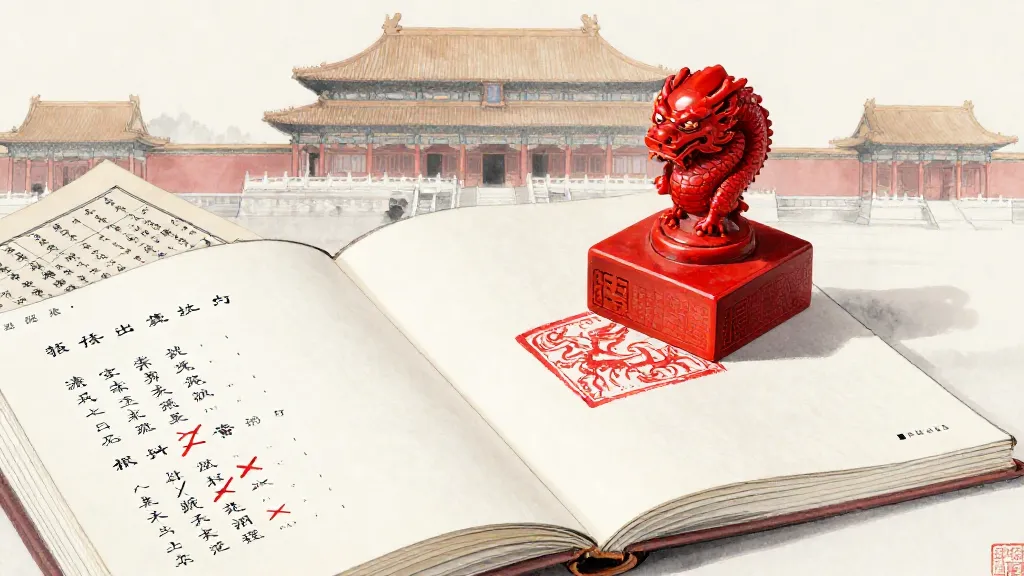
The most revealing feature of Qing ideology as expressed through the library project is the relationship between the Siku Quanshu and the Literary Inquisition (文字獄) that ran alongside it. The same project that collected and preserved 3,460 texts also identified and destroyed thousands of others—texts that contained anti-Manchu sentiment, that referred to the Qing as barbarian invaders, or that expressed loyalty to the fallen Ming dynasty.
The mechanics were precise. Provincial governors who had been ordered to submit books for review were also ordered to identify and confiscate works with seditious content. Between 1774 and 1782, roughly 2,600 titles were suppressed. Some were burned. Some were altered—passages deemed offensive were excised and the texts were included in the library in bowdlerized form. The catalog sometimes preserves entries for texts that were simultaneously being destroyed: the review exists, but the book does not.
This dual function—preservation and destruction operating through the same institutional apparatus—is the defining feature of the Siku project as an ideological instrument. The Qianlong Emperor was not simply collecting books. He was rewriting the intellectual history of China by controlling which texts survived and in what form. The catalog's verdicts on individual works were literary criticism. The suppression program was censorship. Both served the same goal: establishing the Qing court as the authoritative voice on what Chinese civilization contained and what it meant.
Buddhism and Daoism: Respectful but Marginal
The treatment of Buddhism and Daoism in the catalog reveals the limits of Qing pluralism. Both traditions receive their own sub-categories within the Masters division. Both are treated with genuine scholarly respect—the compilers were educated men who knew Buddhist and Daoist texts well, and their reviews demonstrate real engagement with the material. But both are firmly positioned as subordinate to the Confucian core.
The Buddhist section (釋家類) acknowledges the depth of Buddhist philosophy and the literary quality of many Buddhist texts. But the compilers consistently frame Buddhism as a foreign import that, while valuable in its own terms, is not part of the central tradition. Daoist texts (道家類) receive similar treatment: the philosophical Daoism of Laozi and Zhuangzi is respected, but the later Daoist religion with its alchemical and liturgical traditions is treated as popular superstition dressed in philosophical clothing.
The effect is a hierarchy of intellectual legitimacy that maps directly onto the state's institutional needs. Confucianism provides the ideology of governance. History provides the precedents. Military thought provides the tools of defense. Everything else is supplementary. The catalog does not suppress Buddhism or Daoism. It domesticates them—positions them as interesting but peripheral, acknowledged but not authoritative.
The Hierarchy of Knowledge
Step back and look at the catalog as a whole, and you see a complete theory of what knowledge is for. The Classics teach moral principle. History shows moral principle in action. Philosophy debates moral principle. Literature expresses moral principle aesthetically. The entire structure radiates outward from a moral center, and every text is evaluated by its distance from that center.
This is fundamentally different from the Western encyclopedic tradition that emerged in the same century. Diderot's Encyclopedie (1751–1772), compiled in almost exactly the same period as the Siku project, organized knowledge by the faculties of the mind: memory (history), reason (philosophy), and imagination (the arts). The Siku organizes knowledge by its relationship to governance. Diderot asked: how does the mind work? The Siku compilers asked: how does civilization work? The answers produced radically different classification systems.
The Siku's hierarchy also encodes a specific politics of knowledge production. Texts that serve governance are valued most highly. Texts that are merely beautiful or merely clever rank lower. Pure speculation—philosophy that does not connect to practical governance—is viewed with suspicion. The compilers praise evidential scholarship (考證學) that carefully verifies facts and criticize speculative philosophy (義理之學) that spins theories without grounding them in textual evidence. This preference is not neutral. It reflects the intellectual culture of the high Qing, when the evidential research movement had made verification the supreme scholarly virtue.
Two Hundred Years of Influence
The most consequential aspect of the catalog's ideology is its durability. The Siku Quanshu Zongmu Tiyao became the standard reference work for Chinese bibliography from its completion in the 1790s through the fall of the Qing in 1912—and, in many ways, it remains the standard today. When modern scholars organize classical Chinese texts, they still use the Four Treasuries framework. When they assess the authenticity of a pre-modern text, they start with the Siku compilers' verdict. The catalog's categories have become so deeply embedded in Chinese intellectual infrastructure that they feel natural rather than constructed.
This is the deepest ideological achievement of the project. The compilers did not just classify Chinese knowledge. They established the categories through which Chinese knowledge would be understood for centuries to come. The hierarchy they imposed—Classics above History above Philosophy above Literature, Confucianism above everything else—became invisible through sheer repetition. To challenge the Siku's framework is still, in some quarters, to challenge the way Chinese civilization understands itself.
The Irony
A Manchu emperor who worried that his dynasty lacked cultural legitimacy commissioned a project that defined Chinese cultural identity for two centuries. A library intended to demonstrate imperial patronage became the lens through which all subsequent scholarship viewed the Chinese intellectual tradition. A catalog designed to enforce orthodoxy became, through the sheer quality of its reviews, the most trusted guide to the heterodox and marginal texts it was trying to suppress.
The Siku Quanshu Zongmu Tiyao is the most powerful ideological document in Chinese intellectual history precisely because it does not look ideological. It looks like bibliography. It looks like scholarship. It looks like ten thousand careful reviews written by competent scholars who were just trying to get the facts right. And that is exactly what makes it so effective. The deepest ideological work is always the work that presents itself as merely descriptive.
References
Primary Sources
四庫全書總目提要 (Siku Quanshu Zongmu Tiyao). Ji Yun et al., compiled 1773–1782. 200 juan. The category prefaces and general preface are the primary evidence for the catalog's ideological framework.
Secondary Scholarship
Guy, R. Kent. The Emperor's Four Treasuries: Scholars and the State in the Late Ch'ien-lung Era. Harvard University Press, 1987. The essential study of the political dimensions of the Siku project.
Elman, Benjamin A. From Philosophy to Philology: Intellectual and Social Aspects of Change in Late Imperial China. Harvard University Asia Center, 2001. On the evidential scholarship movement and its relationship to Qing ideology.
Crossley, Pamela Kyle. A Translucent Mirror: History and Identity in Qing Imperial Ideology. University of California Press, 1999. On Manchu identity and the cultural politics of the Qing court.
Kuhn, Philip A. Soulstealers: The Chinese Sorcery Scare of 1768. Harvard University Press, 1990. On the broader context of Qianlong-era political control and cultural anxiety.